
Roofing 101 · The Whole System
Anatomy of a Roofing System
A roof is not a single product, it is a layered system where every layer has a job. Each part from the deck up, in plain language for homeowners, with the code and spec detail installers actually build to.
Updated September 15, 2026
It’s a System
The whole system at a glance
Where roofs actually fail
What fails in a storm usually isn’t the shingle in the middle of the roof, it’s an edge, a transition, a fastener, or a layer underneath that was skipped or rushed. This is the whole page in order. Tap any layer to jump to its breakdown, and see it on a real roof in the gallery below.
The nine layers in build order
| Layer | What it does | Where it fails |
|---|---|---|
| The Structure · 01Roof deck | Structural wood base, plywood or OSB, that everything else fastens to. | Rot and delamination from long-term leaks; fasteners lose their grip. |
| Water Control · 02Underlayment | Secondary water barrier rolled over the whole deck, beneath the shingles. | Torn or wrinkled during install; felt degrades faster than synthetic. |
| Water Control · 03Leak barrier | Self-adhering waterproof membrane at the eaves, valleys and penetrations. | Simply omitted, or stopped short of the spots most likely to leak. |
| The Edges · 04Drip edge | Bent metal at the roof edges that throws water clear of the fascia. | Left off, or installed under the underlayment at the eave instead of over. |
| The Edges · 05Starter strip | Sealed first course at eaves and rakes, adhesive bead under the first shingle. | Cut-up shingles used instead; the adhesive lands in the wrong place. |
| The Weather Layer · 06Field shingles | The visible weather layer taking sun, rain, wind and hail. | Granule loss, bruising and creased tabs after a hail or wind event. |
| Shingle PropertyImpact rating | Class 3 survives a 1.75″ steel ball dropped from 17 feet. Class 4 survives a 2″ ball from 20 feet, two strikes in the same spot, no crack through the back. | Class 4 is the top rating and the one carriers most often discount. It is a property of the shingle, not a layer, and not a guarantee against hail. |
| The System That Breathes · 07Ventilation | Intake at the soffit and exhaust at the ridge, moving air under the deck. | Blocked intake, or exhaust added without matching intake. |
| Where Leaks Start · 08Flashing | Metal at every place the roof meets something else. | The most common leak source on a roof that is otherwise sound. |
| The Finish · 09Ridge cap | Finishing course over peaks and hips, covering the ridge vent and cut edges. | Field shingles substituted for purpose-made cap; blow-off at the peak. |
See It On A Real Roof
Tap any part to see it on a real roof
How to use this diagram
Pick an area, then tap a part. Each one is shown on a roof we documented in the field, with what it is and what a sound one looks like. Each part links back to its full breakdown in the layer guide below. Each part is recorded the same way during a documented roof inspection.
Tap a part
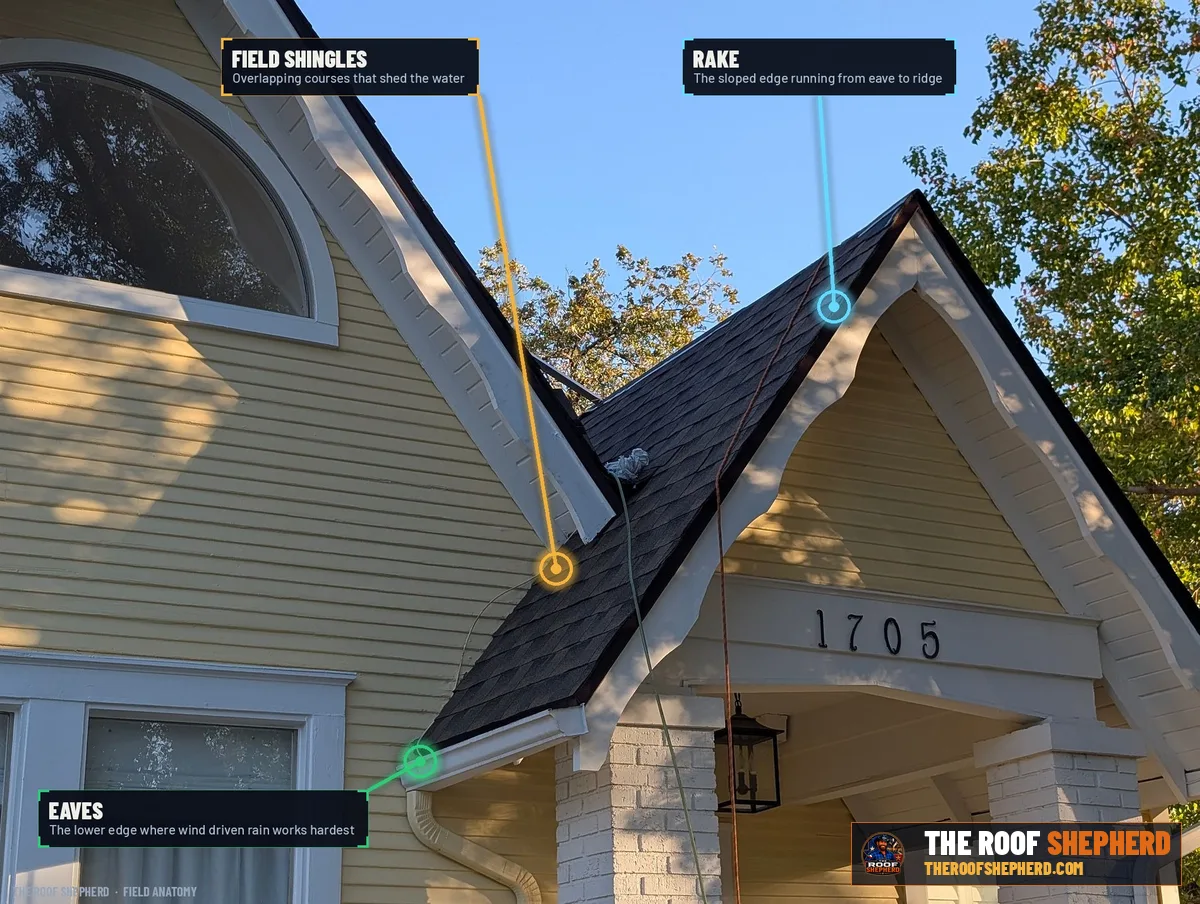
Field shingles
The overlapping courses that shed almost all the water, laid from the eaves up to the ridge.
Lifted tabs, bald spots where granules are gone, cracked or curling edges.
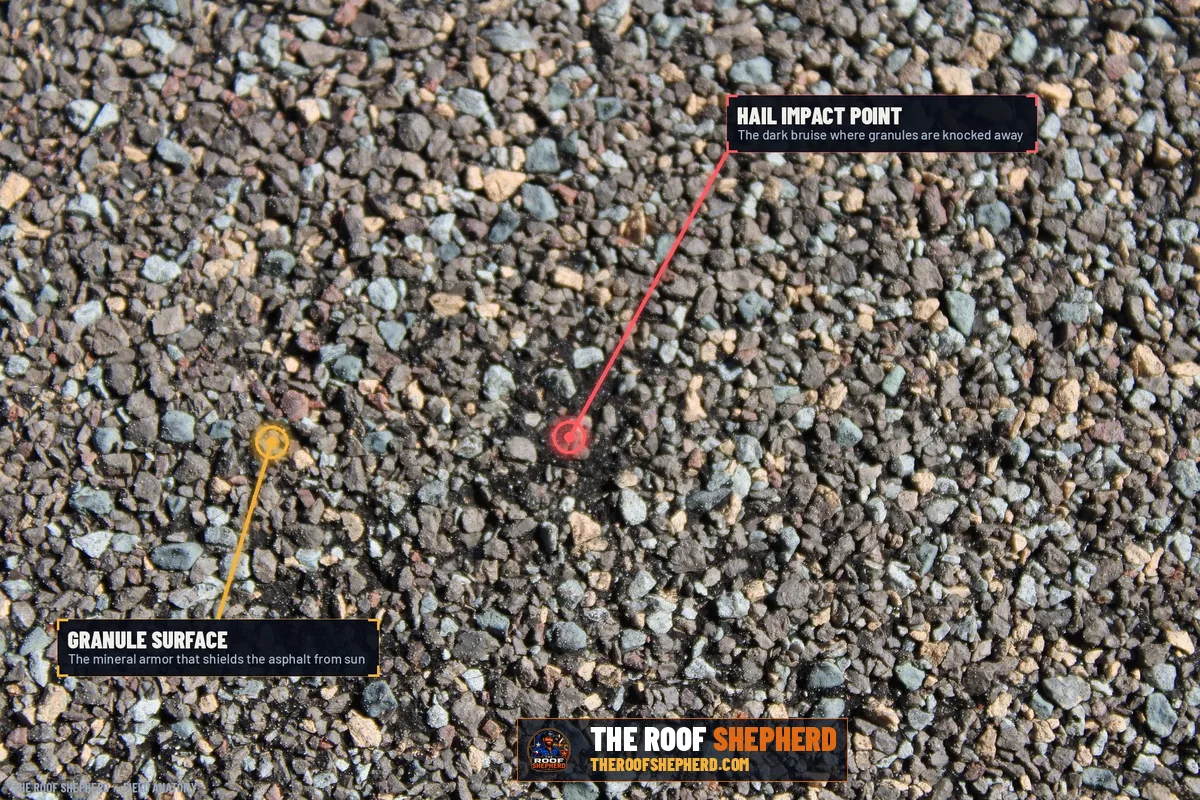
Granule surface
The mineral granules that armor the asphalt against the sun and slow its aging.
Bare spots where granules are knocked off. The dark bruise marked here is a hail impact point, where the mat is exposed.
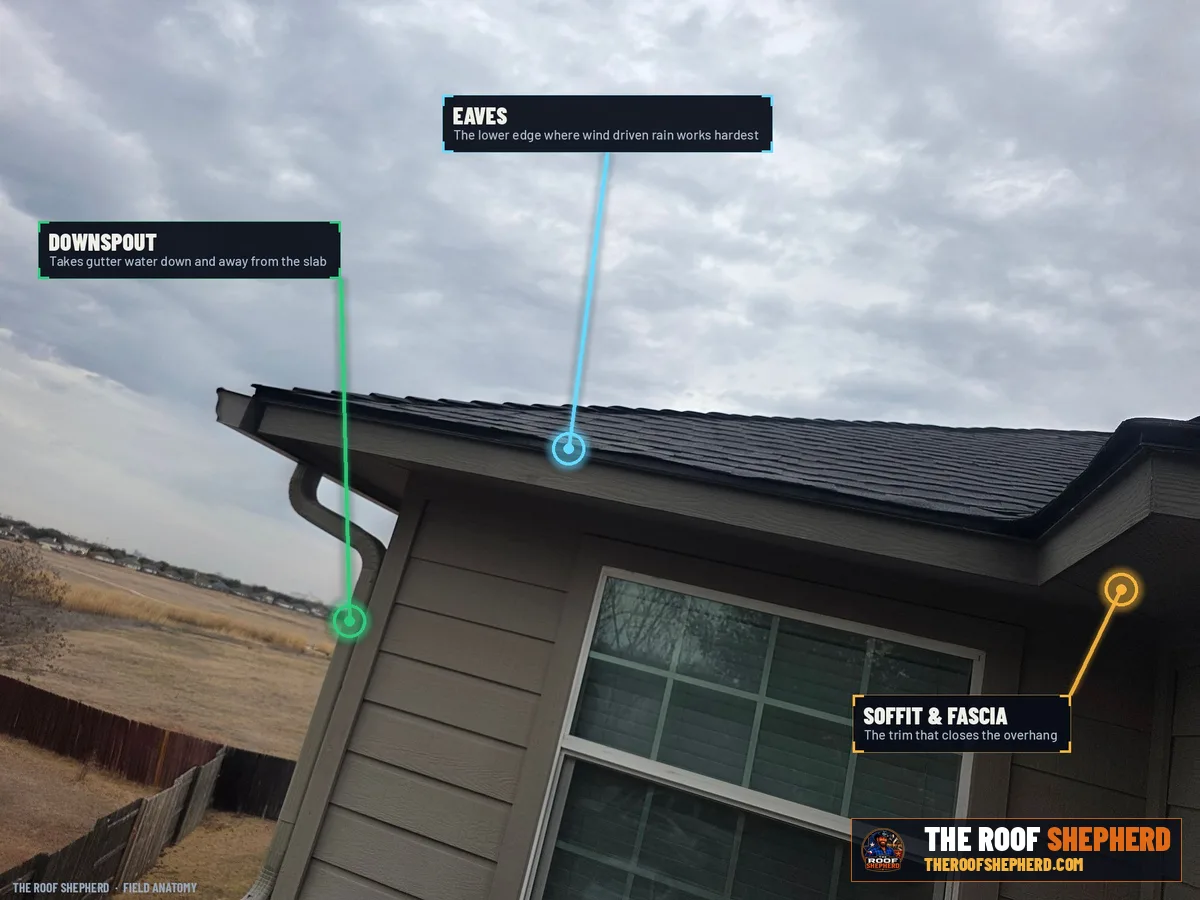
Eaves
The lower edge over the wall, where the gutter hangs and wind driven rain works hardest.
A clean shingle overhang, drip edge present, no rot at the edge.
Drip edge
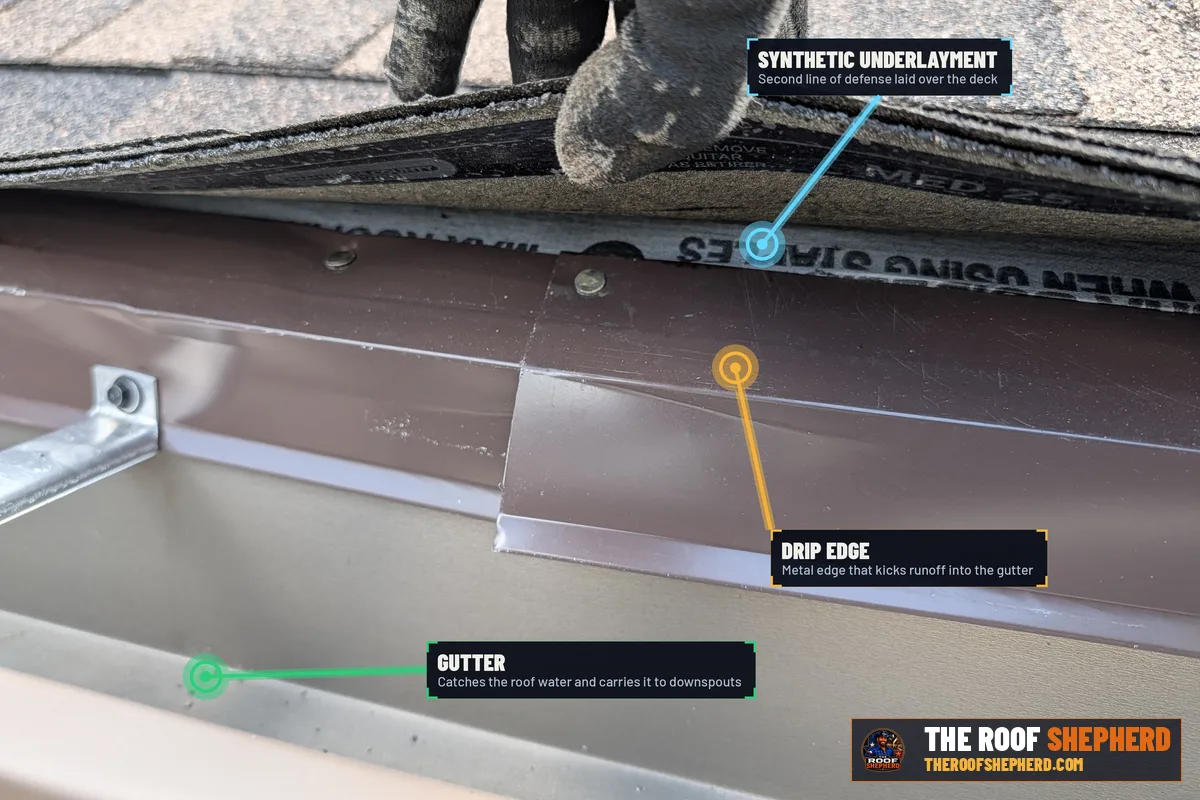
The metal L at the eaves and rakes that throws water clear of the edge instead of letting it run behind.
Continuous metal along every edge, lapped correctly, no gaps for water to get under.
This photo documents another roofer’s incorrect installation. At the eave the synthetic underlayment is supposed to lap over the drip edge, not run under it, so water sheds onto the metal instead of finding a path behind the edge.
Rake (gable edge)
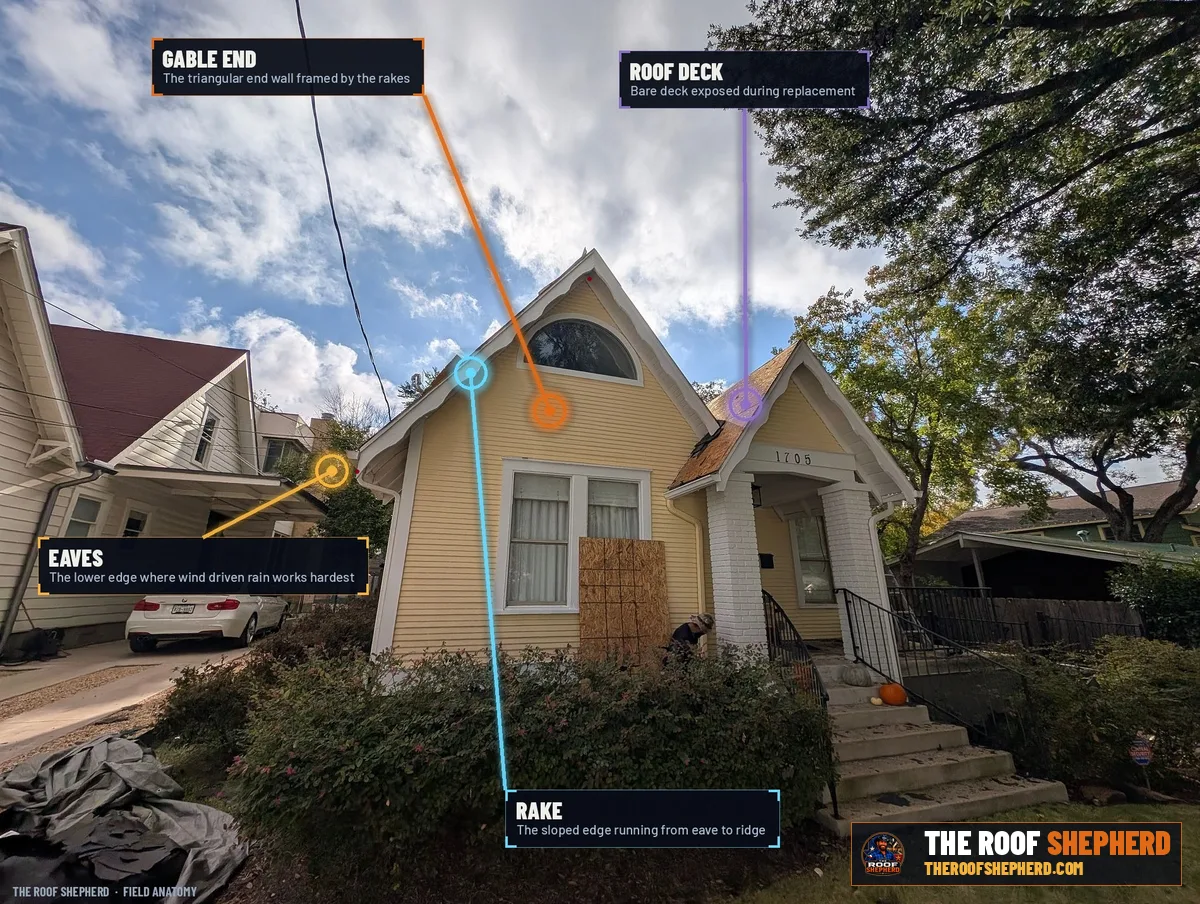
The sloped edge running up a gable from the eave to the ridge.
A sealed edge with no lifting, trim and drip edge intact, no wind damage.
Starter strip
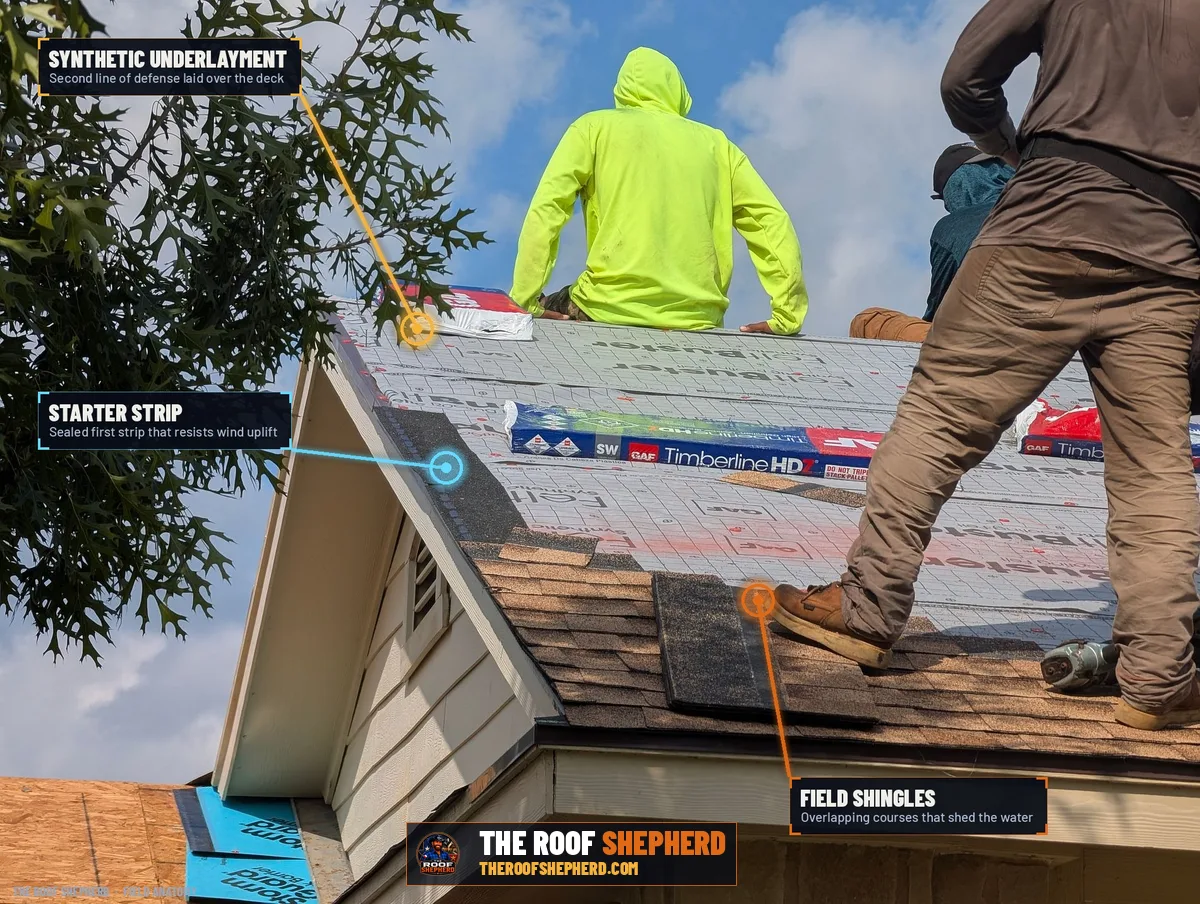
The sealed first strip at the eaves and rakes that bonds the first course and resists wind uplift.
A sealed strip under the first shingles, no exposed edge for wind to catch.
Soffit & fascia
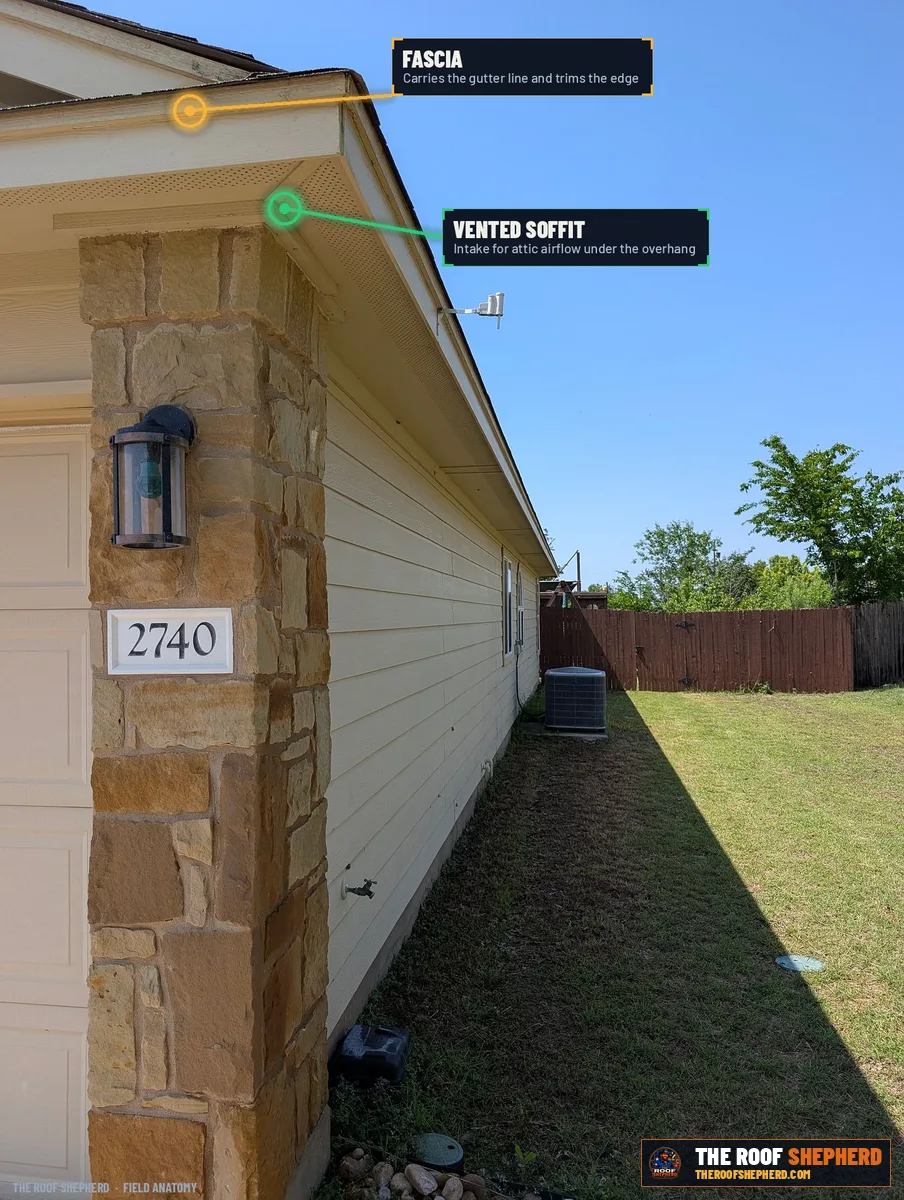
The trim that closes the overhang. The fascia carries the gutter, the soffit beneath is the intake for attic airflow.
Solid, painted fascia with no soft spots, vented soffit panels clear and unstained.
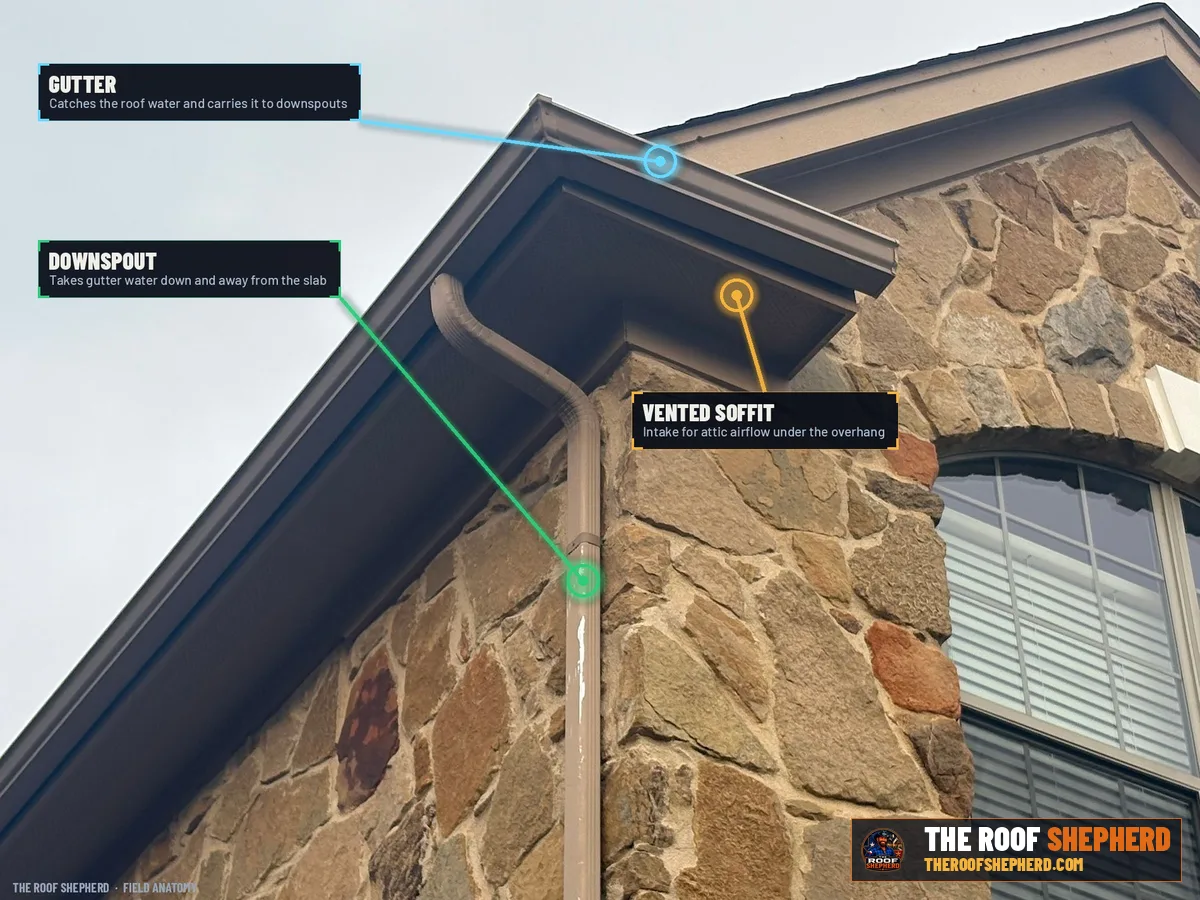
Gutter
The channel at the eaves that catches the roof’s water and carries it to the downspouts.
Hung with a slight fall, sealed corners, no sag, no overflow staining behind it.
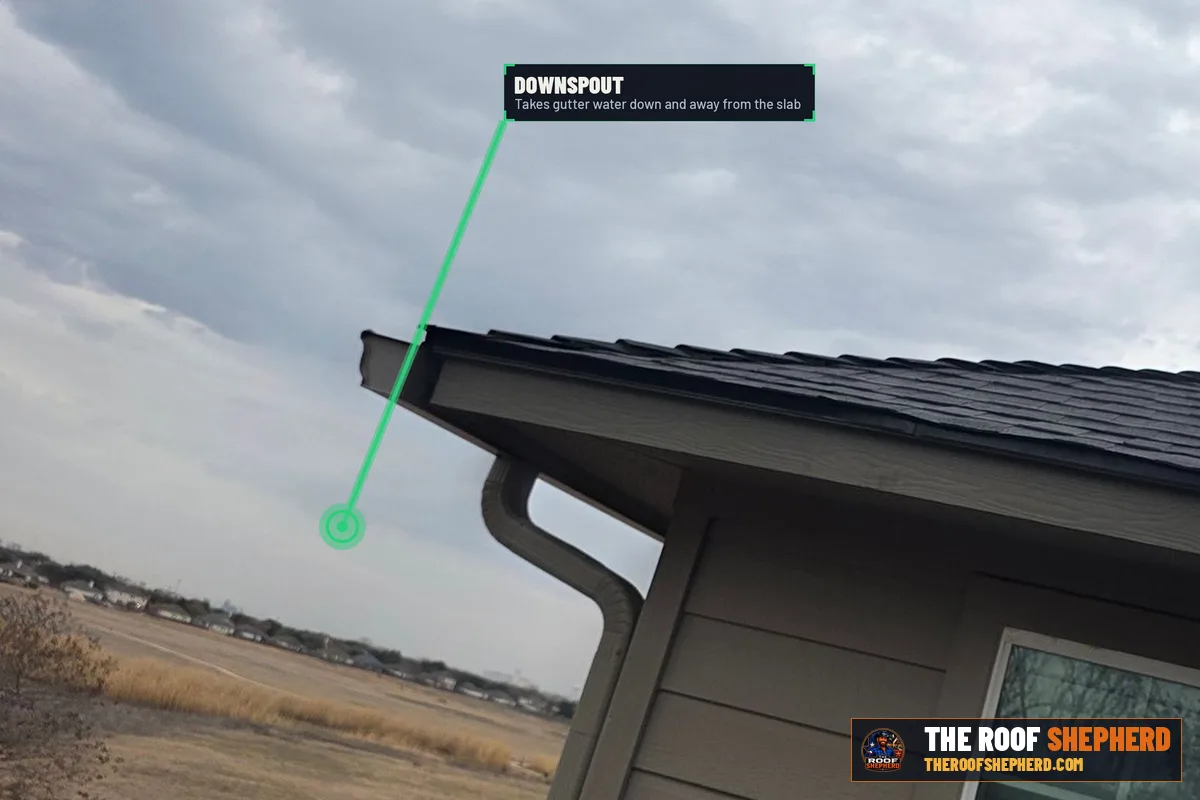
Downspout
The vertical run that takes gutter water down and away from the foundation.
Secured to the wall, elbows tight, water carried well clear of the slab.
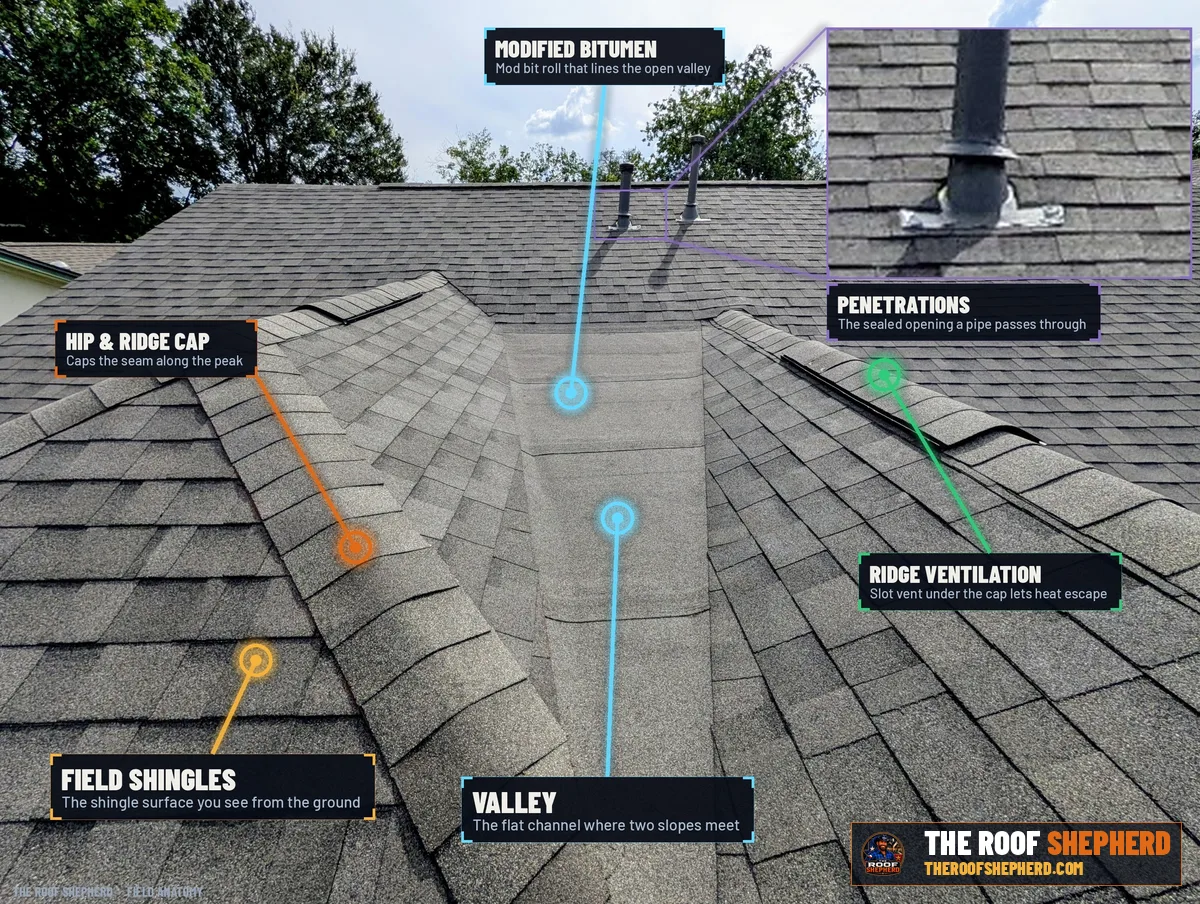
Ridge vent, hip & ridge cap
The lines where roof planes meet. Along the top ridge a vent lets hot attic air escape. Hips and ridges are capped with overlapping shingles. Where two planes fall inward instead, they form a valley that funnels the water.
Caps flat, sealed, and even, with the ridge vent intact. The valley clean and watertight, since it carries the most water of anywhere on the roof.
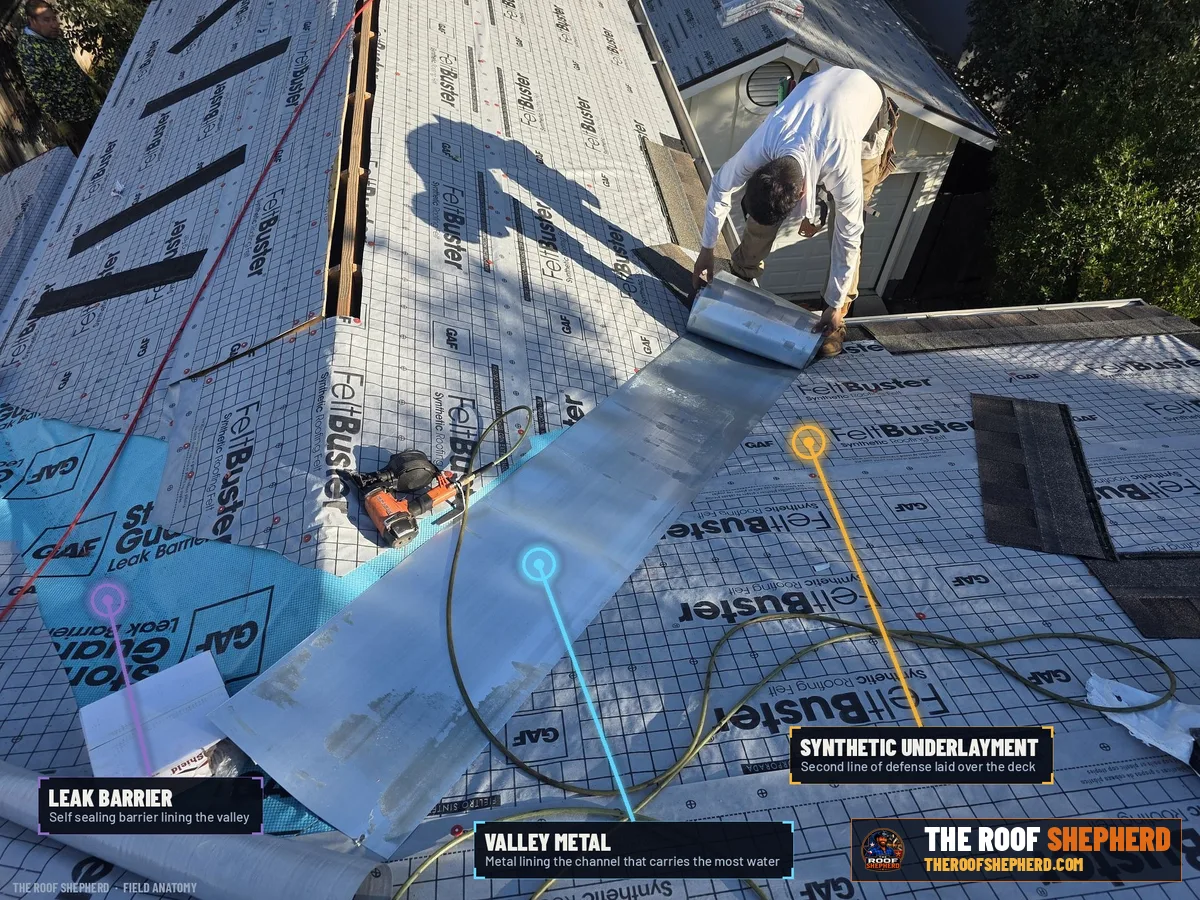
Valley
Where two planes meet and pour their water into one channel. It carries more water than anywhere else, so it is a top leak suspect. Shown here lined with metal.
A clean channel, metal or laced shingles intact, nothing lifting and no debris packing it.
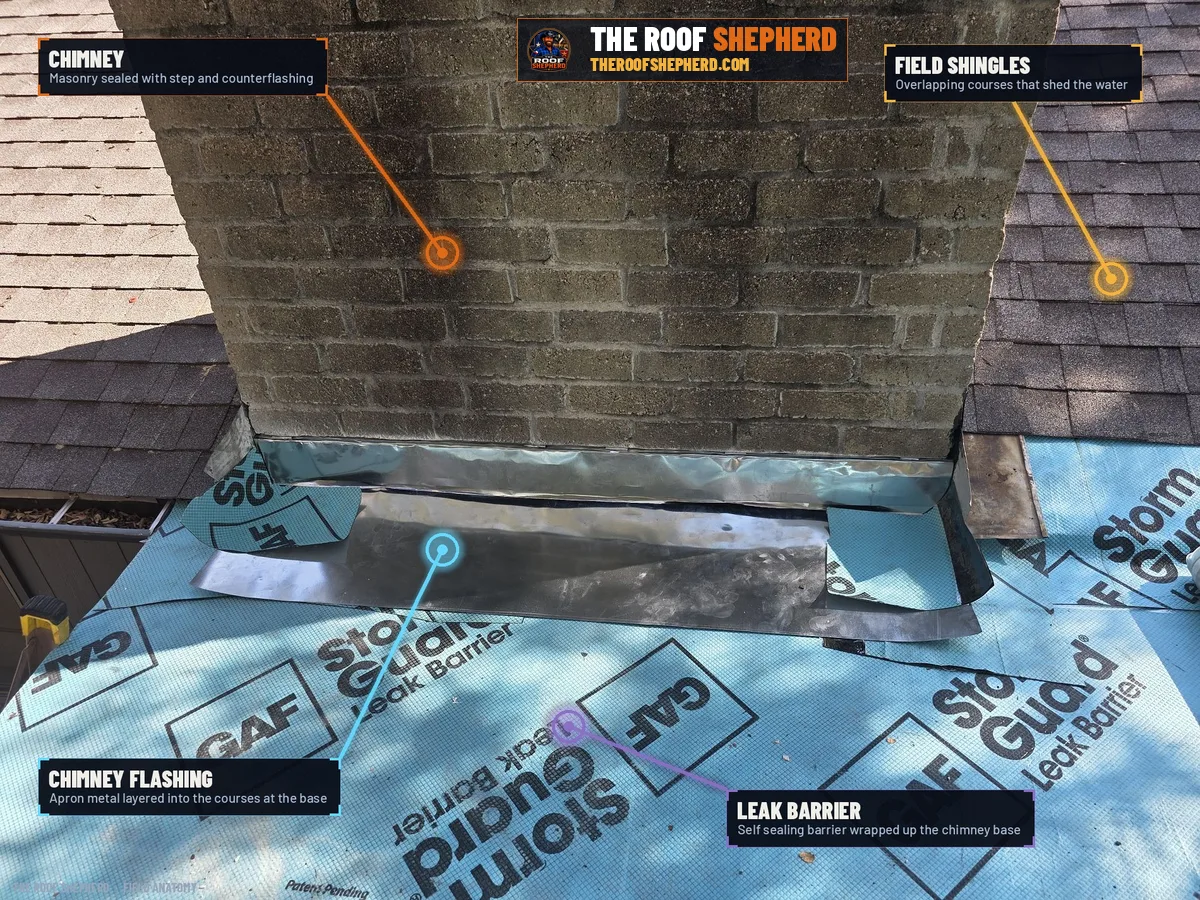
Chimney flashing
The metal and leak barrier that tie a chimney into the roof. Done right it is layered into the courses, not caulked.
Leak barrier wrapped up the base, metal stepped into the brick, no reliance on tar.
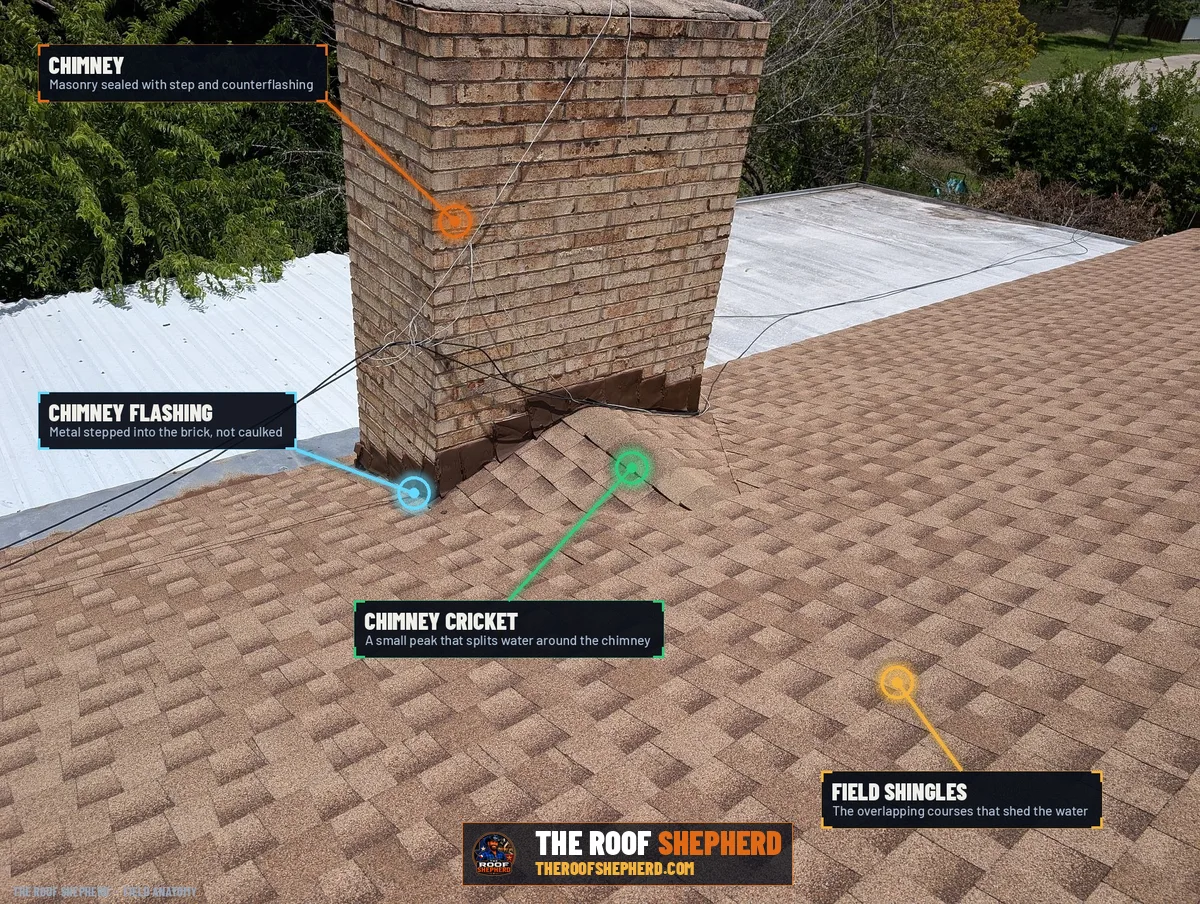
Chimney cricket
A small shingled peak built behind a wide chimney to split the water around it instead of letting it pond.
A raised saddle of shingles behind the chimney, flashed and sealed, not a flat dead spot that holds water.
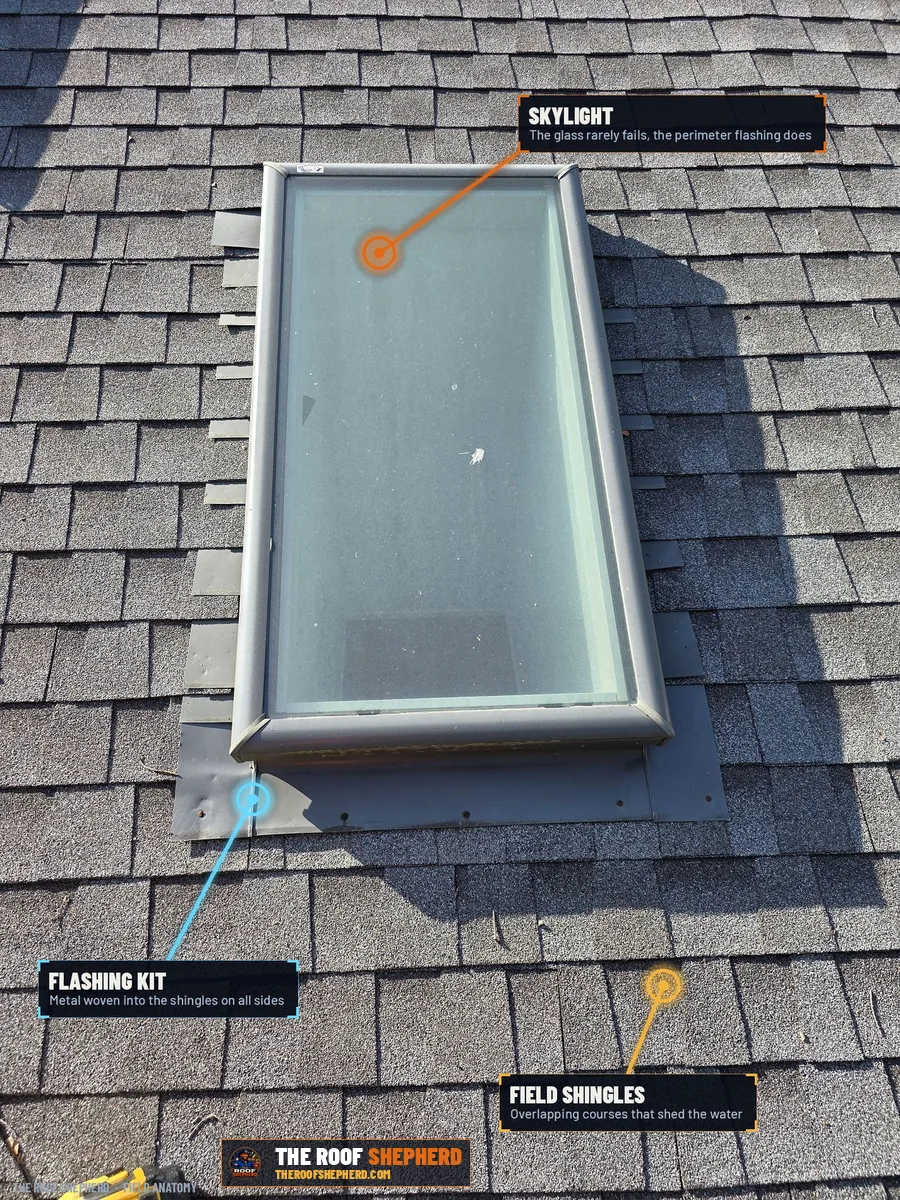
Skylight
A glazed opening. The glass rarely fails, the perimeter flashing does.
A flashing kit woven into the shingles on all sides, no tar patching the corners.
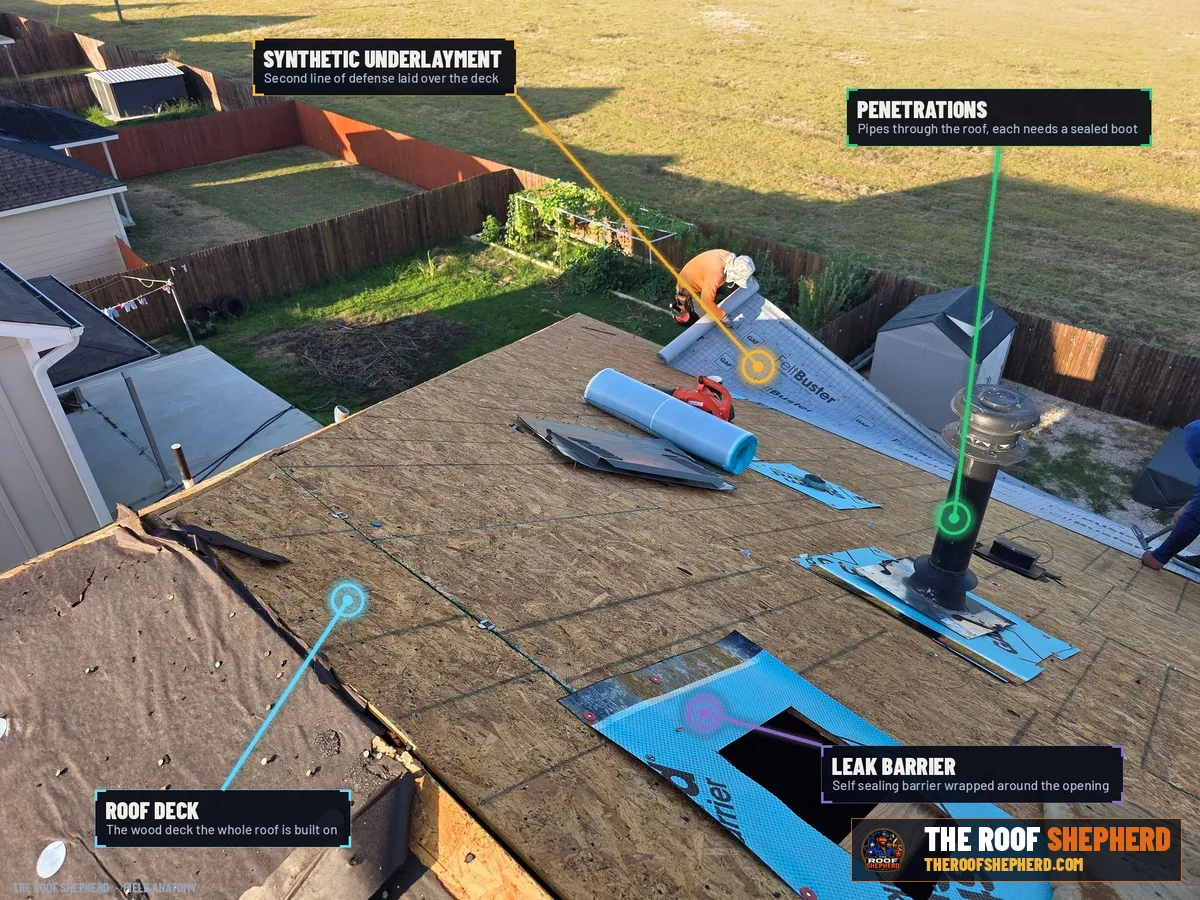
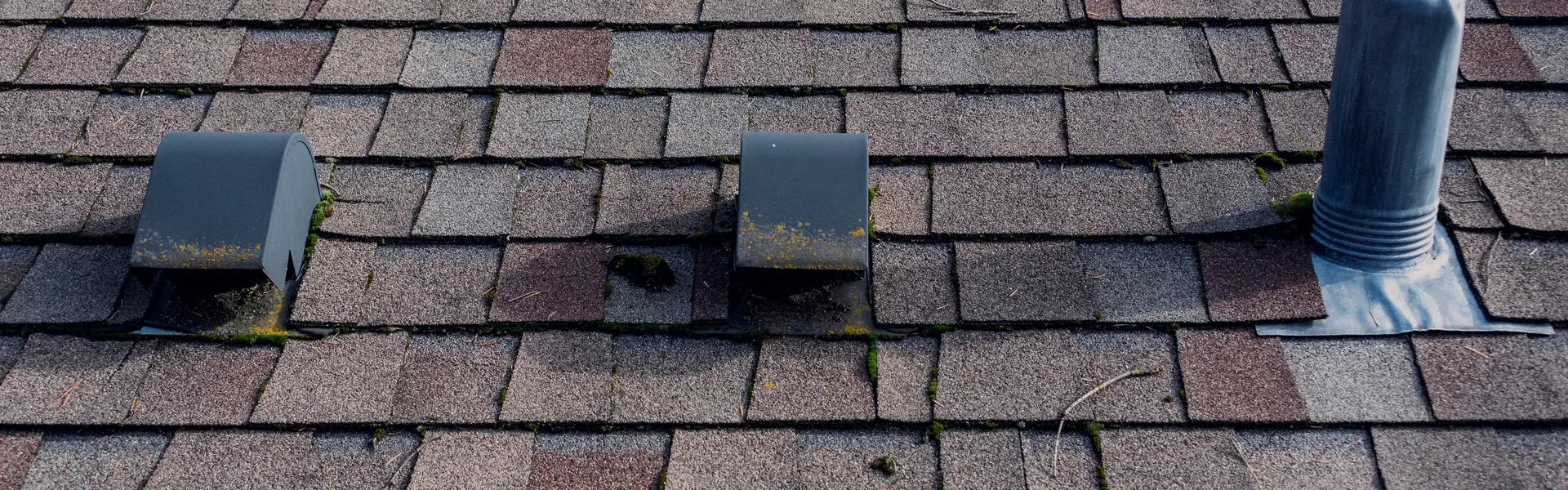
Penetrations & boots
Anything that passes through the roof, vents and pipes, each sealed with a flashed boot or collar at its base.
Each one seated under the up slope shingles, collar intact. In Texas sun the rubber collar fails first.
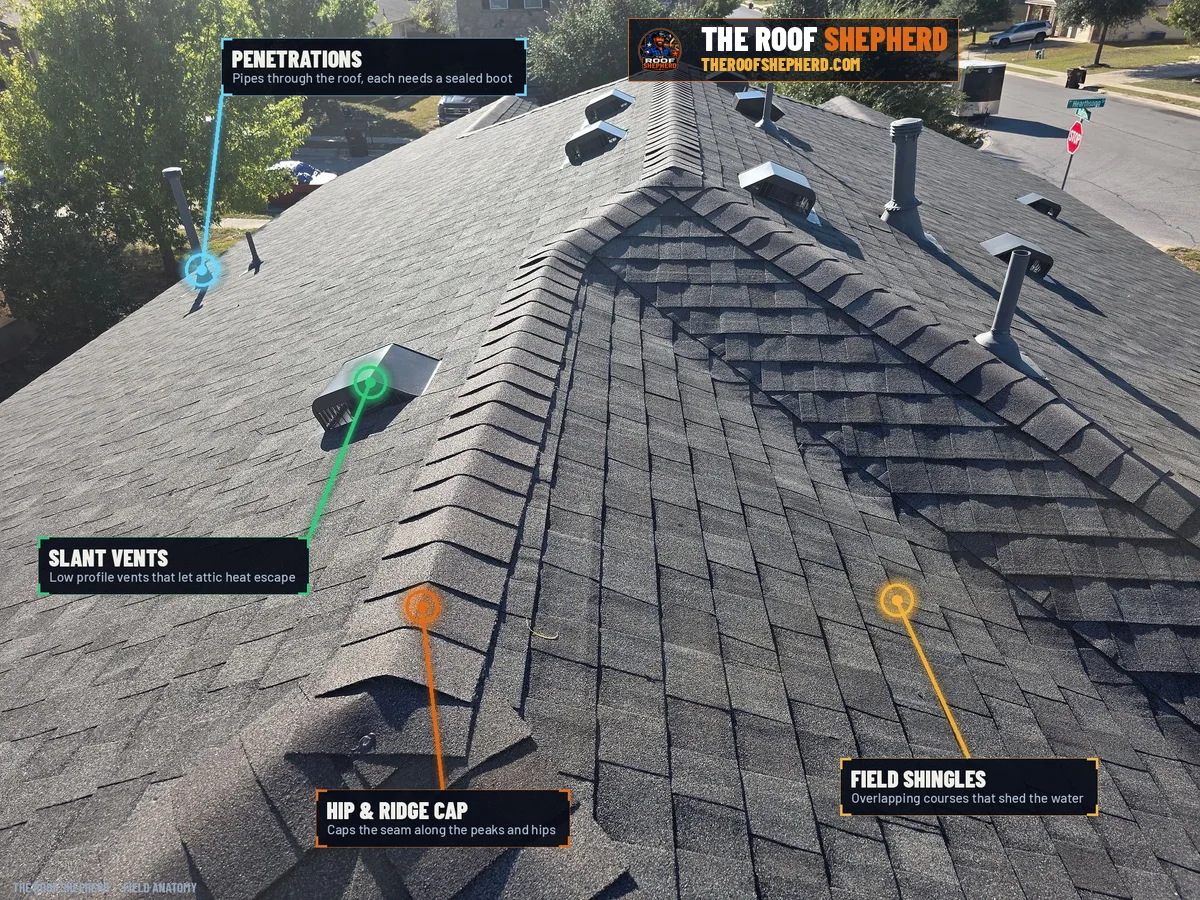
Slant vent
A low profile static vent that lets attic heat escape near the ridge.
A flat seated base under the up slope shingles, housing not cracked or bent.
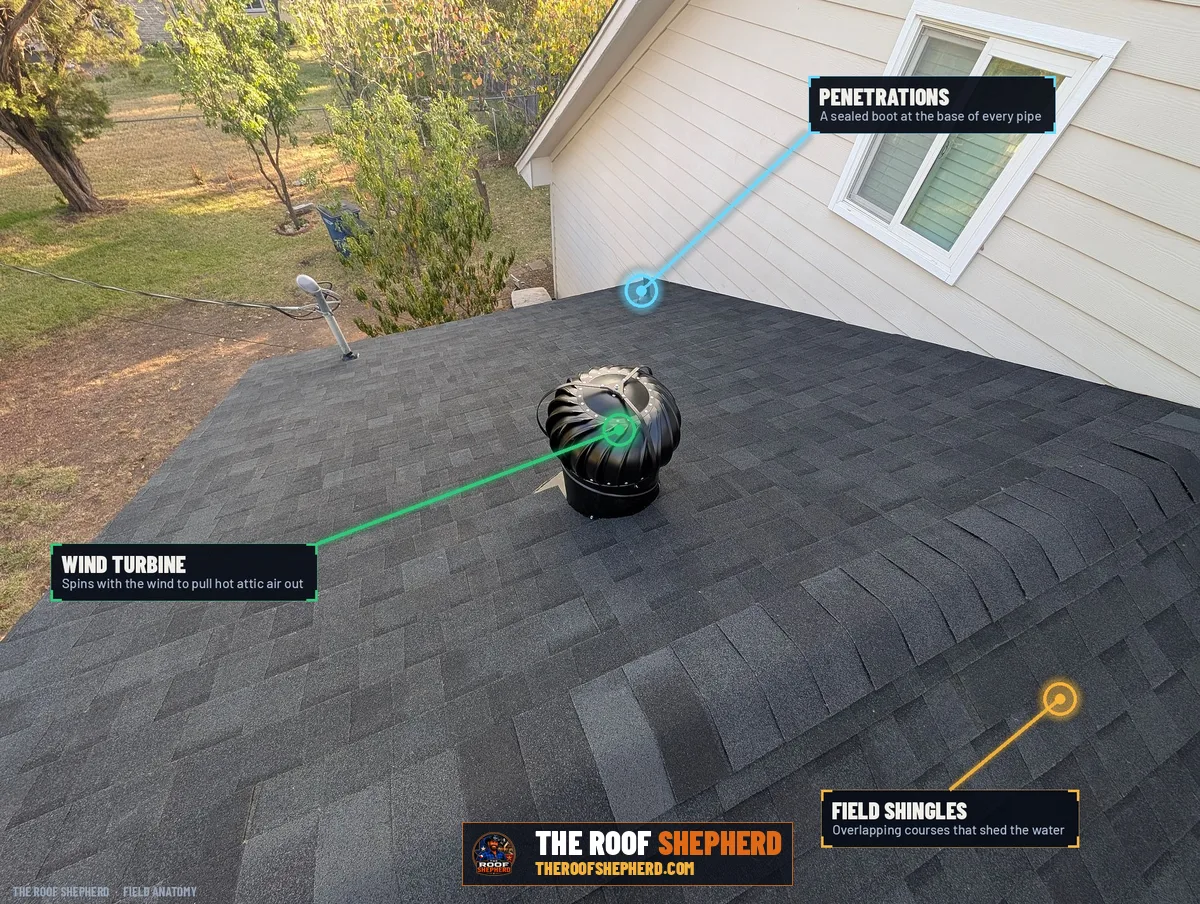
Wind turbine
A spinning turbine that pulls hot air out of the attic as the wind turns it.
A base that is flashed and sealed, the turbine spinning freely, not seized.
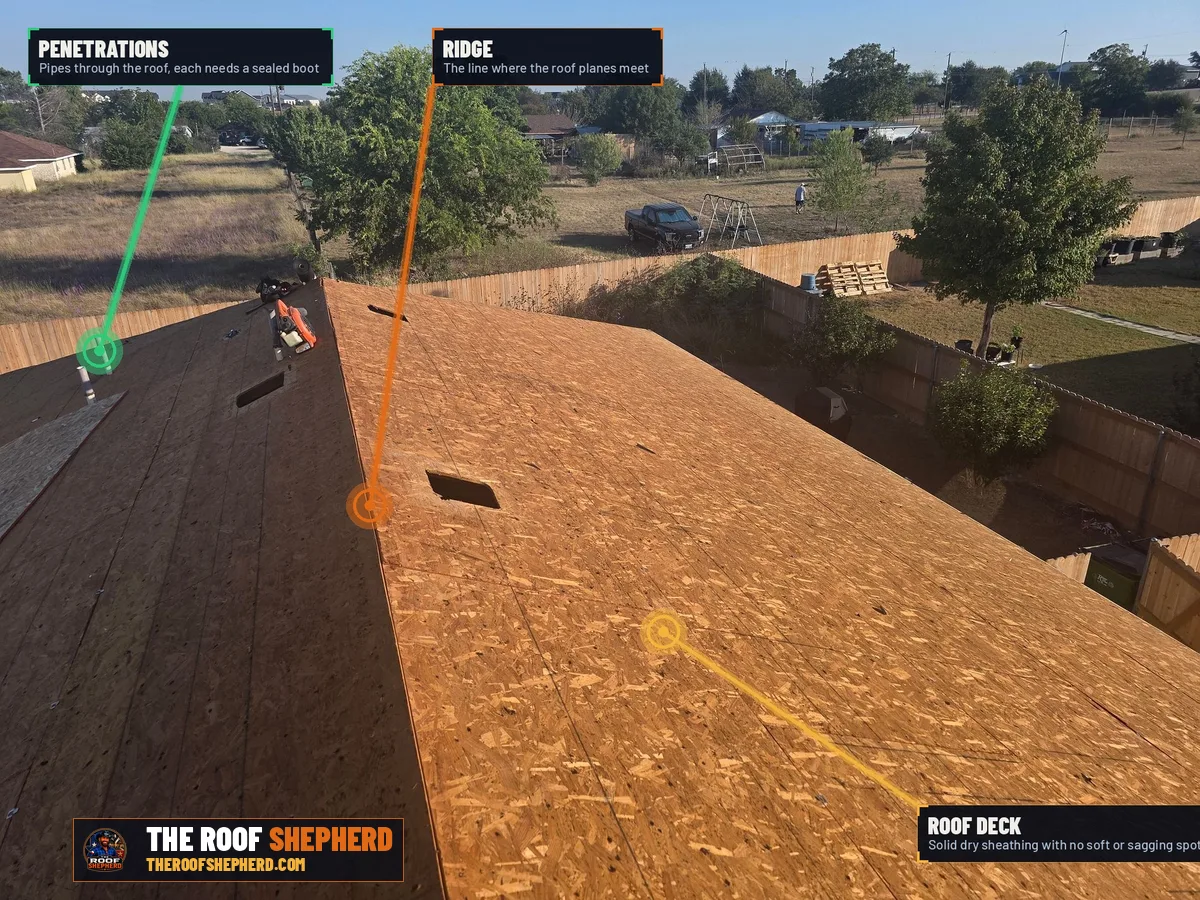
Roof deck
The wood deck the whole roof is built on. Everything above sits on this.
Solid, dry sheathing with no soft, dark, or sagging spots.
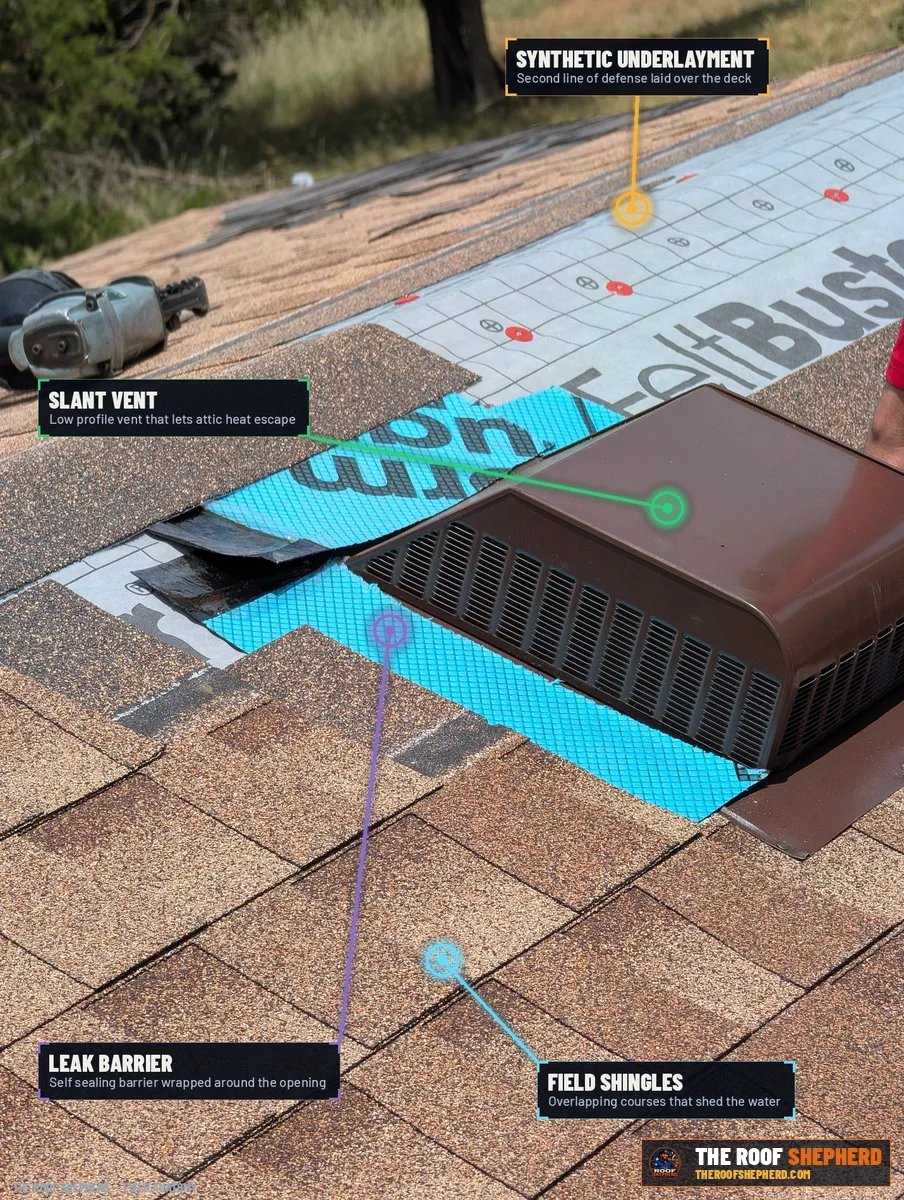
Synthetic underlayment
The synthetic layer over the deck, a second line of defense under the shingles.
Laid flat and lapped down slope, no tears or wrinkles, fully fastened.
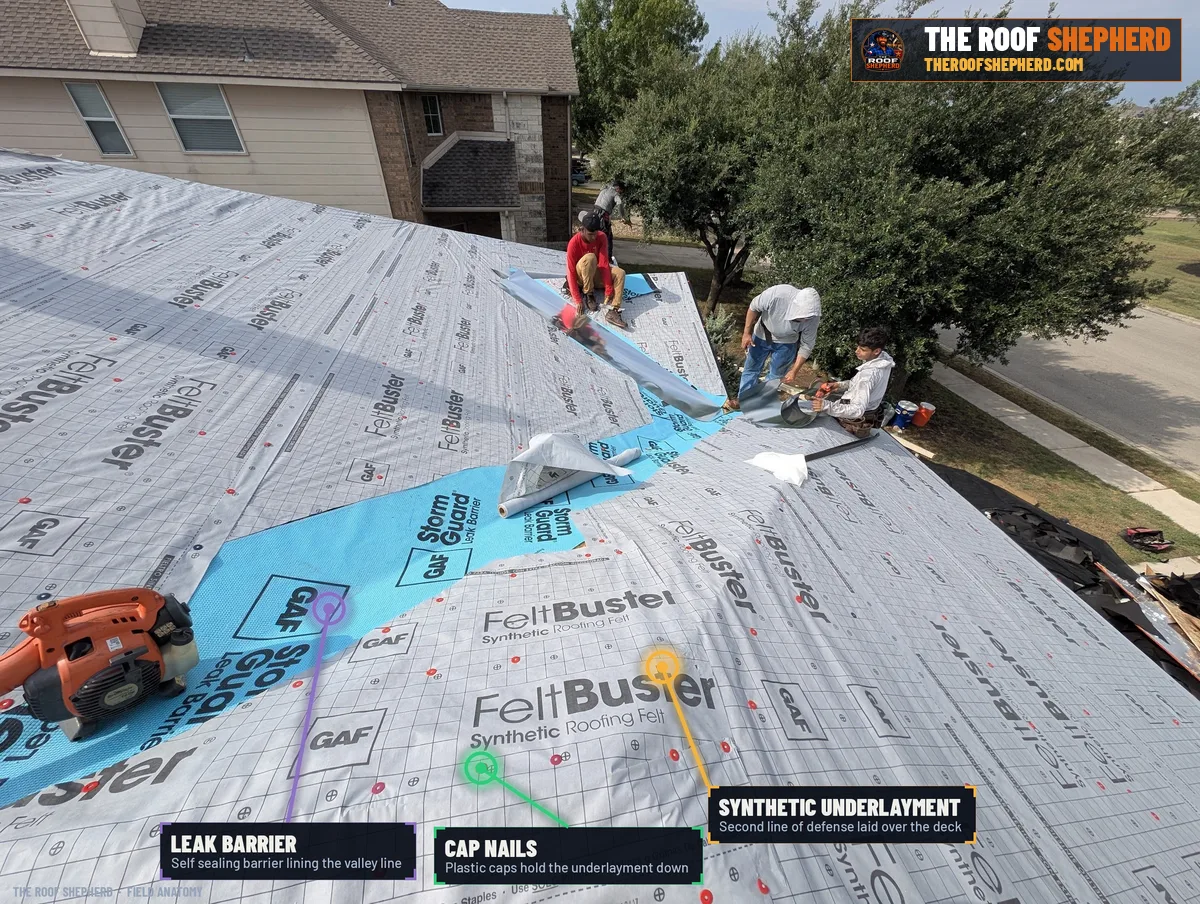
Ice & water shield
A self sealing leak barrier at the eaves, valleys, and around penetrations, the highest risk spots.
Full coverage that seals around nails, wrapped up walls and around every penetration.
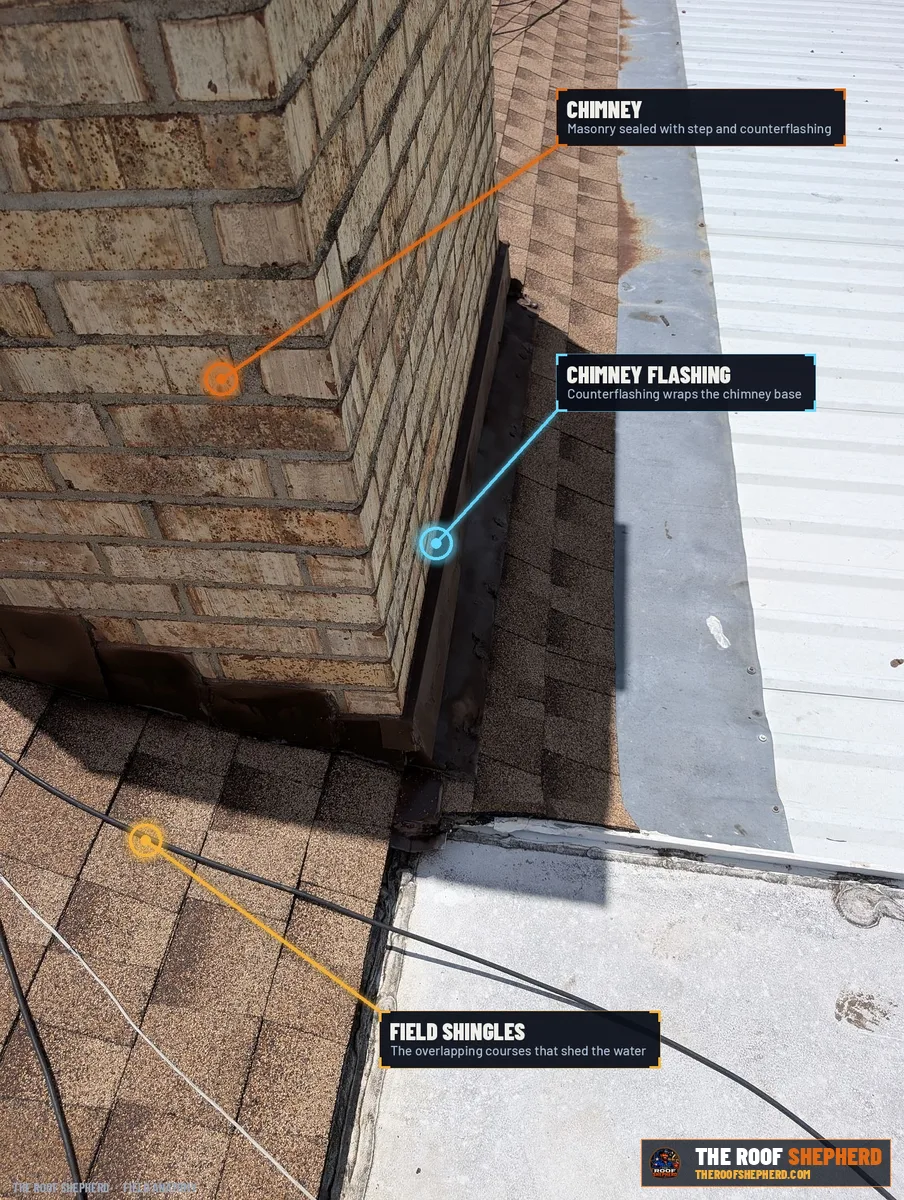
Chimney (masonry)
A masonry chimney rises through the roof and is sealed at the joint with step flashing and counterflashing.
Sound brick and mortar, tight flashing at every course, and no gaps where the brick meets the shingles.
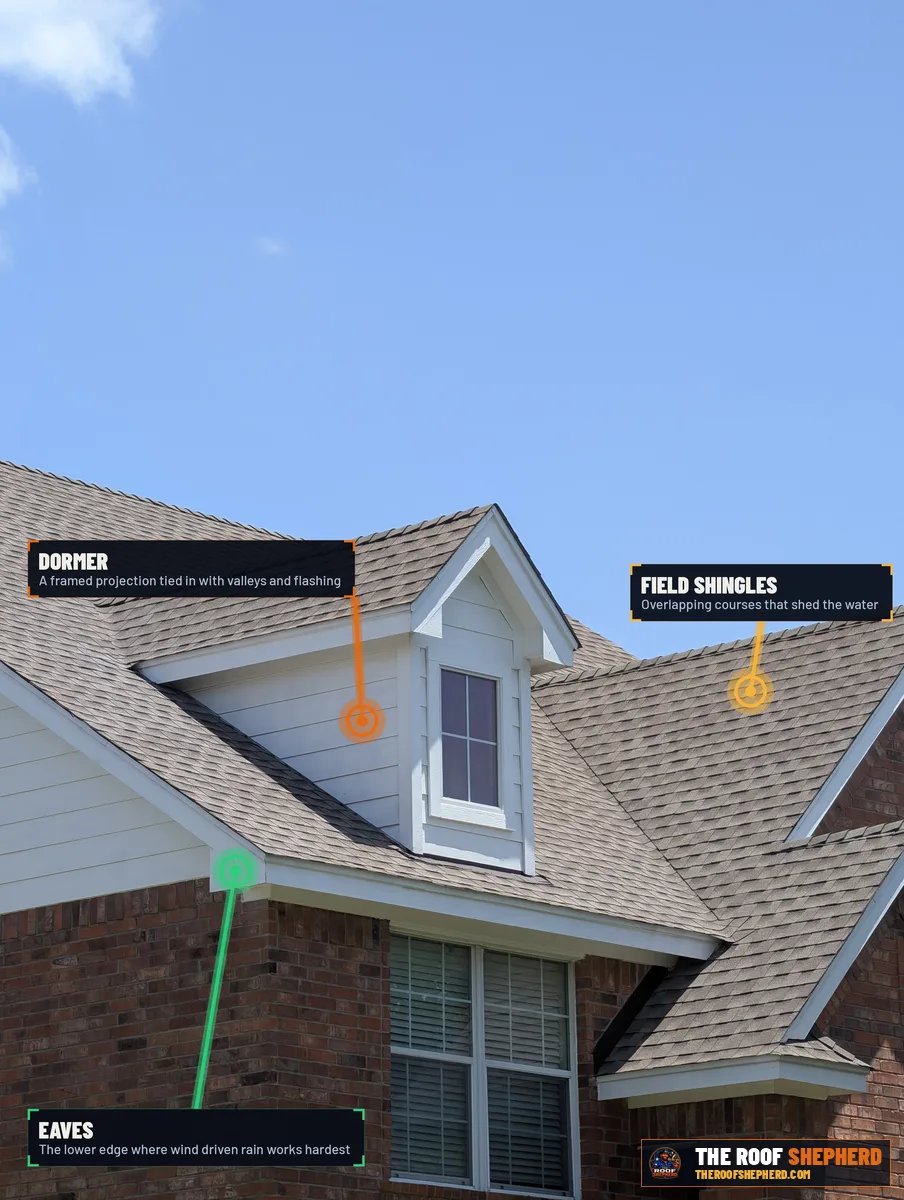
Dormer
A framed structure that projects from the roof slope, usually with a window, tied in with valleys and flashing on each side.
Watertight flashing where the dormer walls meet the roof, sound valleys, and no staining on the siding below.
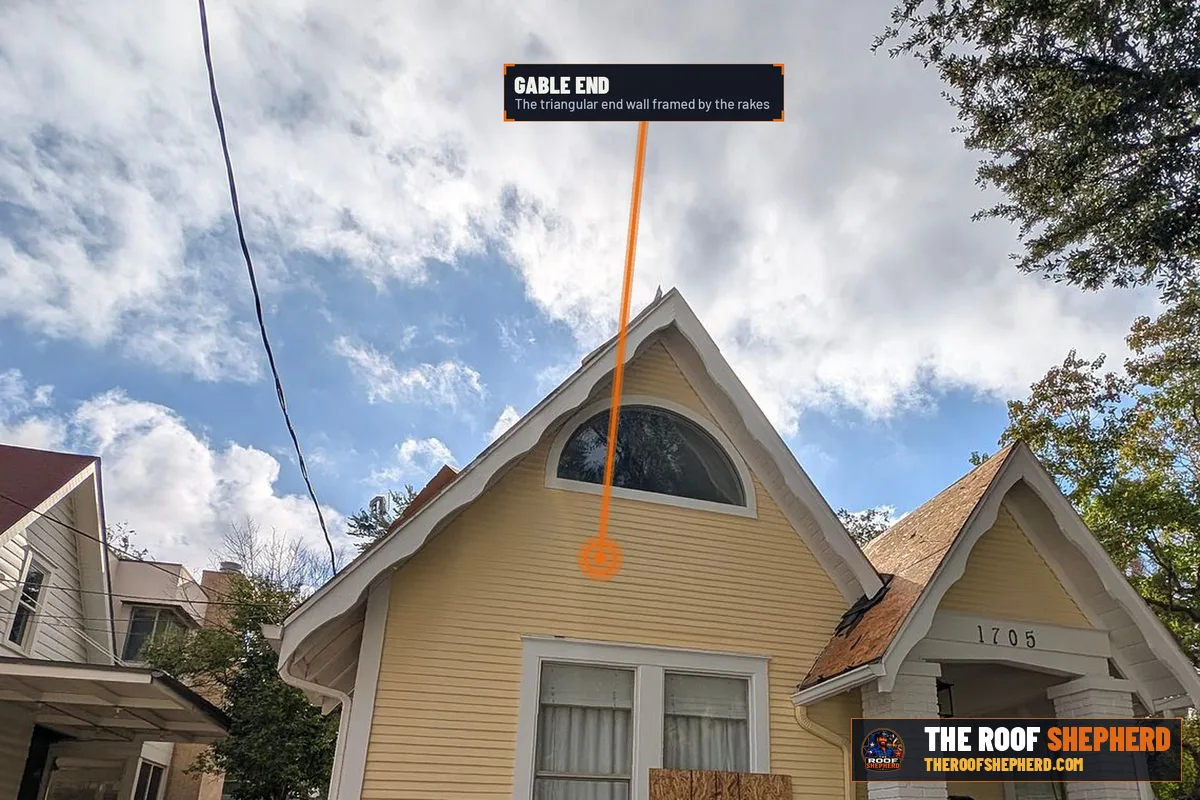
Gable end
The triangular wall at the end of the house where two roof slopes meet. The rake edges frame its sides.
Straight rake lines, intact trim and siding, and sealed edges with no lifting or wind damage.
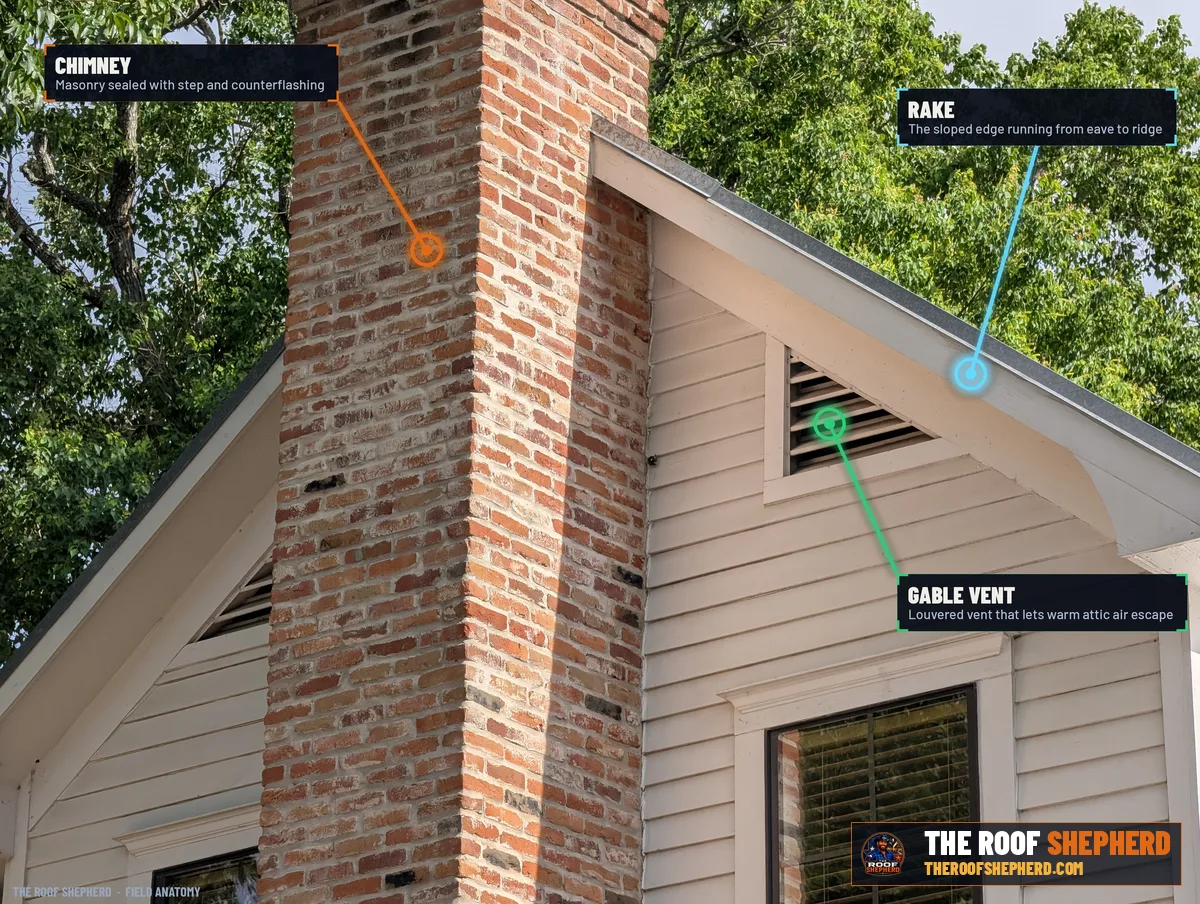
Gable vent
A louvered vent set into the gable wall that lets warm attic air escape near the roofline.
Clear louvers, intact screen behind them, and no painted over or blocked slats that would choke airflow.
The Structure
Roof deck (sheathing)
The structural base under everything
The deck is the structural wood base, plywood or OSB sheeting nailed across the rafters or trusses, that every other layer fastens to. It carries the load and gives the nails something to bite. If the deck is soft, delaminated, or rotted, nothing above it holds, which is why a real inspection looks at decking condition before anything else.
IBHS recommends a minimum 7/16″ plywood or OSB deck. For a FORTIFIED deck, sheathing is fastened with 8d ring-shank nails, roughly 6″ on center, tightening to 4″ on center within 4 ft of edges and the ridge in high-wind and coastal zones. Ring-shank fasteners nearly double the deck’s uplift resistance versus smooth-shank nails.
Water Control
Underlayment: synthetic vs. felt
The secondary water barrier
Underlayment is the secondary water barrier rolled over the entire deck, beneath the shingles. If a shingle lifts or a piece of hail cracks the surface, this is the layer that keeps water off the wood. There are two kinds, and the difference is real. The layer-by-layer detail, including the code rule by roof slope and where leak barrier goes, is in the roof deck and underlayment guide.
Felt is the traditional asphalt-saturated paper (the “15-pound” and “30-pound” rolls). It works, but it’s heavier, tears easily, wrinkles when it gets wet, and degrades faster in sun. Synthetic underlayment is a woven polymer (polypropylene) sheet, far lighter, dramatically higher tear strength, better UV and water resistance, and safer to walk on. Synthetic is the modern default on a quality install; both shed water, but they are not equivalent in durability. Underlayment choices ride on the material above; see roofing materials. Related: the roofing FAQ hub.
Felt is ASTM D226 (Type I #15 / Type II #30). To qualify as a FORTIFIED sealed-deck underlayment, a synthetic must meet a minimum tear strength of 15 lbf (ASTM D4533) and tensile strength of 20 lbf/in (ASTM D5035), and be fastened with annular-ring or deformed-shank cap fasteners, not slick staples.
Water Control
Leak barrier (ice-and-water shield)
Where water gets in first
A leak barrier is a self-adhering, waterproof membrane installed at the spots most likely to leak, the eaves, the valleys, and around chimneys, vent pipes, and skylights. Because it’s self-sealing, it grips around every nail that’s driven through it. Its two jobs are stopping ice dams (water backing up under shingles as snow melts and refreezes at the cold eave) and resisting wind-driven rain forced uphill in a storm.
Self-adhered polymer-modified bitumen, ASTM D1970. Valleys and all penetrations get it as a matter of course; at the eaves in cold climates it should run from the edge to at least 24″ inside the interior warm-wall line. In Central Texas the eave run is more about wind-driven rain than ice, but valleys and penetrations are non-negotiable.
The Edges
Drip edge, and why the eaves and rakes are different
Why the edges need metal
Drip edge is a bent metal strip along the roof’s edges. It exists because water doesn’t fall straight off a roof, surface tension pulls it backward, around the edge, onto the wooden fascia and the ends of the deck, where it sits and rots the wood. The drip edge’s outward kick breaks that surface tension and throws the water clear. Edge metal and gutters work together; see gutters and drainage.
Here’s the detail most people never notice: at the eaves, the underlayment goes over the drip edge; at the rakes (the gable ends), the underlayment goes under it. That’s not a preference, it’s the code, and there’s a reason for each. At the eave, water sheds straight down-slope, so running the underlayment over the metal makes sure any water that gets under the shingles lands on the drip edge and off the roof, never behind it. At the rake, the edge faces sideways into wind-driven rain, so the drip edge goes on top to support the shingle edge and block water from being pushed underneath. Layering order is one of the things recorded in a field record.
IRC R905.2.8.5: drip edge required at eaves and rakes; underlayment installed over the drip edge along eaves and under it along rakes; segments lapped ≥2″; metal extends ≥1/4″ beyond the fascia and ≥2″ onto the deck; fastened ≤12″ o.c. (≤4″ o.c. where the design wind speed is ≥110 mph or mean roof height exceeds 33 ft). FORTIFIED goes further still: a wider drip edge, ~3″ laps, and nailing at 4″ o.c. in a two-row “W” pattern.
The Edges
Starter strip
The sealed first course
The starter strip is a sealed first course installed along the eaves and the rakes, with a factory-applied adhesive bead positioned to grab the bottom edge of the first row of shingles. It’s what keeps wind from catching that first row and unzipping the roof from the edge in. A common shortcut, cutting up field shingles to use as starter, puts the sealant in the wrong place and measurably lowers the roof’s wind resistance at its most exposed line. Edge detail and gutter interaction is covered under gutters and drainage. Sealed courses are checked during a maintenance visit.
Purpose-made starter with factory adhesive at the eave and rake edges. FORTIFIED requires a fully-adhered starter strip at both, because the perimeter carries the highest wind-uplift loads on the roof.
The Weather Layer
Field shingles
Architectural
The field shingles are the visible weather layer, the part that takes the sun, rain, wind, and hail. (also called dimensional or laminate) shingles are built on a fiberglass mat, coated in asphalt and mineral granules, and layered for thickness. They outlast and out-resist the old flat 3-tab shingle, carry wind ratings up to roughly 130 mph, and typically hold a Class A fire rating, the highest. The granules aren’t just color, they shield the asphalt from UV, which is what ages a roof. Which shingle you choose is covered in the materials guide. Storm damage shows here first, as described in the storm damage guide.
Fiberglass-mat asphalt shingles. The single biggest field-quality variable for the wind warranty is nail placement: fasteners must land in the manufacturer’s marked nailing zone, driven flush, not high, not overdriven through the mat.
Impact
Impact resistance, the UL 2218 classes
Class 4
In hail country, this is the rating that matters most. UL 2218 grades a shingle’s impact resistance from Class 1 to Class 4 by dropping a steel ball of a set size from a set height and checking whether the shingle cracks through the back. Bigger ball, greater height, more energy:
| Class | Steel ball | Drop height | Central TX relevance |
|---|---|---|---|
| Class 1 | 1.25″ | 12 ft | Baseline. Most standard shingles. |
| Class 2 | 1.50″ | 15 ft | Moderate improvement over standard. |
| Class 3 | 1.75″ | 17 ft | Good protection for sub-inch and common hail events. |
| 2.00″ | 20 ft | Recommended for Williamson County. Possible premium discount. |
Class 4, in detail
Every class requires two strikes in the same spot with no crack through the backing, not just one. is the top rating and the one most often tied to insurance discounts, though that varies by carrier and by state. Manufacturers reach it either with a polymer-modified asphalt or with a mesh/scrim reinforcement on the back of the shingle. (A parallel test, FM 4473, uses launched ice balls instead of steel.)
A Class 4 rating describes the product as tested in a lab. In the field, impact performance still depends on the deck condition beneath it, the fastening, and the substrate, a rated shingle over a soft deck doesn’t perform like the test.
The System That Breathes
Ventilation
balance
A roof has to move air, or it bakes the shingles from underneath and traps moisture in the attic, both of which shorten its life. The principle is : intake low (soffit or eave vents) and exhaust high (ridge or hip vents), in roughly equal amounts, so air flows continuously up and out by convection. The full sizing and balance rules are in the attic ventilation guide.
The sizing rule of thumb is 1 square foot of net free vent area for every 150 square feet of attic floor (the 1:150 rule), which can be cut to 1:300 when there’s a vapor barrier and the venting is balanced, split about half intake, half exhaust. Two rules get broken constantly: don’t mix exhaust types (a ridge vent combined with power, turbine, or gable vents short-circuits the airflow), and a ridge vent with no soffit intake is nearly useless, with nowhere to draw fresh air, it pulls conditioned air straight out of the house instead.
Size to net free area (NFA), not the vent’s gross dimensions, louvers and screens cut the open area. Baffle the soffits so blown insulation can’t choke the intake. On a reroof that adds a ridge vent, confirm there’s adequate soffit intake or add it.
Where Leaks Start
Flashing
Where the roof meets something else
Flashing is the metal at every place the roof meets something else, walls, chimneys, skylights, valleys, and vent pipes. This is where leaks actually start. Most roof leaks aren’t through the open shingle field; they’re at flashing that was reused from the old roof, sealed with a bead of caulk instead of formed and lapped correctly, or skipped entirely. Caulk is not flashing, it’s a temporary patch on top of one.
Step flashing plus counter flashing at walls and chimneys; metal valleys or a properly woven/closed-cut valley detail; pipe boots at penetrations. Everything integrates with the underlayment in shingle fashion so water always laps over the layer below, never under it.
The Finish
Hip & ridge cap
Finishing the peaks
The ridge cap is the row of finishing shingles installed over the peaks and hips. It covers the ridge vent and the cut edges of the field shingles where two roof planes meet, a wind-exposed line that gets its own purpose-made, pre-formed cap rather than folded field shingles. Ridge ventilation is a related system: attic ventilation. Ridge work is a common upsell, which is why knowing a storm chaser matters.
Use a purpose-made hip-and-ridge cap, not bent 3-tab. When it’s installed over a ridge vent, the nails have to be long enough to pass through the vent and bite into the deck, a common shortfall that leaves the cap under-fastened.
Resilience
FORTIFIED, the whole system, built tougher
nail it down, seal it up, lock it in
FORTIFIED is a higher building standard from the Insurance Institute for Business & Home Safety (IBHS), the insurance industry’s research nonprofit. It targets the three ways roofs fail in severe storms, in plain terms:
sealed roof deck
That means a , the sheathing seams are taped or covered so that even if the wind tears the shingles off, water still can’t get into the house (this single step prevents most storm-related interior losses); ring-shank nails in an enhanced pattern that nearly double how hard the deck is to peel off the structure; and locked-in edges, a wider drip edge and a fully-adhered starter at the eaves and rakes where wind gets its grip. A home doesn’t just claim FORTIFIED; an independent, certified FORTIFIED evaluator verifies the work, which is why photos during installation matter.
Per the IBHS FORTIFIED Roof standard: a sealed-deck method (flashing-tape over the seams plus underlayment, two plies of #30 felt, or a full self-adhered membrane with a bond break under asphalt shingles); 8d ring-shank deck nailing in the enhanced pattern; and the enhanced edge details above. A complete photo record during construction is required for the evaluator, since most of it is concealed once the roof is finished.
The Documentation Angle
Why knowing the layers changes what you document
Reading a roof as a system
Once you see a roof as a system, an inspection stops being “are the shingles okay” and becomes a record of the parts that actually decide whether the roof holds: the deck condition, the flashing at every transition, the edge details, the ventilation balance, and whether the storm-rated components are what they’re claimed to be. A documented record of what’s genuinely on your roof, before any contractor conversation, protects your position whether you’re buying, selling, filing a claim, or simply planning ahead.
Direct answer
Still have a question?
Ask it in plain English and get a straight answer now. Nothing is gated, and you are not handing over your details to read one.
No form, no callback
Ask it in plain English and get a straight answer now. Nothing is gated, and you are not handing over your details to read one.
Roof Anatomy Questions
Common questions about roof anatomy
What are the layers of a roof, from the deck up?
From the structure up: the roof deck (plywood or OSB), underlayment over the whole deck, a self-sealing leak barrier at the eaves, valleys, and penetrations, metal drip edge at the edges, a sealed starter strip, the field shingles, and finally hip-and-ridge cap over the peaks, with flashing at every transition and balanced ventilation moving air from the soffits to the ridge.
What’s the difference between synthetic underlayment and felt?
Felt is the traditional asphalt-saturated paper (#15 or #30). Synthetic underlayment is a woven polymer sheet that is lighter, far more tear-resistant, holds up better to sun and water, and is safer to walk on. Both act as a secondary water barrier under the shingles, but synthetic is the more durable, modern choice.
Why is drip edge installed differently at the eaves and rakes?
Per IRC R905.2.8.5, underlayment goes over the drip edge at the eaves and under it at the rakes. At the eave, water sheds down-slope, so underlayment-over-metal routes any under-shingle water onto the drip edge and off the roof. At the rake (the gable edge), the drip edge goes on top to support the shingle edge and block wind-driven water from being pushed underneath.
What does a Class 4 impact rating mean?
Class 4 is the highest UL 2218 impact rating. The shingle has to survive a 2-inch steel ball dropped from 20 feet, struck twice in the same spot, without cracking through the back. It’s the rating most often associated with insurance discounts, though that varies by carrier and state.
How much attic ventilation does a roof need?
Aim for balanced intake (soffit/eave) and exhaust (ridge), in roughly equal amounts. A common target is 1 square foot of net free vent area per 150 square feet of attic floor, which can drop to 1:300 with a vapor barrier and balanced venting. Don’t mix exhaust types, and never run a ridge vent without soffit intake, it won’t work.
What makes a FORTIFIED roof different from a code roof?
Three upgrades beyond minimum code: a sealed roof deck so water stays out even if the cover blows off, ring-shank nails in an enhanced pattern that nearly double the deck’s hold, and locked-in edges (a wider drip edge and fully-adhered starter). It’s verified by an independent FORTIFIED evaluator and can qualify a home for insurance incentives, which vary by location.
Still have a question about your roof?
Get a straight answer and your real options, no obligation, never a hard sell.
Prefer a person? Call or text 512-575-5052, 8am to 9pm, seven days a week.
Get Help Ask Shepherd AIKeep Learning
Where to go from here
Each guide below picks up a thread from this page: what the layers cost, what storms do to them, and how to hire the person who touches them.