
Education
What Actually Happens After Hail Hits Your Roof
The claim process, your policy type, how your insurer values a roof, and what to do when you disagree with what they offer. Plain language. No contractor sales pitch.
Updated September 15, 2026
Coverage Basics
Does insurance cover hail damage on a roof?
What wind and hail coverage means
Most Texas homeowner policies include wind and hail coverage. What actually gets paid depends on your specific policy: how it values the roof (RCV or ACV), any exclusions, and your wind-and-hail deductible, which many Texas carriers set near 2 percent of your dwelling coverage. Your own documentation is what lets you evaluate the outcome.

Before anything else
Document first. Call second.
What that instinct costs
Every homeowner instinct after a storm is to call someone, a contractor, a neighbor, the insurance company. The problem with calling first is that anyone who shows up before you have your own documentation is now ahead of you in the process. The contractor wants the job. The adjuster works for the insurer. Neither of them creates a written record.
Thirty minutes that protect you
Spend 30 minutes photographing gutters, downspouts, AC condenser tops, vent caps, fascia, and any visible roof surface before a single person arrives. That record, timestamped by your phone, is the only documentation in the entire process that belongs solely to you. Everyone who looks at it after that, this company included, is paid when work proceeds, which is exactly why a record you made yourself is worth having.
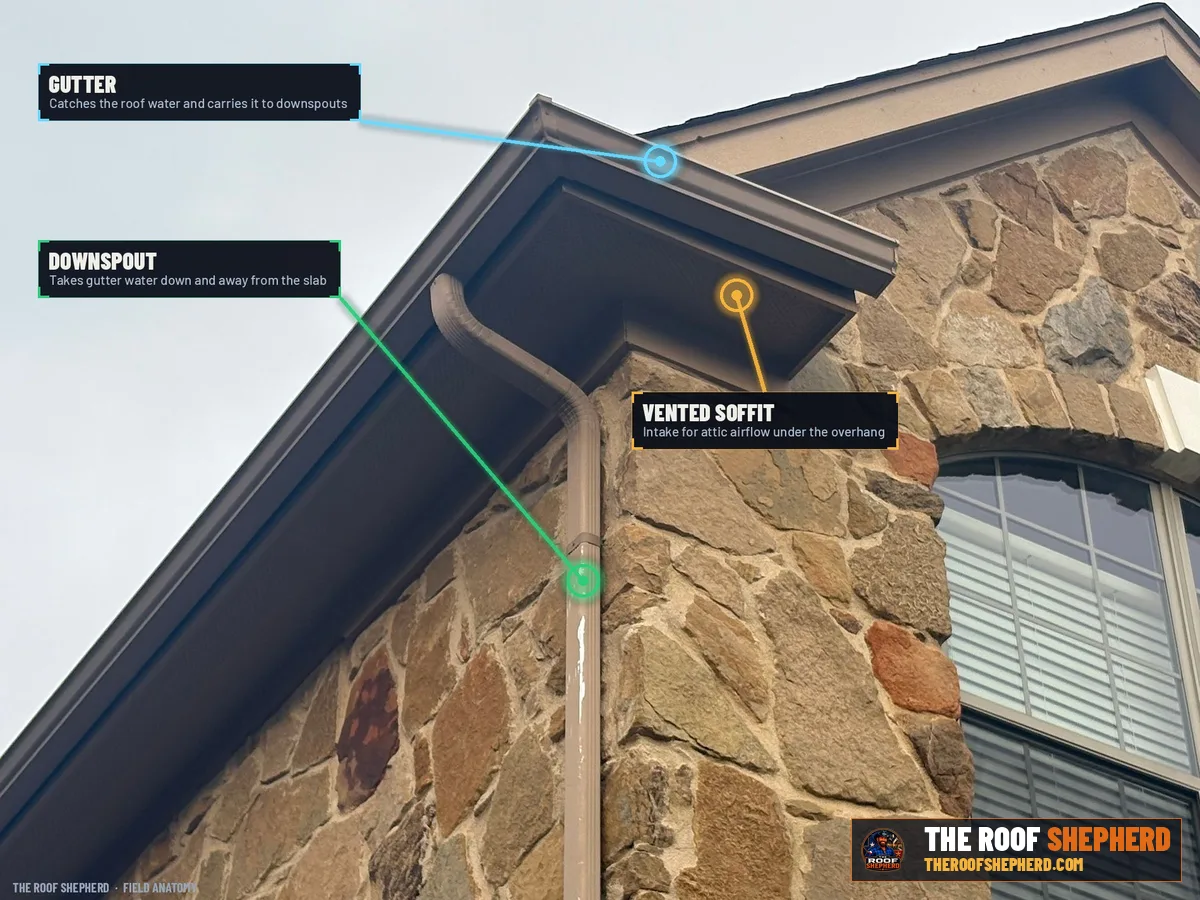
Then notify your insurer. Email works better than a phone call because it creates a timestamp and a written record of what you reported and when.
Before You Call Anyone
How to check your own property first
The order that holds up
Hail documentation follows a systematic sequence. Gutters and vents first, they dent at lower impact thresholds than shingles and provide the first confirmation of hail size and density.
Start with the soft metals
Gutters, downspouts, AC fins, vent caps, drip edge, and ridge vents. Photograph each impact with a scale reference. Record location.
Roof surface
Granule displacement, bruising (mat fracture visible under granules), and impact craters. Focus on north-facing slopes and low-pitch areas first.
Perimeter and transitions
Fascia, soffits, chimney caps, and exposed wood trim. Document paint stippling, small circular depressions in painted surfaces confirm hail contact.
Vehicles and ground surfaces
Dents on vehicles parked outside during the event are corroborating evidence of hail size. Photograph before any vehicle is moved.
Hail in Williamson and Travis Counties
One of the most active hail corridors in the US.
Where you sit on the map
Georgetown, Round Rock, and Cedar Park sit in one of the most hail-active corridors in the United States. Georgetown recorded 15 SPC-confirmed ground-level hail events in 2025 alone, with the largest reaching 2.50 inches on April 22, 2025. Texas led the nation in 2025 with 902 major hail events of one inch or larger, per NOAA SPC reports compiled by the Insurance Information Institute. Documentation before contractor contact protects you from both missed damage and inflated claims.
What changed this year
What changed for Texas roof insurance in 2026
Four changes worth knowing
Texas roof insurance changed in several important ways this year. In 2026, four things shifted for homeowners: wind-and-hail deductibles moved toward 2% of your dwelling coverage as a standard, more carriers convert older roofs to Actual Cash Value, cosmetic-damage exclusions became more common (especially on metal), and the credit for an impact-resistant roof is now set by each carrier rather than by the state. None of it changes what a roof needs. It changes what a claim, and a renewal, will cost you.
Your deductible is likely a percentage now
Many Texas carriers apply a wind-and-hail deductible of about 2% of your Coverage A (dwelling) amount, not a flat figure. On a home insured to rebuild at $400,000, that is roughly $8,000 before coverage applies. Confirm your exact wind-and-hail deductible on your declarations page; it is often different from your all-other-perils deductible.
Cosmetic-damage exclusions. Some policies now exclude “cosmetic” damage, dents that do not cause a leak. This most affects metal roofs: hail can dent a panel without puncturing it, and a cosmetic exclusion can pay nothing for that even though it is visible. How an older roof is valued once damage is covered is explained in the RCV vs. ACV section above.
Impact-resistant roofs still earn a discount, with proof. Texas does not require insurers to give a discount for a UL 2218 Class 4 impact-resistant roof, and the Texas Department of Insurance does not set the amount: in TDI’s words, the discount for each class of roofing material is established by the insurance company on a company-by-company basis. Many Texas carriers do offer a credit for a UL 2218 Class 4 rating. Ask your carrier what theirs is, submit documentation of the rating, and confirm the roof age is updated. From 1998 until Texas deregulated homeowners rates in 2003, the state did set these credits, and the Class 4 credit reached as high as 35% in some territories (TDI Bulletin B-0030-98). That old schedule is where the 15% to 35% figure quoted online comes from. It is history, not current law. See the Roofing Materials Guide and the Roofing Glossary for what Class 4 and UL 2218 mean.
Coastal and windstorm homes: the code changed April 1, 2026. For homes in the designated catastrophe areas, windstorm certification behind TWIA coverage must now be certified to the 2024 International Residential Code or International Building Code, effective April 1, 2026. On the coast or in the covered part of Harris County, verify your contractor is building to the current code.
Know this before the storm, not after
RCV vs. ACV: the most important thing on your declarations page
RCV, Replacement Cost Value
The insurer pays the full cost to replace your roof with materials of similar kind and quality. But it arrives in two payments, not one.
Payment 1: The insurer pays replacement cost minus withheld depreciation, called the holdback. This is what you receive after the claim is approved.
Payment 2: Once you complete the repairs and submit your contractor invoice, the insurer releases the withheld depreciation. This step requires action on your part, the holdback is not sent automatically.
If you accept Payment 1 and never complete repairs or submit proof, the holdback is never released. Many homeowners leave it uncollected simply because they didn’t know it existed.
ACV, Actual Cash Value
The insurer pays replacement cost minus depreciation, permanently. There is no second payment and no holdback to recover.
On a 12-year-old roof in Central Texas, a carrier might depreciate the roof by 50 to 65% of its replacement value. On a $20,000 roof that is a $10,000 to $13,000 permanent deduction before your wind/hail deductible is even subtracted. The remaining payout may not cover full replacement.
ACV policies carry lower premiums, which is why some homeowners choose them, or unknowingly end up on them when carriers restructure coverage at renewal without a clear explanation of what changed.
Check your declarations page now. Look specifically for “actual cash value,” “functional replacement cost,” or “limited replacement cost” language.
Functional Replacement Cost, the third option to watch for
What it is: Some carriers apply “functional replacement cost” (FRC) to older roofs or specialty materials. Instead of replacing in kind, FRC pays only for a functional equivalent, typically a less expensive material.
What it means for you: If your roof has cedar shake, tile, or slate, an FRC policy might only pay for standard architectural shingles. The difference between what FRC pays and what actual replacement costs can be substantial.
Where to find it: This language is sometimes buried in the policy form rather than the declarations page, ask your carrier directly if FRC applies to your roof.
The used car analogy
How your insurer values a damaged roof
Depreciation, explained with a car
The clearest way to understand insurance depreciation is through a car analogy. If your 10-year-old car is totaled in an accident, the insurer doesn’t pay you what a new car costs, they pay you what your 10-year-old car was worth at the moment before the accident. That’s actual cash value. Roofs work the same way.
Age against expected lifespan
Insurers use the roof’s age and the expected lifespan of the material to calculate how much value has been “used up.” In Central Texas, standard architectural shingles have a real-world lifespan of 15 to 20 years due to UV intensity and annual hail exposure. A 12-year-old roof on a 20-year expected lifespan might be considered 60% depreciated, meaning 60% of its replacement value is subtracted from the payout under an ACV policy.
| Scenario | RCV Policy | ACV Policy |
|---|---|---|
| Roof replacement cost | $20,000 | $20,000 |
| Roof age | 8 years | 8 years |
| Depreciation applied | $8,000 (withheld, recoverable) | $8,000 (permanent deduction) |
| Wind/hail deductible (2% on $400K home) | $8,000 | $8,000 |
| Initial payment from insurer | $4,000 | $4,000 |
| Holdback released after repairs | +$8,000 | None |
| Total insurance payout | $12,000 | $4,000 |
| Your out-of-pocket cost | $8,000 | $16,000 |
Read further on these
Related guides: roof anatomy layer by layer and roofing warranties explained.
Illustrative example using 40% depreciation on an 8-year-old roof. Your actual depreciation rate, deductible, and replacement cost will vary. Not a coverage estimate.
Your strongest position before a claim
Pre-storm documentation of your roof’s condition is the most effective tool for contesting aggressive depreciation. An insurer has a harder time claiming significant prior wear when you have dated, organized photos showing otherwise.
Texas Insurance Code Chapter 542
What your insurer is legally required to do, and when
Deadlines your insurer must meet
The Texas Prompt Payment of Claims Act (Texas Insurance Code Chapter 542) sets mandatory deadlines for every phase of claim handling. Violations carry statutory interest on the unpaid claim amount plus attorney’s fees under § 542.060. For weather claims under Chapter 542A, that interest is the judgment rate plus 5 percent; the flat 18 percent applies only to claims outside 542A.
15 days to acknowledge
From the date you file your claim, the insurer must acknowledge receipt and begin investigation. They must also request any additional documentation they need at this stage, they cannot hold the claim indefinitely while requesting items piecemeal.
15 business days to decide
Your insurer is on a clock. After receiving all required information, it must accept or reject your claim. If they need more time, they must notify you in writing with an explanation. Silence is not an extension.
5 business days to pay
Once a claim is accepted, payment is due not later than the fifth business day after the acceptance notice under Texas Insurance Code 542.057(a). Surplus lines carriers have 20 business days. Carriers who miss this deadline owe statutory interest on the unpaid amount plus reasonable attorney’s fees, at the judgment rate plus 5 percent for weather claims under Chapter 542A.
Keep a contact log
Keep a written log of every contact with your insurer: date, method, what was said, what was promised. If deadlines pass, document that too. When filing a complaint with the Texas Department of Insurance, a clear timeline of missed deadlines is your strongest evidence.
Get the denial in writing
- Under Texas Insurance Code § 542.056(c), your insurer must cite the specific policy provision supporting any denial. If you only received a phone call, request the denial letter in writing before taking any other step.
- File a TDI complaintTexas Department of Insurance Consumer Help Line: 800-252-3439 or tdi.texas.gov. TDI cannot force payment, but a complaint creates a regulatory record, and the insurer has 15 days to respond to TDI, with one 10-day extension available.
- Request the full itemized estimateAsk for the complete Xactimate or scope-of-loss document, not just the check or summary letter. Every line item exclusion, depreciation applied, and scope omission will be visible in the full estimate.
- Get an independent assessmentA second opinion from a vetted, insured contractor (Texas has no state roofing license, so vet credentials and insurance directly) gives you an independent scope to compare against the insurer’s valuation, the same documentation-first approach The Roof Shepherd is built on. Texas also licenses public adjusters (Texas Insurance Code Chapter 4102) as a separate option some homeowners choose; that is a path to research independently.
Texas SB 458, Effective January 1, 2026
Invoking appraisal: what it is, when it applies, and how it works
Your strongest lever in a dispute
Appraisal settles a money fight. You and your insurer each hire an appraiser. If those two disagree, a neutral umpire decides. It is for disagreements over the amount, not over whether you are covered, and for residential policies issued or renewed on or after January 1, 2026, Texas law requires it in the policy.
Texas SB 458 became law on June 20, 2025, without the Governor’s signature. It creates Chapter 1813 of the Texas Insurance Code and requires residential property and personal auto policies delivered, issued, or renewed on or after January 1, 2026 to include a binding appraisal provision. Commercial policies and TWIA policies are excluded. TDI has proposed a rule setting a one-year deadline to demand appraisal. Check TDI’s rules page for its status, and your policy’s own appraisal clause. Appraisal disputes are about the amount of loss, which is exactly where storm documentation built before the first contractor visit earns its keep. Previously, some carriers had removed appraisal provisions from their policies, leaving homeowners with only litigation as a dispute resolution option. That practice is now prohibited for any policy issued or renewed on or after January 1, 2026.
Critical distinction: appraisal resolves amount disputes, not coverage disputes
Appraisal settles price, not whether you are covered. It fits when both parties agree that some damage is covered but disagree on the dollar value of that damage. It does not resolve disputes about whether damage is covered at all.
If your insurer says hail did not cause the damage, that is a coverage dispute, and appraisal is not the right tool. If your insurer agrees hail caused damage but values the repair at $4,000 while you have a contractor estimate of $18,000, that is an amount dispute, and appraisal is the right tool.
Two appraisers and an umpire
Appraisal runs on three people. You name an appraiser, your insurer names one, and the two of them choose a neutral umpire. When any two of the three agree on the amount of loss, that figure is binding on both sides.
Send a formal written demand, email or certified mail, to your insurer stating that you are invoking the appraisal clause due to a dispute over the amount of loss. Check your policy’s “Conditions” section for the exact language and any specified timelines for your carrier.
You hire your own appraiser, typically within 20 days of the demand. The insurer appoints theirs. Appraisers must be competent and independent. The insurer cannot use the claims adjuster who handled your file. You cannot use a public adjuster who previously worked on the same claim.
The appraisers jointly choose a neutral umpire. If they cannot agree on one, either party may petition a Texas district court to appoint one. The umpire is a tiebreaker, they review disputed items and issue findings that become part of the binding award.
Both appraisers independently inspect the property, review documentation and contractor estimates, and develop itemized valuations. They meet to compare findings and attempt to reach agreement on the amount of loss.
Any agreement signed by two of the three panel members, your appraiser and the umpire, both appraisers, or the insurer’s appraiser and the umpire, constitutes a binding award. The insurer must pay based on the award. Either party can only challenge the award in court for fraud, accident, or material mistake.
Warning: appraisal does not pause your lawsuit deadline
A federal court in Texas held in 2025 (Pool v. State Farm Lloyds, W.D. Tex., June 30, 2025) that the appraisal process did not pause the statute of limitations for filing a lawsuit. The clock continues running from the date your claim was denied or underpaid, not from when appraisal concludes.
Breach of contract claims: four years by default under Tex. Civ. Prac. & Rem. Code § 16.004, but your policy has almost certainly shortened it to two. § 16.070 lets a contract cut that window to two years and no lower, and Texas homeowners policies routinely set exactly that floor. Treat two years from the date of loss as your wall and check the “Suit Against Us” condition in your own policy. Bad faith claims under Texas Insurance Code Chapter 541: 2 years. If your deadline is approaching while appraisal is ongoing, consult a licensed Texas property insurance attorney before time runs out. Do not assume the process gives you extra time.
Who pays, and roughly how much
Each side pays for its own appraiser. The cost of the umpire is split equally. Appraiser fees typically run $500 to $2,000+ depending on property size and complexity of the claim. The process is substantially less expensive than litigation and usually faster, which is the policy rationale behind SB 458.
Where to get help
Where to take a dispute
Texas Department of Insurance
The Texas Department of Insurance is free to use. File a complaint, check a company, or ask a question. Use it to file complaints, verify insurer licensing, and reach the Consumer Bill of Rights for homeowners policies, and get answers about your coverage rights. Companies have 15 days to respond to a TDI complaint and can ask for a 10-day extension.
Consumer Help Line: 800-252-3439
Website: tdi.texas.gov
Online complaints: tdi.texas.gov/complaint
Texas State Bar, Lawyer Referral
Some fights need a lawyer, and the state bar can point you to one. A referral helps most with the hardest disputes: bad faith, coverage denials, or litigation. Many Texas property insurance attorneys work on contingency for storm damage cases. Breach of contract: four years by default, but two in practice, because § 16.070 lets the policy shorten it to two and almost every Texas homeowners policy does. Bad faith (Chapter 541): 2-year deadline.
Referral line: 800-252-9690
Website: texasbar.com
Texas SB 458, Mandatory Appraisal
A new state law gives you a built-in way to settle price fights. Texas now requires a binding appraisal provision in residential policies issued or renewed on or after January 1, 2026, under Texas Insurance Code Chapter 1813. TWIA and commercial policies are not included. If your policy qualifies, appraisal is available when you and your insurer disagree on the amount of loss.
Reference: Texas SB 458, 89th Legislature (2025)
Became law: June 20, 2025, without the Governor’s signature
What The Roof Shepherd does and does not do
Where documentation ends and advocacy begins
What we document, and when
We photograph what your roof looks like, before contractors arrive and before decisions are made under pressure. We explain your options and submit a documented supplement when the insurer’s estimate leaves out work your roof needs. We do not file the claim, negotiate it, or decide what it is worth. That documentation, timestamped, photo-backed, and organized, is the foundation of every option described on this page.
Where our role stops
What The Roof Shepherd does do: advocate for your rights as a policyholder, build the evidence, teach you every right your policy gives you, requesting a re-inspection, submitting supplemental documentation, invoking appraisal when the amount of loss is disputed, and stand with you while you exercise them. What The Roof Shepherd does not do: act as a public adjuster, decide what your policy covers (that is the insurer’s call), negotiate your settlement, represent you in appraisal proceedings, or promise claim payouts. Those roles require licensing under Texas Insurance Code Chapter 4102 and belong to licensed public adjusters and, where litigation is involved, licensed Texas attorneys.
The way to understand the boundary clearly: The Roof Shepherd creates the record. What you do with that record, file a claim, invoke appraisal, hire a public adjuster, consult an attorney, is your decision, made with complete information rather than under sales pressure.
Texas note: a homeowner must pay the deductible on a property-insurance claim, and any contractor who offers to waive, absorb, or rebate it is violating Texas HB 2102 (Insurance Code ch. 707).
What documentation does
Creates a pre-claim record of visible conditions. Establishes the basis for contesting aggressive depreciation assessments. Confirms storm event contact through soft-metal impact evidence. Gives you a complete picture before any party with a financial interest shapes the narrative.
What documentation does not do
Does not guarantee claim approval. Does not determine coverage. Does not negotiate with your insurer. Does not replace a licensed public adjuster if you need representation. What it does is equip you to exercise every right your policy gives you, the re-inspection request, the supplemental evidence, the appraisal clause if it comes to that, from the strongest possible foundation. A record built right usually means it never gets that far.
Direct answer
Still have a question?
Ask it in plain English and get a straight answer now. Nothing is gated, and you are not handing over your details to read one.
No form, no callback
Ask it in plain English and get a straight answer now. Nothing is gated, and you are not handing over your details to read one.
Frequently asked questions
Hail damage & insurance, plain answers
What is the difference between an RCV and ACV roof insurance policy?
RCV (Replacement Cost Value) pays the full cost to replace your roof with new materials of similar kind and quality, but in two payments. You receive an initial ACV payment with depreciation withheld, then a second payment releasing the holdback once repairs are complete. ACV (Actual Cash Value) permanently subtracts depreciation. On a 10-year-old roof, the depreciation deduction can be thousands of dollars, and there is no second payment coming to cover it.
How does my insurance company calculate depreciation on my roof?
Insurers use the roof’s age and condition at the time of loss to calculate depreciation. In Central Texas, where standard shingle lifespans run 15 to 20 years due to heat and hail, a roof mid-life can be deprecated significantly even if it was in good condition before the storm. Documentation of pre-storm condition is the most effective tool for contesting aggressive depreciation.
What should I do immediately after hail damages my roof in Texas?
Document first, call second. Photograph gutters, vents, AC condenser tops, fascia, and any visible roof surface before a single contractor or adjuster visits. This timestamped record establishes pre-claim condition before anyone with a financial interest in the outcome shapes the narrative. Then notify your insurer in writing, email creates a timestamped record.
What are my rights if my insurance company denies my roof claim in Texas?
Several paths exist. First, request the denial in writing citing the specific policy provision under Texas Insurance Code Section 542.056(c). File a complaint with the Texas Department of Insurance at 800-252-3439, the insurer has 15 days to respond to TDI and can ask for a 10-day extension. If the dispute is about the amount of loss (not coverage), invoke the appraisal process. Bad faith handling may give rise to claims under Texas Insurance Code Chapter 541 with a 2-year statute of limitations.
What is the insurance appraisal process in Texas?
Appraisal is alternative dispute resolution for disagreements about the dollar amount of loss, not whether damage is covered. You send a written demand. Each side selects an independent appraiser; the two appraisers choose a neutral umpire. Any agreement signed by two of the three is binding. Texas SB 458, which became law on June 20, 2025 without the Governor’s signature, requires residential property and personal auto policies delivered, issued, or renewed in Texas on or after January 1, 2026 to include a binding appraisal provision. It does not apply to commercial policies or TWIA policies, and on older policy forms the appraisal terms are whatever your policy says.
Does the appraisal process pause my deadline to sue my insurance company in Texas?
No. A federal court in Texas held in 2025 (Pool v. State Farm Lloyds) that the appraisal process did not pause the statute of limitations. The clock for breach of contract claims is four years by statute and two years in almost every real policy, because Tex. Civ. Prac. & Rem. Code § 16.070 permits a contract to shorten it to two and voids anything shorter. For bad faith claims under Texas Insurance Code Chapter 541 it is two years. Assume two, verify in your policy, and do not let the four-year number talk you into waiting. If your deadline is approaching while appraisal is ongoing, consult a licensed Texas insurance attorney immediately.
What is a holdback or withheld depreciation on a roof insurance claim?
On an RCV policy, the insurer withholds the depreciation amount from the first payment. Once you complete repairs and submit proof, the insurer releases the holdback as a second payment. The holdback is not lost, but you must complete the repairs and submit the paperwork to collect it. Some homeowners accept the initial ACV payment and never collect the holdback because they did not understand the two-payment structure.
What is functional replacement cost and how does it differ from RCV?
Functional replacement cost (FRC) pays only for a functional equivalent of damaged materials, not replacement in kind. If your roof has cedar shake or tile, an FRC policy might only pay for standard architectural shingles. Check your declarations page specifically for the terms “functional replacement cost” or “limited replacement cost.”
Is my roof deductible a flat amount or a percentage in Texas?
Increasingly a percentage. Many Texas carriers now use about 2% of your dwelling (Coverage A) amount for wind and hail, so your out-of-pocket cost scales with your rebuild value. Check your declarations page for the exact figure.
Can I get an insurance discount for an impact-resistant roof?
Texas does not require insurers to give a discount for a UL 2218 Class 4 impact-resistant roof, and the Texas Department of Insurance does not set the amount. In TDI’s words, the amount of discount for each class of roofing material is established by the insurance company on a company-by-company basis. Many Texas carriers do offer a Class 4 credit; ask your carrier what theirs is, submit documentation of the rating, and confirm the roof age is updated in your carrier’s records. Worth knowing: from 1998 until Texas deregulated homeowners rates in 2003, the state did set these credits, and the Class 4 credit reached as high as 35% in some territories (TDI Bulletin B-0030-98). That old schedule is where the 15% to 35% figure quoted online comes from. It is history, not current law.
Does insurance pay for a dented metal roof?
Only if your policy does not carry a cosmetic-damage exclusion. Many 2026 policies exclude cosmetic denting, meaning a dented but un-punctured metal panel may not be covered even though the damage is visible.
Still don’t see your question?
Get a straight answer and your real options, no obligation, never a hard sell.
Prefer a person? Call or text 512-575-5052, 8am to 9pm, seven days a week.
Get Help Ask Shepherd AIHow long do I have to file a hail damage claim in Texas?
Plan on two years or less from the date of loss, and treat that as a hard wall. Texas does not publish a filing deadline of its own, so the deadline that binds you is the one in your policy, and the law lets that policy be short. Tex. Civ. Prac. & Rem. Code § 16.070 permits a contract to cut the time to sue down to two years and makes anything shorter void, and Texas homeowners policies routinely sit on that two-year floor even though the statutory default is four. The reporting side can be shorter still: § 16.071 voids a notice condition of less than 90 days, which means 90 days is the shortest your policy can lawfully demand, and some are close to it. The Texas Department of Insurance tells homeowners to “call your insurance agent or company as soon as possible to report property damage”, and that is the safe way to treat it. Read the “Suit Against Us” condition in your own policy for the exact number, and know that a federal court in Texas held in 2025 that going to appraisal does not pause the clock. This is general information about deadlines, not advice about your claim, and a deadline question with money on it is worth a licensed Texas attorney.
Should I file a hail claim before or after I know what the damage is?
Know first. A claim filed on a guess is a claim you cannot describe, and the adjuster’s findings become the only record of what happened to your roof. A dated condition record made before anyone is called costs nothing and means every later opinion has a starting point to agree with or explain. The Texas Department of Insurance tells homeowners to “take pictures and video of the damage” and to “be there when the adjuster visits and point out all damage”, which is difficult to do well if you have not looked first. The Roof Shepherd documents and explains what is there. We are not public adjusters and we do not negotiate or settle claims on your behalf.
Next steps