
Roofing 101 · Reading the Paperwork
Anatomy of a Roofing Estimate: Every Line Explained
A roofing estimate is a description of a roof in numbers. Once you can read one, you can compare two, spot the one that is hiding something, and ask the questions that change the price for a reason. This walks a written estimate from the header to the exclusions, in the order the roof is built, with the Texas planning ranges we quote and what moves them.
Updated October 19, 2026
Read This First
The short version
- A complete roofing estimate has ten parts, and a missing part is where the surprises live.
- It should state the squares priced and the waste assumed, and name the product at every layer.
- Our planning ranges are published on this page per installed square, with the dates they run, and they are ranges, not quotes.
- Decking is its own line: our estimate includes the first 2 sheets and prices each sheet after that at $80 installed.
- No roofer can promise what your policy will pay, and in Texas it is illegal to waive or rebate your deductible.
Ask Shepherd AI for a planning range on your own squares, or call or text 512-575-5052.
Short version: 3 min. Full page: 15 min. Want the detail? Each section below opens with a tap, or switch to Full at the top to open them all.
The Document
The ten parts of a written estimate
An estimate is a written opinion for a set time, not a contract, and it is unfinished if a part is missing.
If a part is missing, the estimate is not finished
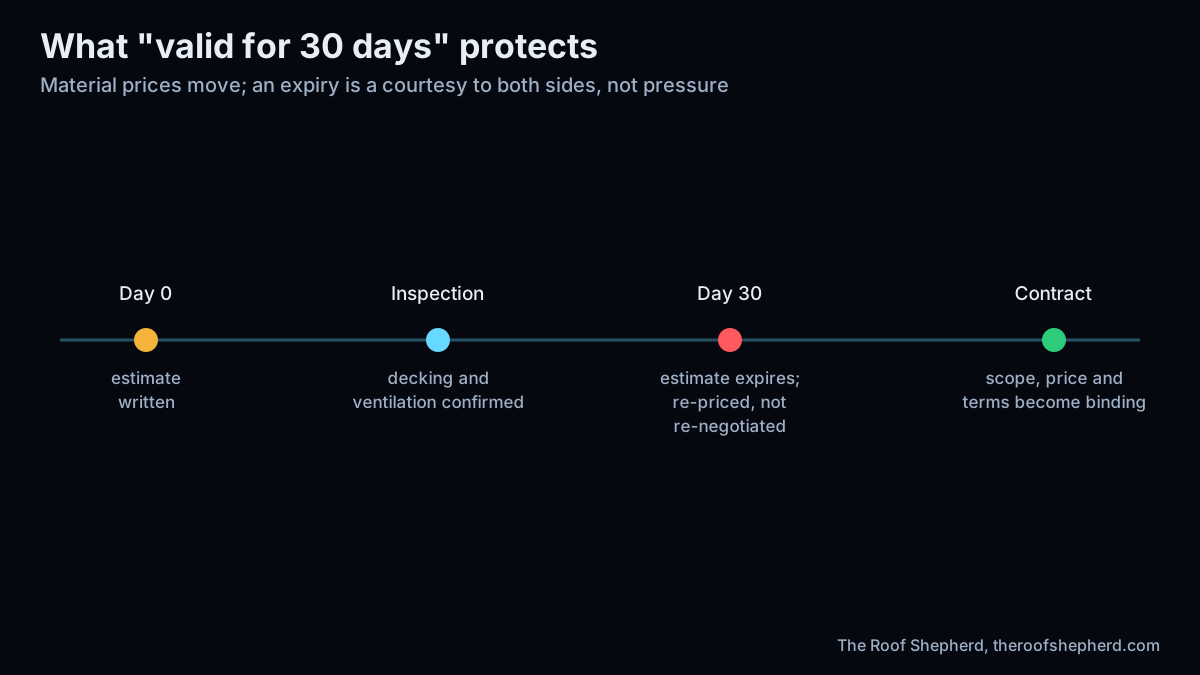
An estimate is not a contract and not a quote. It is the contractor's written opinion of what the roof needs and what that will cost, good for a stated period, based on what could be measured and seen before the old roof came off. A proposal or contract is the same document with signatures, terms and a scope that binds both sides. Knowing which one you are holding matters, because an estimate can change when the decking comes into view and a contract can only change by a written change order.
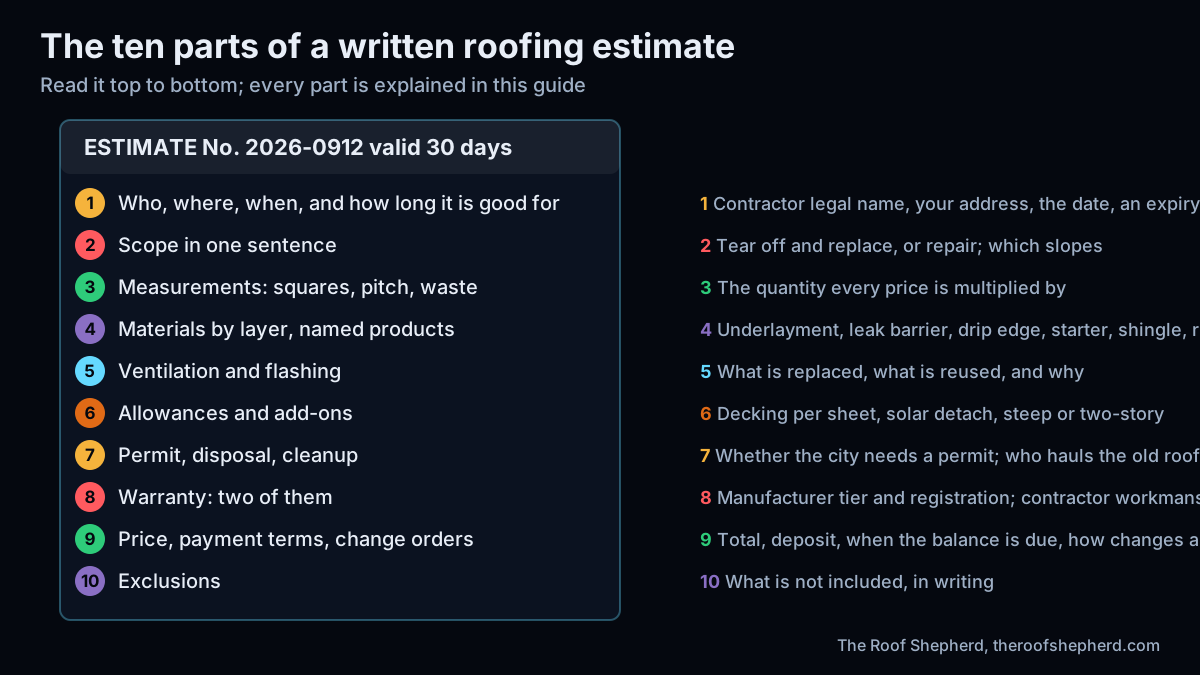
Every complete estimate has the same ten parts, whoever wrote it: who and where and when, the scope in a sentence, the measurements, the materials by layer, ventilation and flashing, allowances and add-ons, permit and disposal, the two warranties, the price and payment terms, and the exclusions. The rest of this page takes them in that order. A document missing three of the ten is not a bad estimate; it is an unfinished one, and the missing parts are where the surprises live.
The contractor name on the estimate must be the legal entity that will sign the contract and register the warranty. A different name on the truck, the estimate and the contract is a question to ask before anything else.
The Multiplier
Squares, pitch and waste: the number everything is multiplied by
A square is 100 square feet, the roof is bigger than the house, and with no measurement report we plan 15 percent waste.
A square is 100 square feet of roof, and the roof is bigger than the house
Roofing is priced per square, and a square is 100 square feet of roof surface, not of floor. A 2,000 square foot house does not have a 20 square roof: the pitch adds area (a 6:12 roof is about 12 percent larger than its footprint, a 9:12 roof about 25 percent), the overhangs add more, and the cuts at hips, valleys, rakes and around penetrations add waste that is ordered but never lies flat on the roof.
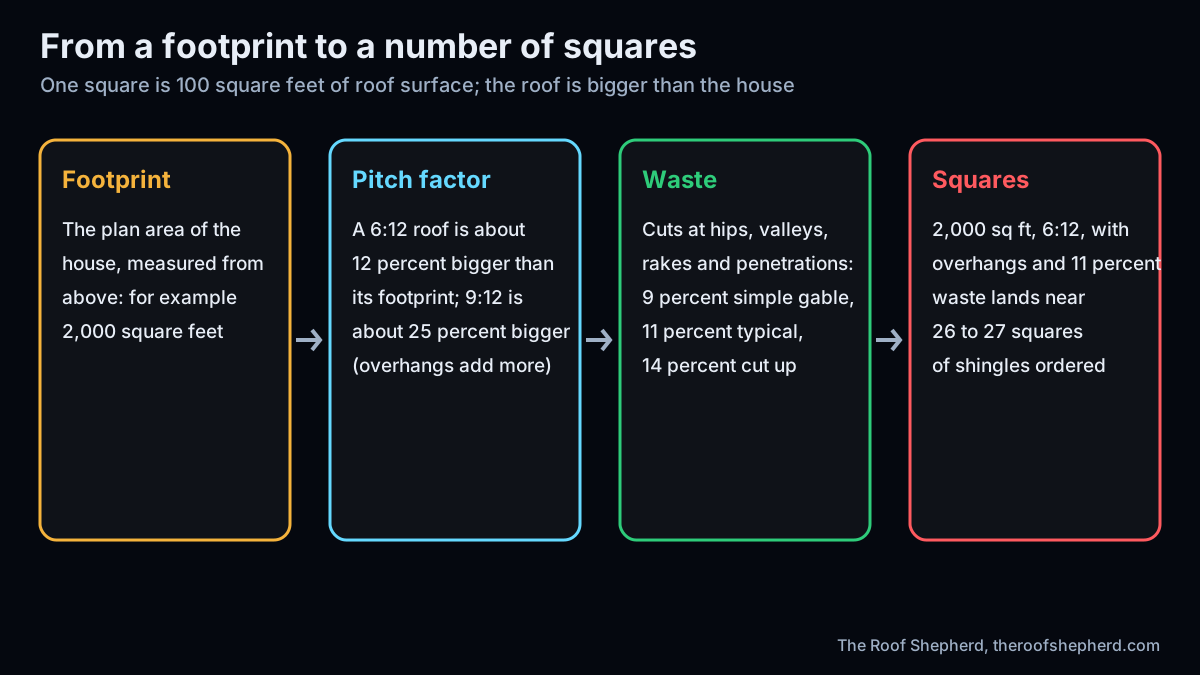
Waste is the honest variable. When a measurement report suggests a waste figure for the roof, we order to it; with no report we plan on 15 percent, and a cut-up roof with many valleys and facets can run above 20 percent. An estimate should state the squares it priced and the waste it assumed. If it states only a total, you cannot tell whether the price is high because the roof is complex or because the number was rounded up.
The measurement itself comes from a satellite report, a drone, or a tape on the roof, and each is fine when it is stated. What is not fine is an estimate that never says how many squares it is for, because that estimate cannot be compared with any other.
Order in bundles: architectural shingles run about three bundles to the square, so 27.3 squares is 82 bundles, and a starter and ridge take-off is separate from the field.
Layer by Layer
Materials by layer, in the order they go on
A good estimate names the product at each layer, even the starter strip, since a category can mean anything.
Named products, not categories
Read the materials the way the roof is built. Tear-off and haul-off first, then the deck inspected and any rotten sheets replaced under an allowance, then drip edge at the eaves, then underlayment across the field (synthetic on most Texas roofs now), leak barrier in the valleys and around penetrations, drip edge at the rakes over the underlayment, starter shingles at every eave and rake, the field shingles, then hip and ridge cap over the ridge vent, then flashings and pipe boots, and the ventilation at the end.
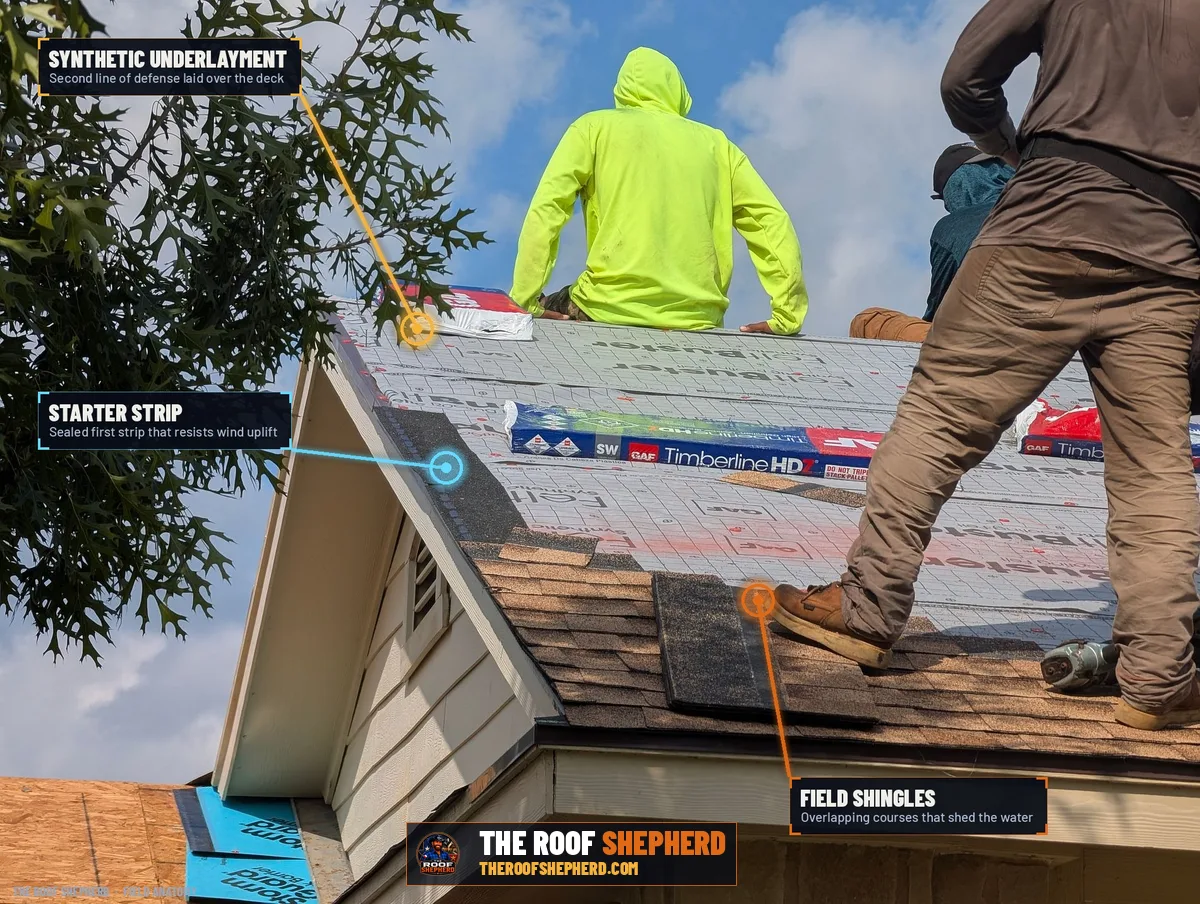
A good estimate names the product at every layer: the shingle line and color, the underlayment brand, the leak barrier, the ridge cap, the vent. "Architectural shingles" and "underlayment" are categories, not products, and a category can be filled by anything. Naming the product also tells you whether the manufacturer's enhanced warranty is even possible, because those tiers require the maker's own starter, ridge, underlayment and ventilation as a matched system.
The layer people skip is the starter strip. It is the sealed course that holds the first row down against wind and it is invisible when the roof is done, which is exactly why an unnamed estimate can leave it out.
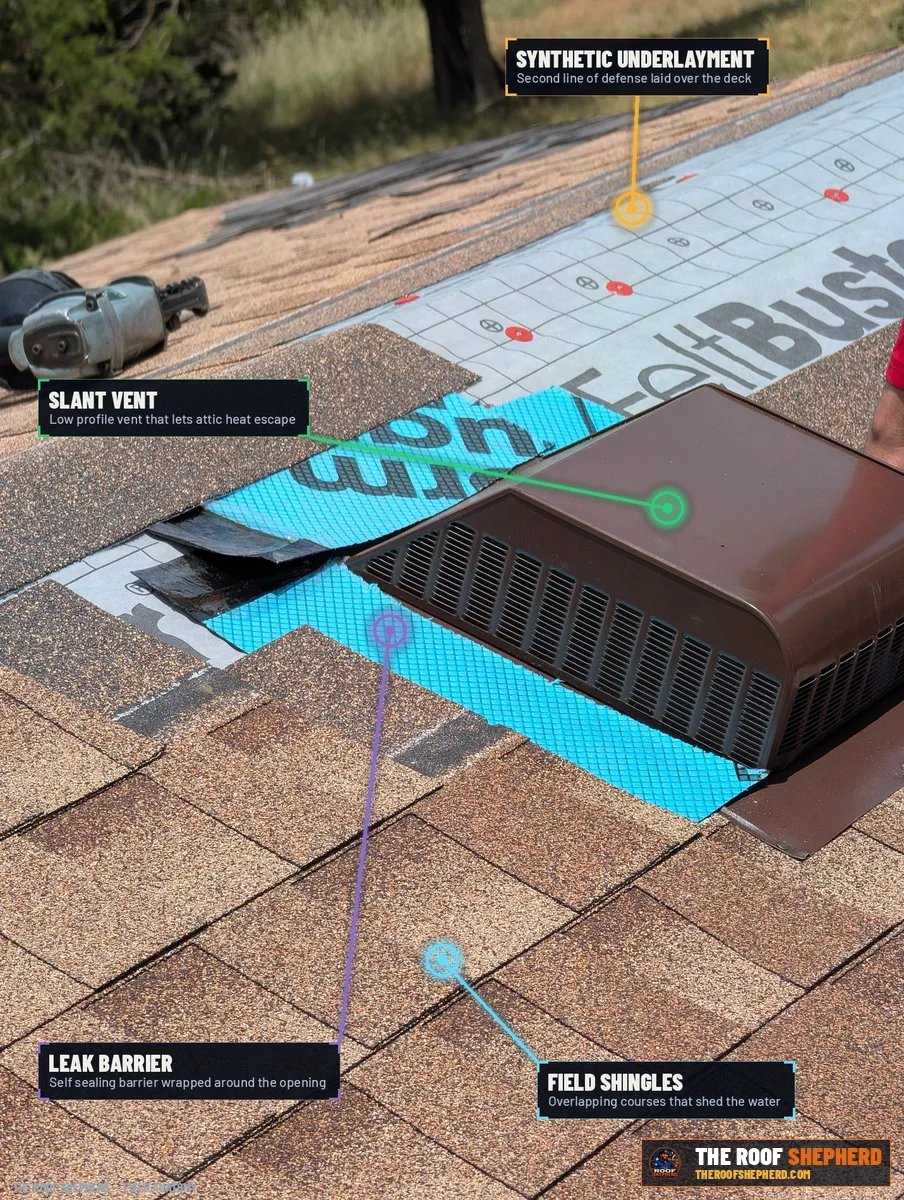
Underlayment goes over the drip edge at the eaves and under it at the rakes. Leak barrier in valleys and around every penetration is a manufacturer detail on most enhanced warranties; it is not code at the eaves in Austin or Georgetown.
Planning Ranges
What a square costs installed, by tier
Planning ranges run $545 to $670 a square for architectural shingle and $1,500 to $2,200 for standing seam.
Planning ranges, approved in September 2026, valid until December 2026
Here are the numbers, and what they are for. These are the ranges our assistant quotes, and they are planning ranges, not quotes: architectural asphalt shingle $545 to $670 a square installed, Class 3 impact-resistant $545 to $670, Class 4 impact-resistant $600 to $735, and standing seam metal $1,500 to $2,200. Each figure is per measured square, the roof surface before waste, because waste is already inside it. A planning range times your measured squares gives a low and high figure to think with before anyone has been on the roof; the estimate you sign replaces it.
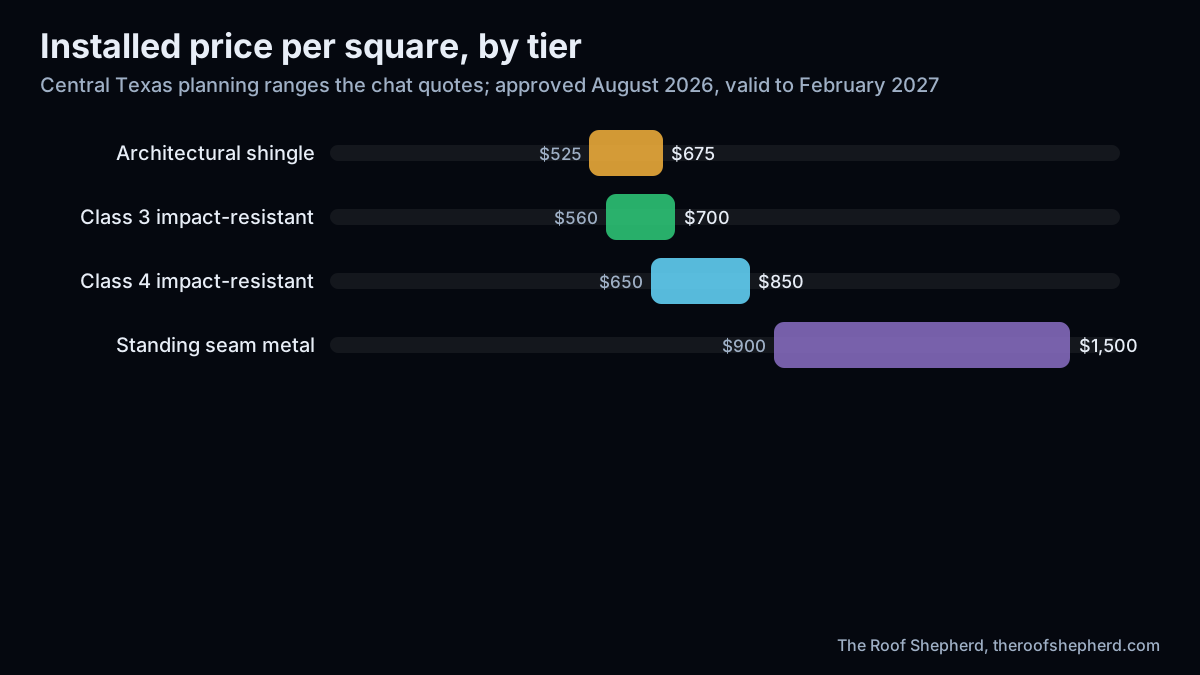
Two things move a roof cost inside its range. A cut-up roof with many valleys and facets takes more shingle waste, about $25 more a square in our planning ranges. A steep pitch and a second story add labor and safety work. In our planning ranges a pitch from 7/12 to 12/12 adds about $20 to $45 a square, and a second story about $20 a square. Anything steeper is priced on the walkthrough. Any estimate should show these as their own lines, not as a mystery inside the per-square figure. If they cannot be seen, they should not be charged.
The ranges expire. Material prices move and the register that feeds our assistant carries an approval date and an expiry; after December 31, 2026 it refuses to quote until the numbers are re-approved. An estimate from any roofer should carry the same discipline: a date, and a period it is good for. You can ask the assistant for a planning range for your own squares and tier any time.
Quote from the register, never from memory, and never derive a per-square-foot figure from a per-square one on the fly; the arithmetic error rate is why the assistant is forbidden to do it.
Own Lines
Allowances and add-ons: the lines that move the total
Decking, steep pitch, a second story and solar detach and reset each get a line, and haul-off is in the tear-off.
Decking is the one you cannot price until the old roof is off
Decking is priced per 4 by 8 sheet, and nobody knows how many sheets a roof needs until the shingles are off. A clear estimate either includes an allowance with the per-sheet price for more, or states the per-sheet price and that the count is unknown. Ours includes the first 2 sheets and prices each sheet after that at $80 installed. An estimate that is silent about decking will produce a change order on the first day, and that is where a low bid catches up with a fair one.
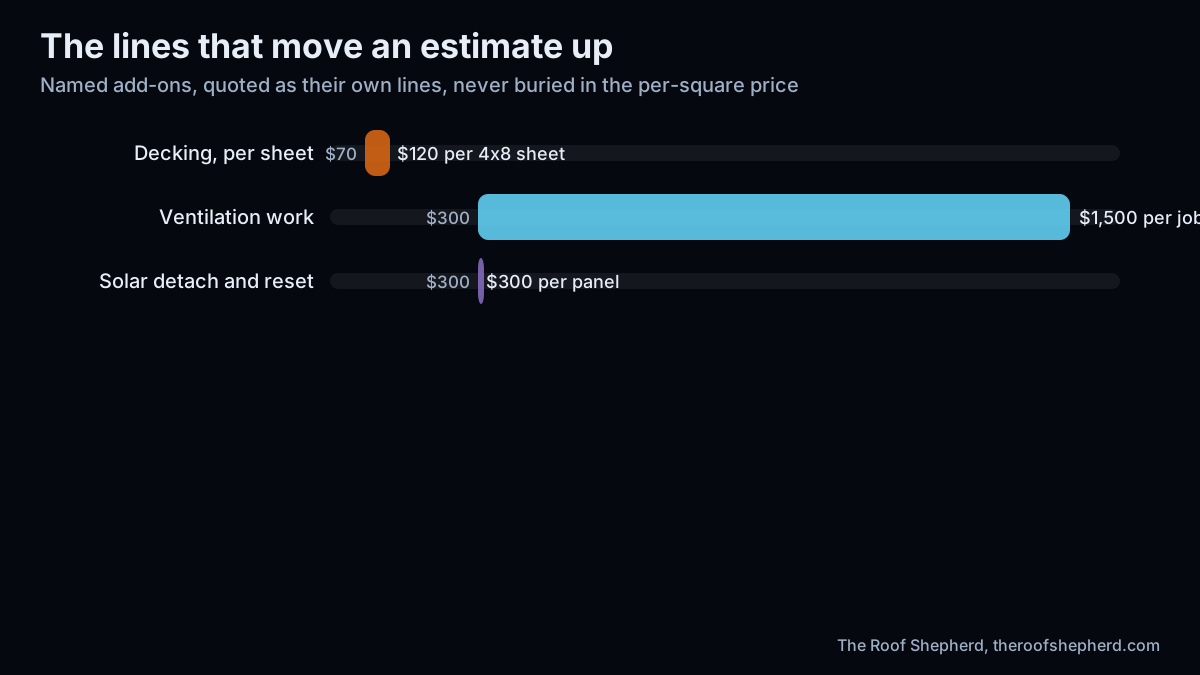
Ventilation work is priced from the vent design the roof needs, and the estimate should say what is added or converted: new metal vents, turbines removed and decked over, intake added at the soffits. Solar detach and reset is priced per panel, $255 to $545 each in our planning ranges, and is a licensed electrical scope coordinated with the panel installer, not a roofing line. Skylights, chimney crickets and a new pipe boot for every penetration are each a line, not a footnote.
What should not be an add-on: cleanup, magnetic nail sweep, haul-off and the dumpster. Those are part of tearing off a roof and belong inside the tear-off line, not added at the end.
Replace decking beyond the allowance at the stated per-sheet price with a photo of every sheet replaced, before it is covered. The photo is the invoice support.
Two Documents
How an insurance scope differs from a contractor estimate
A contractor estimate and a carrier scope are not the same, and code items the scope missed go in a supplement.
RCV, ACV, depreciation and O&P, in the policy's own terms
When a storm is involved there are two documents about the same roof. The contractor estimate prices the roof to the code and the manufacturer's specification in squares and named products. The insurance scope is written in the carrier's estimating software as line items, and it carries three numbers that confuse everyone: replacement cost value (RCV) is what the carrier estimates a new roof costs; depreciation is the share held back for the age and condition of the old roof; actual cash value (ACV) is RCV minus depreciation, and it is what the first check is usually for. On a replacement cost policy the held-back depreciation is paid when the work is done and invoiced.
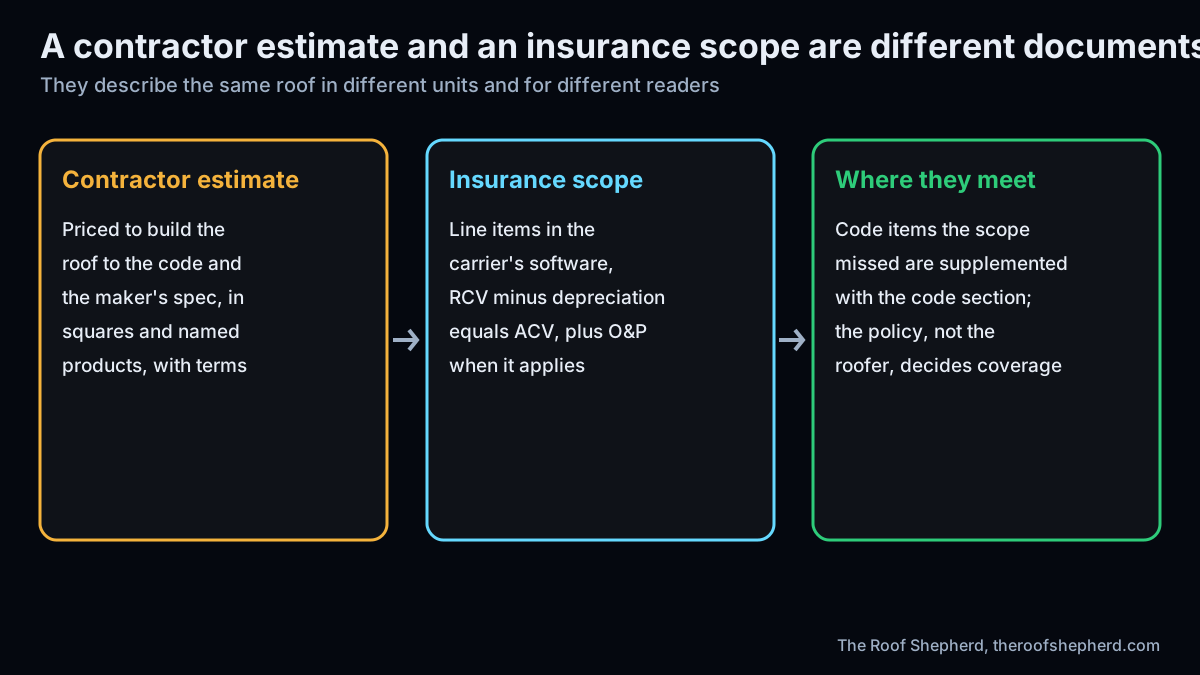
Overhead and profit (O&P) is a percentage some scopes add when a job needs a general contractor coordinating several trades; whether it applies is the policy and the carrier's call, not the roofer's. Items the code requires that the scope missed (drip edge, ice barrier where a city requires it, a second layer tear-off) are submitted as a supplement with the code section cited. That is the honest use of a supplement. Inflating quantities is not, and it is the thing that gets a claim denied and a contractor investigated.
What no contractor can do is promise what the policy will pay, or make the claim "come out even" by adjusting the estimate to the scope. And in Texas it is illegal for a contractor to waive, absorb or rebate your deductible; an estimate that offers to is telling you who you are dealing with.
A supplement cites the adopted edition's section number (R905.2.8.5 for drip edge; for the two-layer rule, R908.4 in 2024 IRC cities and R908.3.1.1 in 2015 to 2021 IRC cities) and attaches the photo. Nothing else moves a desk adjuster.
Read Twice
Permit, warranties, payment terms and exclusions
Read the permit line, both warranties by tier and years, the payment terms and written exclusions before you sign.
The four lines people skip, and what each one decides
Start with the permit line. Permit: whether the city requires one depends on the city, and around Round Rock and Austin it ranges from Georgetown ($60, ten to fifteen business days, contractor registration first) to Round Rock, where the city says none is required for a residential re-roof. The estimate should say which applies and who pulls it; our permit and code page has the city by city answer.
Warranties: there are two and the estimate should name both. The manufacturer's warranty comes in tiers, the higher tiers require a credentialed installer and the maker's own components, and it is registered after the job; the estimate should name the tier and say who registers it. The contractor's workmanship warranty is a separate promise, in years, from the company that installed the roof, and it is only as good as that company's willingness to answer the phone. "Lifetime warranty" with no document behind it is not a line item; it is a slogan.
Payment terms and exclusions: what is due and when, with nothing due before your cancellation period ends and the last payment after the finished roof, and a written rule for how changes are priced (decking per sheet is the usual one). Exclusions are the part most people never read and should read first: rotten framing, hidden layers, skylight replacement, gutter work, interior repairs and anything discovered after tear-off are commonly excluded, and an estimate that excludes them in writing is more honest than one that never mentions them.
On a roof the homeowner pays for directly: nothing at signing, then the homeowner's choice of the full price the morning installation begins or half that morning and the balance at the completion walkthrough; on the half-and-half plan, no final payment before the photo report and, where the manufacturer provides one, the warranty registration confirmation are in the homeowner's hands.
Side by Side
How to compare two estimates, and what ends the conversation
Compare estimates on the same squares, tier and named products, and treat a deductible offer as a stop sign.
Same squares, same tier, same named products; only then compare totals
Two estimates can only be compared when they describe the same roof. Line them up: the squares and waste each priced, the shingle and underlayment each named, what each does about decking and at what price per sheet, the ventilation plan, the flashings replaced, the permit, and the two warranties with the tier and the years. If one of them is a lump sum with none of that, it is not the cheaper estimate; it is the one you cannot read.
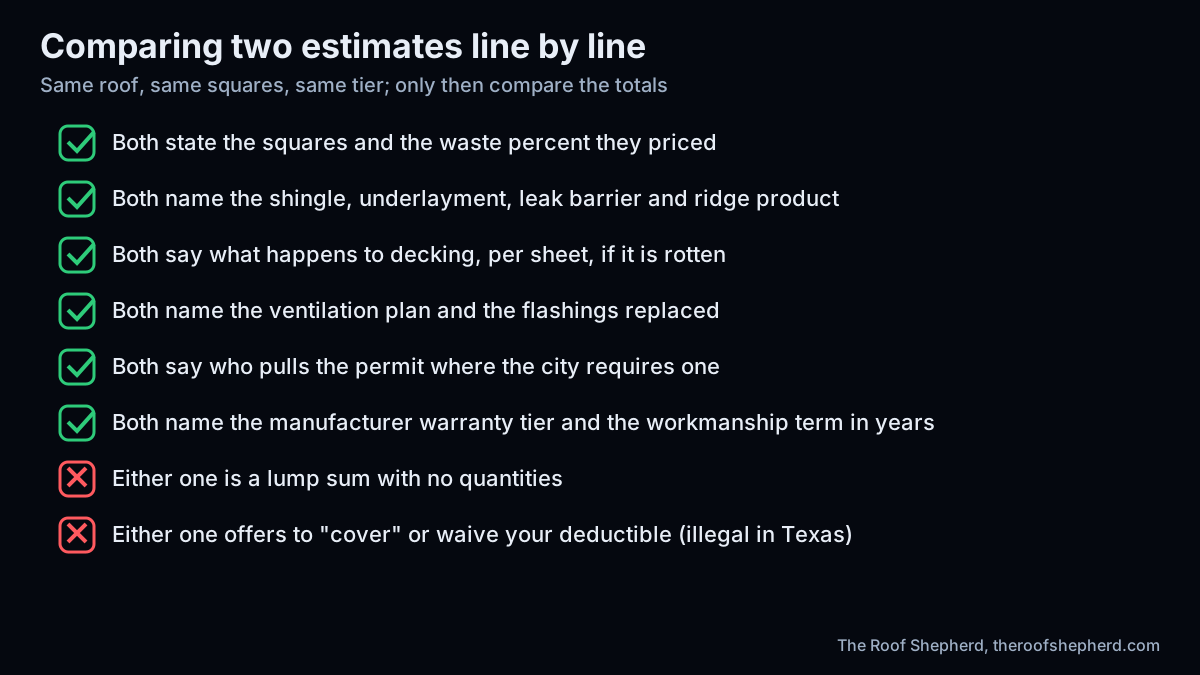
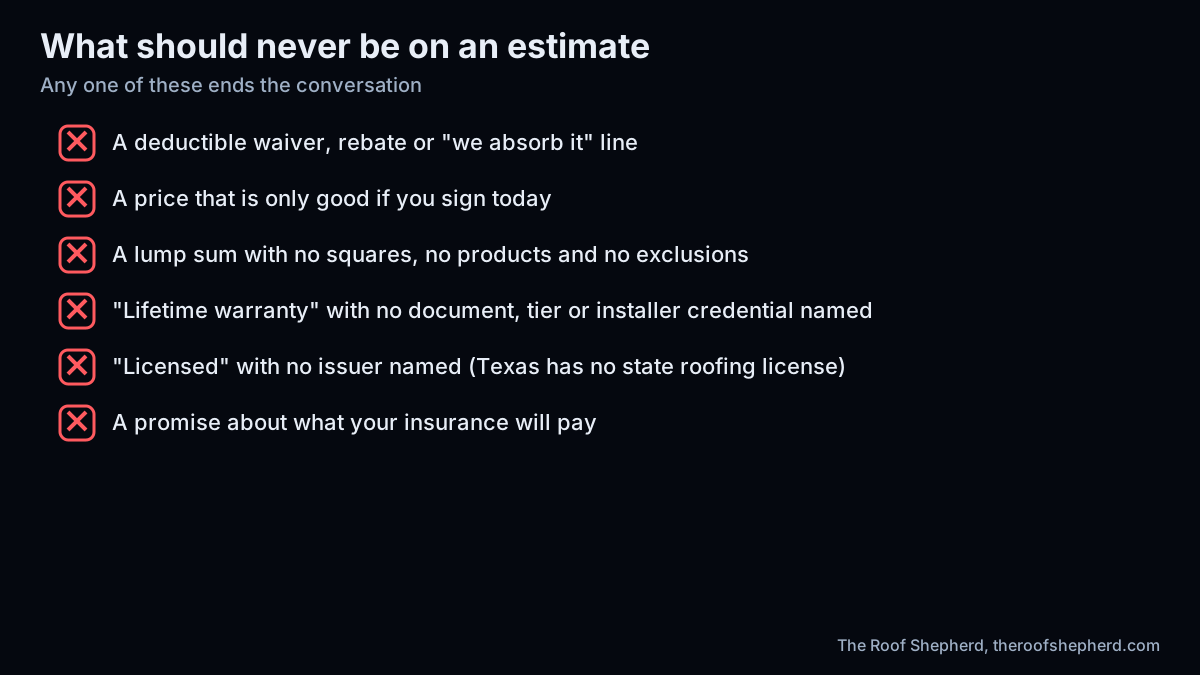
Then the red flags, any one of which ends the conversation: an offer to cover, waive or rebate your deductible (illegal in Texas since 2019); a price that is only good if you sign today; a "lifetime warranty" with no document, tier or installer credential named; "licensed" with no issuer, because Texas issues no state roofing license; and any promise about what your insurance will pay. None of those is a negotiation point. Each is a reason to stop.
The estimate worth signing is the one you understood before you signed it. That is the whole purpose of this page, and if a line on yours is not explained here, ask the assistant or ask us; the answer is free either way.
If you want to see an estimate written this way before you ask anyone else for one, our roof replacement service page shows what ours includes, line by line.
Put both estimates on the same squares before comparing: ask each roofer for the squares and waste they priced, and if they differ by more than a square, one of them measured wrong.
When You Are Ready
When you are ready
Roof Replacement
Here is how we help. Our replacement estimate is written the way this page reads it: squares and waste shown, decking by the sheet, permit named, and the two warranties stated separately.
Or call or text 512-575-5052.
Estimate Anatomy Questions
Common questions about estimate anatomy
How much does a new roof cost per square in Texas?
Our planning ranges, approved September 2026 and valid until December 2026: architectural asphalt shingle $545 to $670 a square installed, Class 3 impact-resistant $545 to $670, Class 4 $600 to $735, standing seam metal $1,500 to $2,200. A square is 100 square feet of roof surface. These are ranges to plan with, not quotes; the estimate you sign replaces them.
What is a roofing square?
100 square feet of roof surface. A 2,000 square foot house has more than 20 squares of roof because pitch and overhangs add area: at 6:12 it is about 23 squares of roof surface. Cuts add waste, so about 27 squares of shingles are ordered. Our per-square planning ranges are per measured square, so they multiply the 23, not the 27.
Why is my roofing estimate different from my insurance scope?
They are different documents. The estimate prices the roof to the code and the manufacturer's specification in squares and named products. The scope is written in the carrier's software as line items with replacement cost value, depreciation and actual cash value. Code items the scope missed are submitted as a supplement citing the code section; what the policy pays is the carrier's decision, not the roofer's.
What should a roofing estimate include?
Ten parts: the contractor's legal name, your address, the date and an expiry; the scope; squares, pitch and waste; materials named by layer; ventilation and flashing; allowances and add-ons such as decking per sheet; permit and disposal; both warranties with the tier and the years; price and payment terms; and exclusions in writing.
Is a roofing estimate a contract?
No. An estimate is a written opinion of what the roof needs and what it will cost, good for a stated period. A contract or signed proposal binds both sides to a scope, a price and terms, and can only change by a written change order.
Can a roofer pay my deductible?
No. In Texas it has been illegal since 2019 for a contractor to waive, absorb or rebate a homeowner's insurance deductible. An estimate that offers to is a reason to stop.
Keep Learning
Where to go from here
Each guide below picks up a thread from this page: what the layers cost, what storms do to them, and how to hire the person who touches them.