
Learning Center · Storm and Insurance
Wind Damage to a Roof: What It Looks Like and How It Is Documented
Wind does not hit a roof evenly. It pulls hardest at corners, edges and ridges, and it leaves a pattern an inspector can read. This guide explains what lifts a shingle, what a documented wind inspection records, and what an adjuster is trained to look for, in plain words.
Updated October 12, 2026
Read This First
The short version
- Wind damage shows as creased, flipped, torn or missing shingles, concentrated on the slopes and edges that faced the wind.
- Haag Engineering researchers list four wind failure modes on shingles: creasing, flipping, tearing or removal, and abrasion from flying debris.
- A broken sealant bond with no crease is a real condition, but it is not proof of wind by itself, because sealant also fails from age, dirt and installation.
- The National Weather Service calls a thunderstorm severe at 58 mph, and the shingle class on your roof is rated by code for a design wind speed.
- We advise and educate you on your options and rights, document the roof, and submit documented supplements. We are not a public adjuster and never negotiate or settle a claim for you. We never waive, absorb or discount a deductible.
After a wind event, start with Get Help or call or text 512-575-5052.
Short version: 3 min. Full page: 11 min. Want the detail? Each section below opens with a tap, or switch to Full at the top to open them all.
Direct Answer
What does wind damage to a roof look like?
Creased, torn, flipped or missing shingles on the windward slopes and edges, recorded slope by slope.
The short answer
Wind damage to a roof shows as shingles that are creased, torn, flipped back or missing, usually on the slopes and edges that faced the wind. Broken sealant with no crease is harder to call. A documented inspection records each slope, the pattern, and photos, so the record speaks before any claim decision.
Why the pattern matters
Wind has a direction, so wind damage has one too. The Haag Engineering paper on wind effects on asphalt shingles found uplift pressures highest along windward corners, rakes, eaves and ridges, and that damage starts in those places first. A roof with the same loose shingles on every slope is telling a different story than a roof with torn tabs on one side and nothing on the other.
Mechanism
What lifts shingles in the wind
When the sealant strip lets go, the tab lifts, creases at the top and can tear away.
The sealant strip
Every shingle has a strip of factory adhesive, called the sealant strip, that bonds it to the shingle below once the sun warms it. The Haag paper describes wind damage as a pressure difference between the top and bottom of the shingle that breaks that bond. As the tab rises, more of it catches the wind, and the lift grows.
Creased tabs
A crease is the fingerprint of wind. In the paper’s hurricane field survey, tabs whose sealant bond broke would fold back and crease along the top of the tab, and repeated flipping eventually tore some tabs off. A crease line across the shingle, often with cracked granules along it, is what we look for first.
Missing tabs and torn shingles
Removal is the obvious case. The same survey found three-tab shingles failed most often where the tab was not bonded, breaking at the top of the tab, and that tabs bridging a butted joint below went first. Laminated shingles, the thicker architectural type, outperformed three-tab shingles in wind resistance in that survey.
Why old sealant fails
Age works against the bond. The paper explains that as asphalt ages it dries, shrinks and cracks, and sealant strips under the shingles deteriorate, so an aged tab can sometimes be lifted by hand. Underdriven nails, nails placed too high, dirt on the strip and starter shingles installed wrong all leave shingles unbonded before any storm arrives.
Inspection
How to inspect a roof for wind damage
Slope by slope, with the wind direction, test areas, and photos that show where each shingle sits.
Slope by slope, with a direction
A wind inspection is a map, not a list. The Haag paper says shingles can be assessed for wind damage slope by slope, and that a plot of the damage on a roof plan shows patterns that a pile of photos cannot. We record each slope by its compass direction, note the wind direction from the storm record, and mark where creased, torn and missing shingles sit on that slope.
Test areas
Counts beat adjectives. On each slope we mark a test area, lift the shingles gently along the bottom edge, and record how many are creased, how many are unbonded with no crease, and how many are sound. That number, slope by slope, is what separates a windward slope from a leeward one.
Photo standards for wind documentation
Each photo needs context. Our photos go wide first, the whole slope with the direction labeled, then close, with a hand or a gauge showing the crease or the lifted tab, and the date and address on the record. The same standard applies to hail, which our storm damage guide covers surface by surface.
What is not wind damage
Some things look like wind and are not. The Haag paper lists cupping and clawing, where shingles curl slowly as they shrink, splitting from thermal movement, and overlaps that never bonded in a repeating pattern on every slope. It also describes deliberate damage: broken corners away from the edges, tool marks on the sealant, damage on a slope that does not match the wind. An honest record names these too.
Claims
What an adjuster looks for on a wind claim
Creases, tears and missing shingles with a direction, and whether lifted shingles can be resealed or must be replaced.
Visible damage with a direction
Adjusters are trained on the same material. The Haag paper summarizes that wind damage is usually obvious as a combination of uplifted and creased, flipped and removed shingles, concentrated on windward sides and along eaves, ridges and the tops of valleys. A careful adjuster walks each slope, lifts shingles, and asks where the wind came from.
Sealant only, versus creased
This is where claims are argued. A shingle whose seal broke but did not crease is unbonded, and GAF’s wind bulletin TAB-R-143 says shingles whose bond was broken by wind are unlikely to reseal on their own and recommends hand sealing when no other damage is present. Whether a carrier treats an unbonded shingle as storm damage or as a condition of the roof is a policy question for the homeowner and the carrier. Our job is to record which shingles are creased and which are only unbonded, so the decision rests on counts.
Our role
Here is our role. We advise and educate you on your options and rights, document the roof, and submit documented supplements. We are not a public adjuster and never negotiate or settle a claim for you. We never waive, absorb or discount a deductible. Texas Insurance Code 4102.163 bars a contractor from acting as a public adjuster on property it may work on. A documented record is how we help within that line. Our claim documentation inspection is built for exactly this.
Repairability
Wind damage roof repair in Round Rock and Georgetown: when a repair holds
A repair holds when nearby shingles are still flexible enough to lift, reseal and renail without cracking.
The brittle test
Repair depends on the shingles around the damage. To replace one shingle, the nails in the course above must come out, which means lifting those shingles. On an aged roof the asphalt has dried, and a tab that cracks when it is lifted cannot be put back. We lift a few shingles beside the damage on each slope and record whether they flex or crack. That is the brittle test, and it decides whether a repair is honest or a patch that creates new leaks.
Hand sealing lifted shingles
Unbonded shingles can be resealed. The Haag paper describes resealing by the Asphalt Roofing Manufacturers Association method, quarter sized dollops of roofing cement under the tab corners, and its pull tests found the repaired bond exceeded the original sealant strength. GAF TAB-R-143 likewise recommends hand sealing where wind broke the bond and nothing else is damaged. It is a real repair when the shingle is otherwise sound.
Replacing damaged shingles
Creased and torn shingles are replaced, not glued. GAF TAB-R-126 notes that when individual shingles are replaced, the surrounding shingles that had nails removed must be resealed by hand, and that shingles with tarp nails through them must be replaced, since caulking the holes is not a permanent repair. It also notes that damage to surrounding shingles can be latent, which is why we record the brittle test and the count on every slope, not only the damaged one.
What the code says about the shingle itself
Shingles are rated for wind. IRC R301.2.1 has every house built to the ultimate design wind speed the code’s wind map assigns to its site, and R905.2.4.1 requires asphalt shingles to be tested to ASTM D7158 and labeled with a class that matches the ultimate design wind speed for the site, and R905.2.6 requires at least four fasteners per strip shingle, or more if the manufacturer says so. A replacement shingle has to meet the same class as the roof, and the nailing has to match the instructions on the wrapper. Our flashing guide covers the edges and transitions wind reaches first.
Weather and Policy
How much wind damages a roof, and what your policy says about wind
Severe storm winds start at 58 mph by NWS definition; the Texas FAIR Plan form applies its own wind and hail deductible.
The weather numbers
Two numbers help put a storm in context. The National Weather Service defines a severe thunderstorm as one producing winds of 58 mph or greater, and the Storm Prediction Center calls 75 mph or greater significant severe. On the Beaufort scale the NWS publishes, slight structural damage such as chimney pots and slates removed begins at force 9, 47 to 54 mph. A storm record for your area dates the event; the roof itself shows what the wind did at your address.
What a Texas policy does with wind
Wind is usually a covered peril with its own deductible. The Texas FAIR Plan homeowners policy, a form approved by the Texas Department of Insurance, applies its Deductible Clause 1 to each loss that results from windstorm or hail, separate from the all other perils deductible. Your own policy’s declarations page names yours. Our hail damage and insurance guide walks through how a Texas roof claim is valued and paid.
When You Are Ready
When you are ready
Roof Inspections
Here is how we help. After a wind event we document lifted and creased shingles slope by slope, with the wind direction and date, in a record you keep before any repair or claim decision.
Or call or text 512-575-5052.
Field Photos
On the job
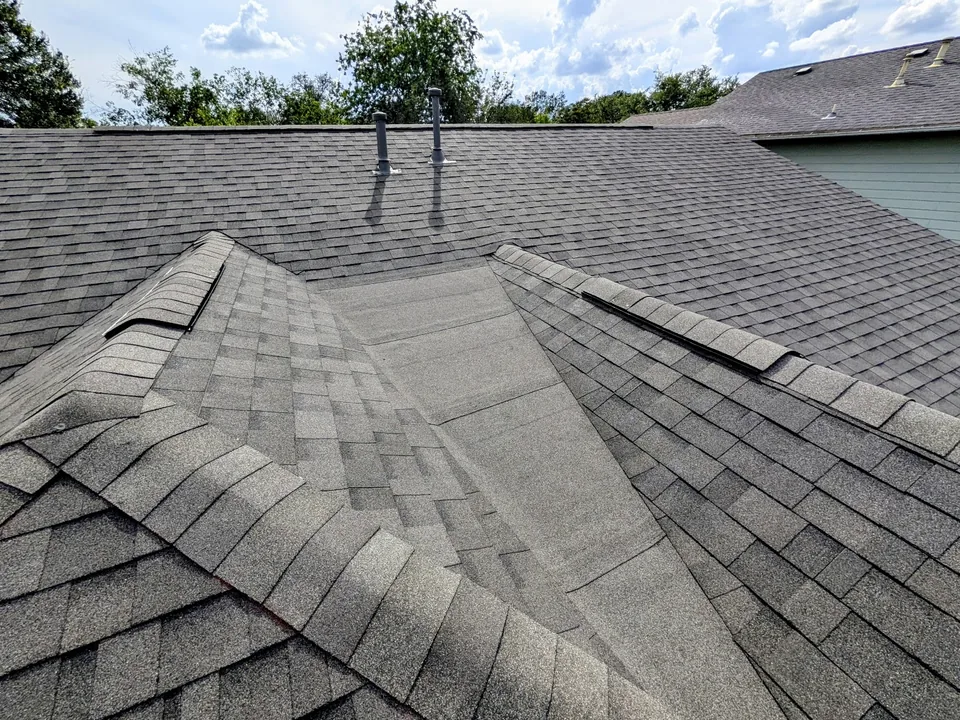
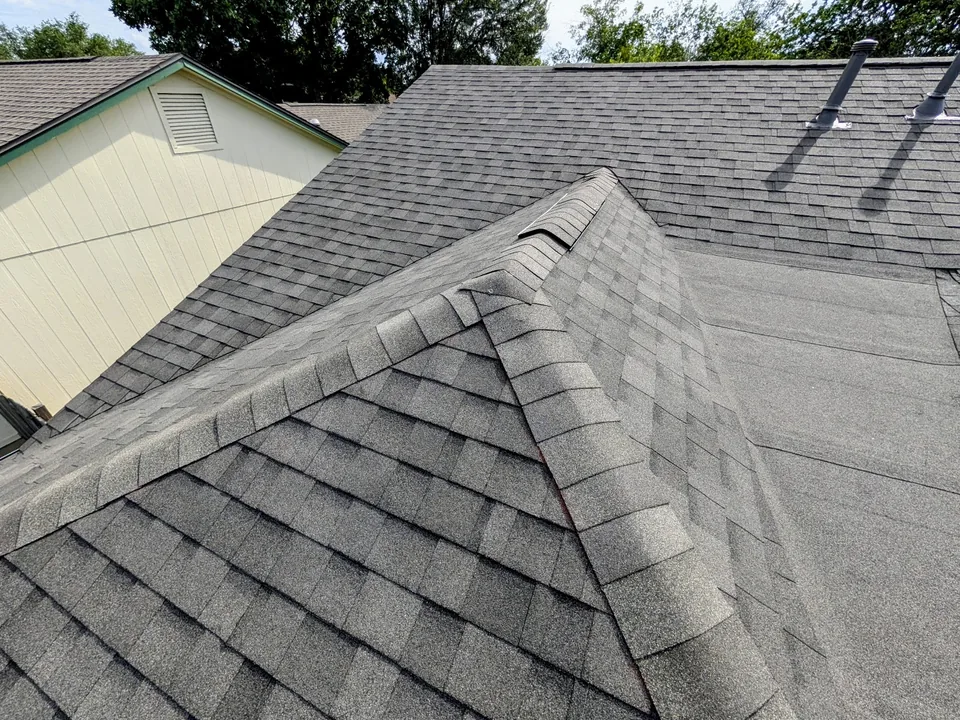
Photos from roofs we have worked on. Select one to enlarge it.
Common Questions
Questions homeowners ask
How can I tell if my roof has wind damage from the ground?
Look at the slopes that faced the storm for tabs standing up, flipped back, or missing, and for shingle pieces in the yard or gutters. Ridge caps and the shingle rows along eaves and rakes go first, because that is where uplift is highest. A sealant break with no crease is not visible from the ground, which is why a documented inspection records each slope up close.
Is a lifted shingle wind damage?
Not by itself. Shingles lift when the sealant bond fails, and that bond also fails from age, dirt on the strip, underdriven nails and bad starter courses. Wind damage is a creased, torn, flipped or missing shingle with a direction. An inspection records which shingles are creased and which are only unbonded, because the two are treated differently.
Can wind damaged shingles be repaired instead of replacing the roof?
Often, yes, when the surrounding shingles pass the brittle test and the damage is limited to a slope or a few courses. Unbonded shingles can be hand sealed, and creased or torn ones replaced with a shingle of the same wind class. On an aged, brittle roof a repair can do more harm than good, and we say so when that is what we find.
What wind speed damages a roof?
There is no single number. The NWS calls a thunderstorm severe at 58 mph, and the Beaufort scale puts slight structural damage at 47 to 54 mph. A roof with aged or unbonded shingles can lose tabs in lighter wind, and a well bonded roof can ride out more. The roof shows what happened at your address; the weather record only dates the event.
Will my insurance pay for wind damage to my roof?
That depends on your policy, its windstorm deductible, how it values the roof, and what the carrier finds. We do not decide coverage and we do not promise an outcome. We advise and educate you on your options and rights, document the roof, and submit documented supplements. We are not a public adjuster and never negotiate or settle a claim for you. We never waive, absorb or discount a deductible.
Keep Learning