
Gutters
Gutters and Drainage: Installation, Repair and Cleaning
Seamless gutters installed, repaired and cleaned, anywhere in Texas. Five or six inch aluminum, fabricated on site to your run and pitched to drain, with guards and underground downspouts where they help.
I need...
Updated October 11, 2026
Read This First
The short version
- Seamless aluminum gutters installed, repaired at the real cause, and cleaned with photos.
- Six inch gutters carry more water than five inch and cost more per foot.
- Standard slope is 1/4 inch of drop per 10 feet toward the downspout, and gutters that settle flat hold standing water.
- On expansive clay soil, a clogged or misdirected downspout can move a foundation. Drainage is a foundation issue.
- Replacing gutters after a new roof is standard, because the roofing crew can damage new gutters when it sets drip edge.
To have your gutters documented, call or text 512-575-5052 or use Get Help.
Short version: 4 min. Full page: 11 min. Want the detail? Each section below opens with a tap, or switch to Full at the top to open them all.
What Gutter Review Covers
What we install and why it matters
Gutters are the drainage system for the roof above them, so we treat them as one job. Seamless aluminum in five or six inch, fabricated on site to the length of your run, and pitched so water reaches the downspout instead of standing in the trough.
We install seamless aluminum gutters in five or six inch, pitched to drain, and document dents, fascia and downspouts.
Hail Impact Documentation
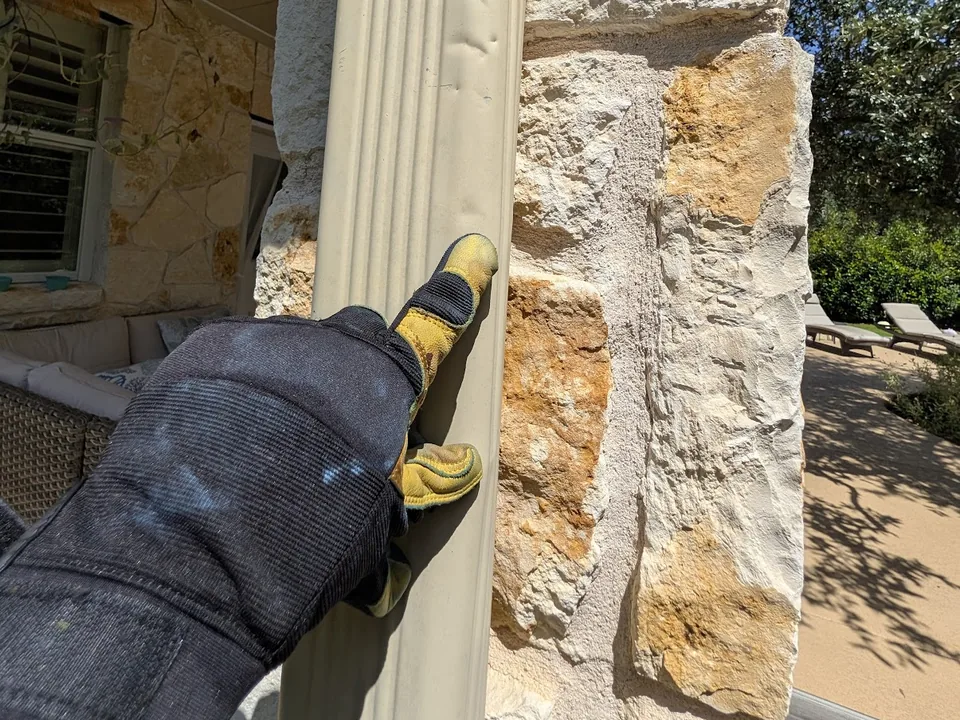
Aluminum gutters dent at lower thresholds than asphalt shingles. Round dimple dents across the gutter face confirm hail contact. The size of the dents corresponds to approximate hail diameter, this documentation serves as evidence of a hail event even when shingle damage is ambiguous from the ground.
Attachment and Fascia Condition
Older gutter systems pull away from the fascia over time. A run that looks intact from the ground can be loose along much of its length, and fascia rot behind the gutter is common in Texas once water has been sitting there. We photograph the attachment points and the board behind them.
Where the water actually goes
Downspout discharge point, slope, and clearance from the foundation are all part of the condition record. In the Round Rock area where expansive clay soils respond directly to moisture, a clogged or misdirected downspout can cause foundation movement independent of any storm event. This gets documented as part of the full property condition review.
Seamless, cut on site
A seamless run has no joints along its length, which removes the seams that leak first. We roll-form on site to your exact run rather than joining ten-foot stock sections.
Five inch or six inch
Six inch carries more water than five inch and costs more per foot. In Texas flash rainfall that capacity is usually the difference between draining and overflowing.
Pitched to actually drain
A gutter only works if the run is pitched toward the downspout. Set it flat and water stands in the trough, which is what rots fascia and grows the black streaks down the face. We set fall across the run and check it before we leave.
Guards and underground drainage
Micro-mesh guards where trees make cleaning a recurring cost, and underground downspout drainage where water needs to leave the foundation rather than pool beside it. Both are separate line items, never buried in a gutter price.
If a New Roof Is Planned
Gutters before or after roofing?
Replace gutters after the roof, because new shingles change the drip edge overhang and roofers can damage new gutters.
Sequencing with the roof
Gutter cleaning clears debris and keeps water moving through the system. Gutter repair covers leaks, sagging, and pulled-away sections, documented before any work is scoped. Gutter replacement after a roof replacement is standard. But the sequence matters. New shingles overhang the drip edge differently than old ones. Fascia that was acceptable under the old roofline may not hold a new gutter at the right pitch. And if gutters are replaced before the roof, particularly if the fascia is rotted and needs to be addressed first, new gutters can be immediately damaged when the roofing crew installs the drip edge.
The Roof Shepherd’s role is to document the existing gutter condition, identify what matters before any contract is signed, and give homeowners enough information to sequence the work correctly. That coordination is what keeps a new gutter run from being torn up by a roof replacement two months later.
Gutter Cleaning
Gutter cleaning that keeps water moving
A cleaning visit clears leaves, grit and debris, checks for clogs and sagging, and photographs signs of bigger problems.
What a cleaning visit covers
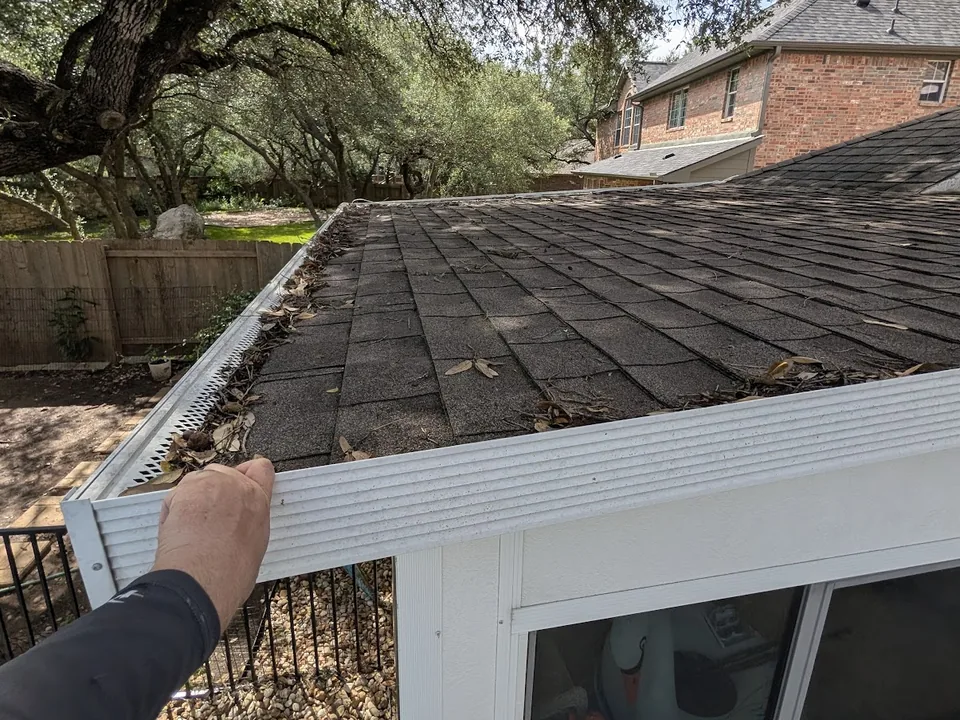
Gutter cleaning keeps water moving where it should. We clear leaves, shingle grit, and debris from gutters and downspouts, check for clogs and sagging, and flag anything that could let water back up under your roof edge or pool against your foundation.
Every cleaning visit is documented. If the debris pattern points at a bigger problem, heavy granule loss, a sagging run, or a downspout that drains against the slab, you will see it in photos with a plain-language note, not a surprise quote.
Gutter Repair
Gutter repair at the actual cause
Leaks, sagging and overflow usually trace to loose fasteners, poor slope, split seams or damage, and a reseal may do.
Finding the cause, not the symptom
Gutter repair starts with why the gutter is failing, not just where. Gutters and downspouts that leak, sag, pull away, or overflow usually trace back to a short list: loose fasteners, poor slope, split seams, or sections damaged by hail or falling limbs.
We find the actual cause, fix what needs fixing, and make sure water drains away from your roofline and foundation. No upsell: a run that needs refastening and a reseal does not need a replacement, and we will say so.
Water Management
Drainage as a system, not a feature
Water moves through drip edge, gutter, slope, downspout, extension and grade, and a failure at any point hurts the rest.
The Drainage Chain
Effective roof water management requires every component to function: drip edge → gutter → slope → downspout → extension → grade. A failure at any point defeats the components above it. A properly sloped gutter connected to an undersized downspout overflows in heavy rain. A correctly sized downspout discharging against flat grade pools water at the foundation. NOAA’s rainfall atlas puts a once a year storm at Round Rock near 1.6 inches of rain in an hour, and a once in ten years storm near 2.8. One inch of rain on a 1,500 square foot roof is about 935 gallons of runoff that the drainage system must route away from the structure without overflow or ponding.
Slope, Capacity & Overflow
Standard residential gutters are sized at 4 to 6 inches wide. The correct slope is ¼ inch of drop per 10 feet of run, directing water toward downspouts. Gutters that have settled flat, common in Texas where wood fascia movement flattens the run over time, hold standing water after every rain. Standing water accelerates corrosion, supports mosquito breeding, and overflows laterally at every storm rather than routing through downspouts. Gutter capacity also limits drainage: a gutter too small for the roof section it serves overflows in a hard rain, however clean it is.
Foundation Impact in Clay Soils
The Round Rock area sits largely on expansive clay soils that swell when wet and shrink when dry. Consistent moisture variation at the perimeter, the zone directly controlled by roof drainage, is a common driver of differential foundation movement in this region. A clogged or misdirected downspout deposits water against the foundation in the same spot after every rain, saturating the clay locally while the rest of the perimeter remains dry. This moisture imbalance is the soil condition that produces corner cracks, sticking doors, and visible foundation deflection. Roof drainage condition is a foundation maintenance issue, not a cosmetic one.
Google Reviews
Homeowner Reviews
These are verified Google reviews from Texas homeowners we’ve served.
If you're looking for a roof replacement, look no further than the Roof Shepherd himself, David. A few months ago, an exterminator discovered a hole in our roof while checking for squirrels. David and his crew went out of their way and placed a solid, temporary patch over the hole. David and his crew did this at 11:30 at night, hours before severe weather hit the area. David did this right at the beginning of the process which most roofers would never bother to do. David and the crew did an excellent job, along with the full replacement of our gutters!!! The roof looks great and we are extremely happy with the result. David stayed in constant contact throughout the process and explained how to smoothly get things done with the insurance company, which we all know can be a pain. David's knowledge in roofing is second to none, so if you are close to replacement, or have questions about the process, trust me, call the Roof Shepherd!!!
Owner Response
Lonnie, thank you for the incredible review and for trusting The Roof Shepherd team with your home in Cedar Park. That late-night emergency response was definitely one of those real roofing moments, but the goal was simple: protect the home before the weather moved in and keep a roof opening from turning into interior damage. I'm grateful we were able to help at the very beginning of the process, then follow it through with the full re-roof and gutter replacement. I also appreciate you mentioning the communication side of the job. Roofing and insurance-related work can be stressful, so my goal is always to keep homeowners informed, prepared, and protected from start to finish. Thank you again for the trust, the kind words, and the opportunity to take care of your home.
David did an excellent job replacing our roof and gutters. I was very impressed with how clean they left the yard. They used good quality underlayment, unlike the previous roofer. Great communication. Our insurance adjuster knew who he was and it helped for a very smooth claim process. Highly recommend!
Owner Response
Dr. Liboiron, thank you for the thoughtful review. It was a privilege to help with your roof replacement and gutter installation in Pflugerville, Texas. I’m glad the communication, cleanup, underlayment selection, and overall installation process stood out to you. We try to treat every roofing project with clear documentation, quality materials, and a clean jobsite from start to finish. I also appreciate you mentioning how smooth the process felt. That kind of trust matters, especially when a homeowner is navigating a roof replacement and coordinating details along the way. Thank you again for allowing me to serve your family.
Where We Work
Seamless gutters in Round Rock and nearby towns
The Roof Shepherd is based in Round Rock and works anywhere in Texas. These are the towns closest to home.
Field Photos
On the job
Photos from the field. Select one to enlarge it.
Common Questions
What homeowners ask about gutters
How often does gutter cleaning need to happen?
Twice a year is the working rhythm for most homes, after spring storm season and after fall leaf drop, plus a check after any major hail or wind event. Homes under mature trees often need more. Overflowing during rain and plant growth in the run are the two signs it is overdue.
Do you handle gutter repair or full replacement?
We repair them when repair is what the gutter needs. Loose fasteners, slope corrections, seam resealing, and section swaps solve most problems for a fraction of replacement cost. Replacement enters the conversation only when the run is failing broadly, and the photos will show you why.
Why plan gutters and a roof replacement together?
Replacing a roof without addressing gutter condition means new roofing material drains into a compromised system. In Texas, hail and high wind frequently damage gutters in the same event that damages shingles. Separating the two creates downstream problems, often at the homeowner’s expense a year later when water intrusion appears and the roof contractor and the gutter contractor each point at the other.
How does hail damage gutters?
Hail impacts aluminum gutters at lower force thresholds than asphalt shingles. A 1-inch hailstone that leaves only granule displacement on shingles can leave visible dimple dents in soft metals. This makes gutter condition one of the most reliable ground-level indicators of whether a hail event occurred and how large the stones were. Round, evenly spaced dents across the gutter face are the signature pattern of a real hail event versus random mechanical damage.
What does a gutter inspection actually look at?
How the run is attached, fascia board condition behind the gutter, pitch and drainage direction, debris load and blockage, soft-metal impact damage from hail, downspout condition and discharge, and end cap and corner integrity. Documentation covers all of these with photographs before any repair or replacement work begins.
Does The Roof Shepherd install gutters?
Yes. We install seamless aluminum gutters. The Roof Shepherd documents the condition first, explains what needs to be done and in what order, and lays out your options; you decide.
What is the correct gutter slope and why does it matter?
Standard slope is ¼ inch of drop per 10 linear feet toward the downspout. Gutters that have settled flat hold standing water after every rain, which accelerates corrosion, supports mosquito activity, and overflows laterally during storms instead of routing through downspouts. In Texas, wood fascia movement from heat cycling gradually flattens the slope of a gutter run over time. This is why gutter performance degrades on older systems even when the gutters themselves are intact.
How does gutter drainage affect a Round Rock area foundation?
Round Rock area clay soils expand when wet and shrink when dry. Consistent moisture variation at the foundation perimeter, the zone that roof drainage controls, is a common driver of differential foundation movement in this region. A clogged or misdirected downspout deposits water in the same spot after every storm, saturating the clay locally while adjacent areas dry out. That imbalance is what produces sticking doors, corner cracks, and visible foundation deflection. Gutter condition is a foundation maintenance issue.
Get Started