
Roofing 101 · Storm Country
Hail Damage Atlas: What Hail Does to Each Roofing Material
Hail damage has a definition, a size at which it starts, and a set of look-alikes that fool homeowners, roofers and adjusters in both directions. This is the engineering literature on one page: what hail does to asphalt, metal, tile, wood and flat roofs, at what size, what only looks like hail, how an inspector counts it, and what the Texas claim clock owes you afterward. Every fact is sourced to the page it was read on.
Updated October 25, 2026
Read This First
The short version
- Hail damage on a shingle is a bruise, a puncture, or lost granules that show the asphalt. The key sign is a cracked mat under the mark.
- The National Weather Service calls hail severe at 1 inch, and Haag data puts damage to weathered asphalt at about 1 to 1.25 inches and new laminated shingles at about 1.5.
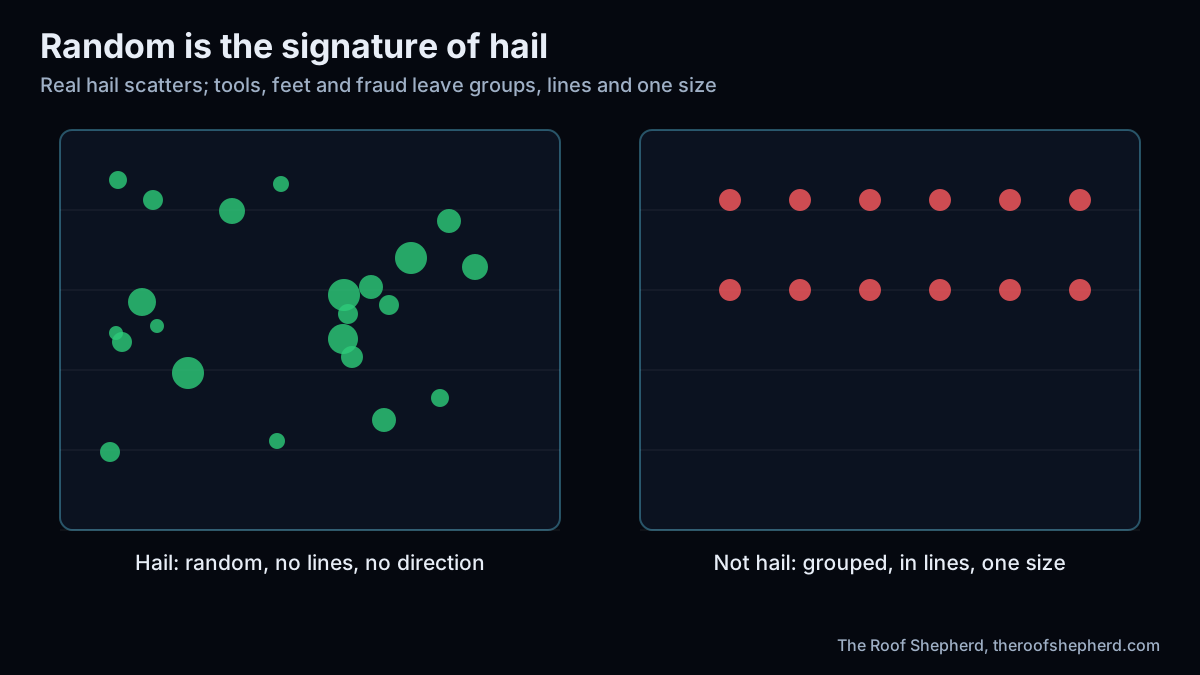
- Real hail marks are round, soft to the thumb and random across the slope facing the storm, while marks in lines, groups or one size came from something else.
- Inspectors count hits in a 10 by 10 foot test square on each slope. Insurers set the hit count that makes a claim, not engineering.
- The Texas Department of Insurance states the usual clock. A carrier has 15 days to acknowledge, 15 business days to decide on a complete file, and 5 business days to pay after a yes.
Have the roof documented before anyone talks about money: call or text 512-575-5052 or use Get Help.
Short version: 3 min. Full page: 16 min. Want the detail? Each section below opens with a tap, or switch to Full at the top to open them all.
The Definition
What hail damage is, and how big hail has to be
Haag defines hail damage as a bruise, puncture or exposed asphalt, and the weather service calls 1 inch hail severe.
A bruise, a puncture, or granules gone down to the asphalt
Hail damage has a written definition. Haag Engineering, whose assessment protocol is the one most adjusters and engineers work from, defines hail damage to an asphalt shingle as "a bruise (fracture of the reinforcing mat), puncture, or displacement of granules sufficient to expose underlying bitumen" (Haag, October 2019). The word that matters is fracture. A shingle that lost some granules but whose mat is intact has a cosmetic mark; a shingle whose mat is broken under the mark has a shorter life, because water now has a path to the fiberglass. Haag's own testing found that granule loss without a mat fracture "did not affect the shingle service life".
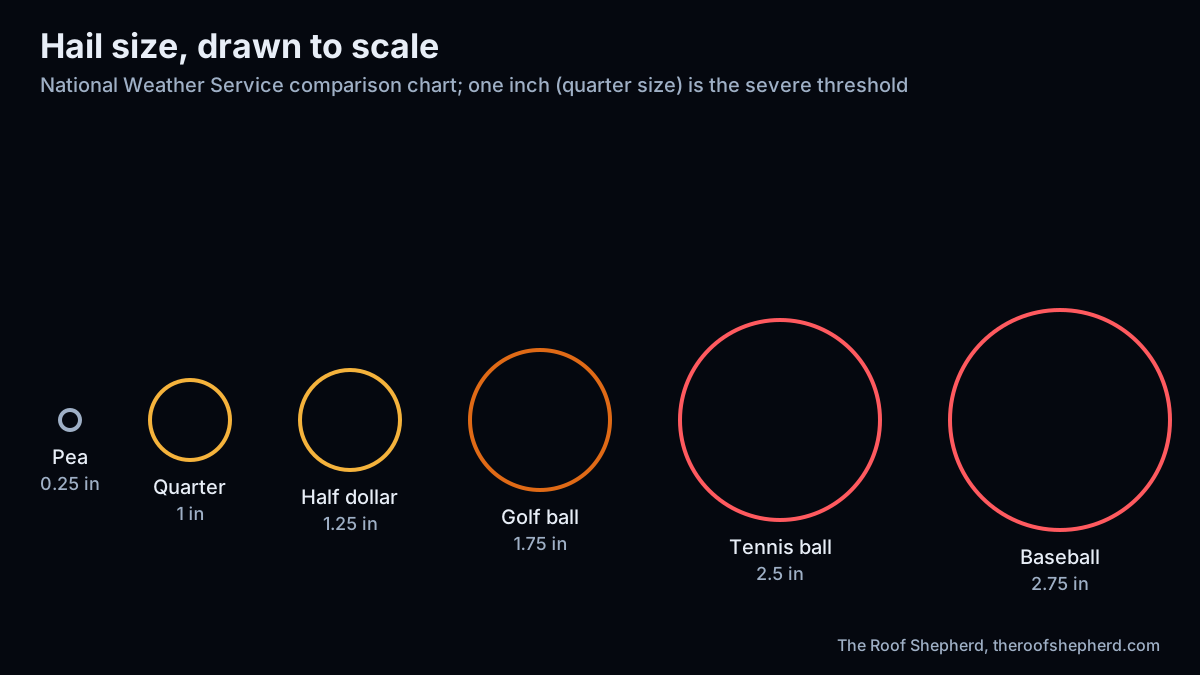
Size decides whether that fracture is possible. The National Weather Service calls hail severe at one inch, the diameter of a quarter, and its comparison chart runs from pea (a quarter inch) through golf ball (1.75 inches) to softball (4 inches) (NOAA National Severe Storms Laboratory). Hail of one to 1.75 inches falls at 25 to 40 miles an hour. Round Rock, Austin and the cities around them see stones above two inches most springs; the NOAA record for many of our cities tops out at four inches.
The size on the ground is not the size on the roof. Hail that has been on the lawn for twenty minutes has melted, and the roof takes the storm's largest stones on its windward slope with the leeward slopes catching glancing hits. That is why an inspector reads the roof rather than the driveway, and why the slope facing the storm is where the count is made.
Photograph the freshest exposed asphalt: a new bruise shows black, unweathered asphalt under the granules; an old one has grayed by oxidation. Haag dates the damage by that color.
Asphalt
Asphalt shingles: the bruise, the pattern, and the size that does it
Hail marks on asphalt are round, random and soft where the mat cracked, and the damaging size depends on shingle age.
Random, roughly circular, soft to the thumb
Hail leaves a round soft spot. On an asphalt shingle, hail leaves a roughly circular mark with the granules driven into or off the asphalt, and under a true hit the mat is fractured and the spot feels soft when pressed. Haag's protocol says the marks are "roughly circular in shape and randomly distributed" across a slope, denser on the slope that faced the storm (Haag assessment protocol). Chipped shingle edges, which look alarming, "do not shorten shingle service life" and are not counted. IBHS puts it in a sentence: "Real hail damage occurs in a random pattern" and a bruise "can usually be felt" (IBHS, Is It Hail Damage). GAF's technical bulletin lists the same signs and adds two that matter for a claim: cracks radiating from the impact, and a fractured mat "which may or may not be immediately visible" (GAF TAB R-108).
The size at which it happens depends on the shingle's age. Haag's protocol gives the working thresholds: weathered shingles are damaged by hard ice at about 1.25 inches, new shingles at about 1.5 inches, when it strikes at a right angle. Its test data behind that: half of aged organic-mat shingles were damaged at one inch, aged fiberglass shingles needed 1.25 inches, and aged laminated (architectural) shingles 1.5 (Haag, Hail Damage to Asphalt Shingles). A storm reported at three-quarter inch that "destroyed" a laminated roof did not; something else is in the picture.
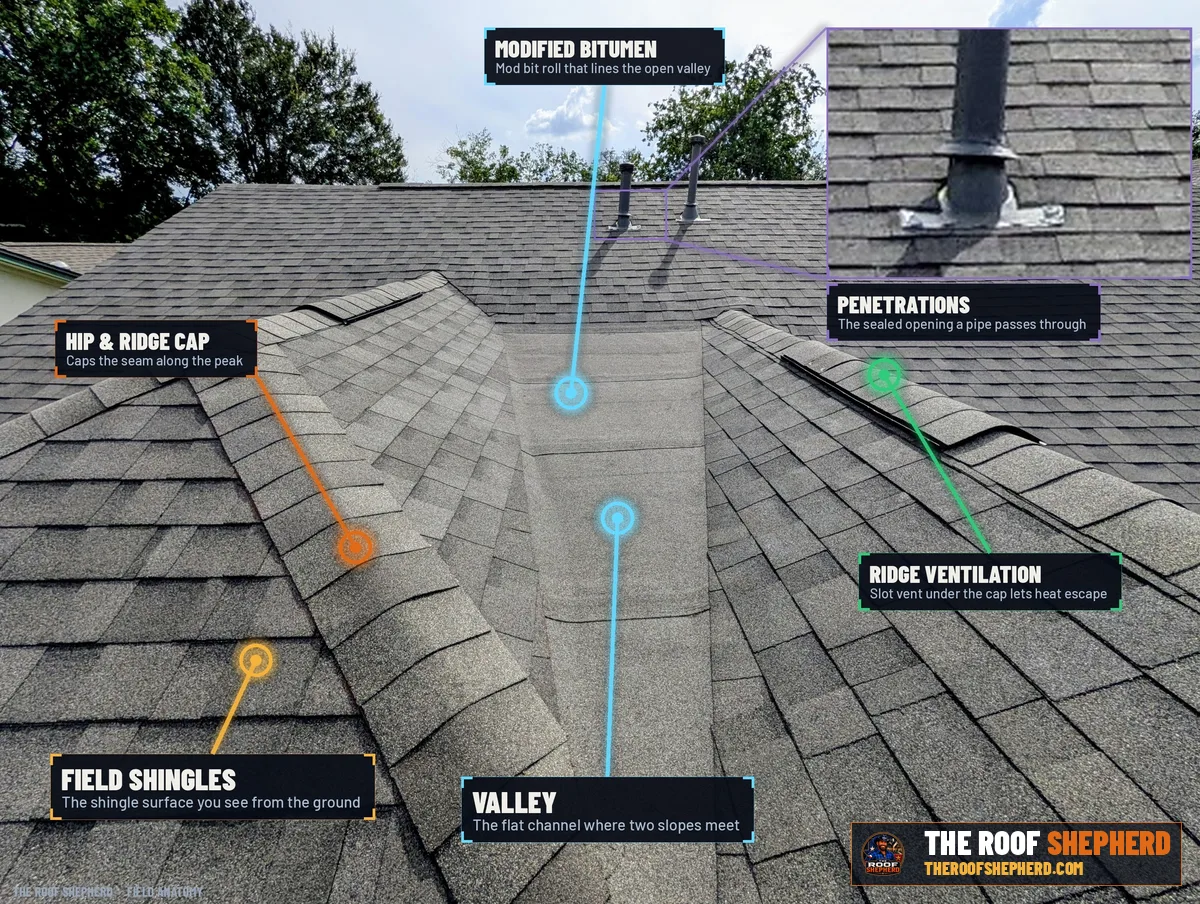
Ridge caps and hip caps are the most exposed shingles on the roof and often the first to show it, which is why an inspection that never looks at the ridge is not an inspection. Fractures start on the underside, at the point of greatest bending, so a mark that looks minor from above can be a through-fracture when the shingle is lifted and flexed.
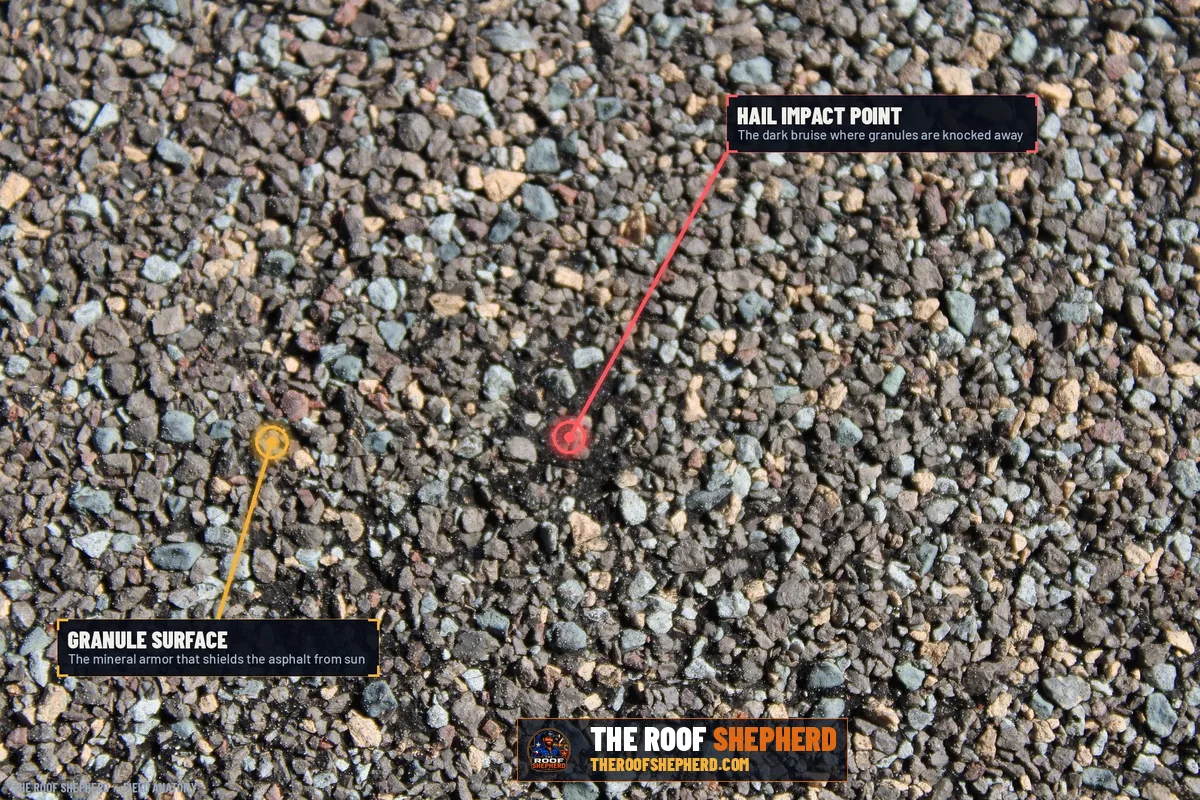
Press every suspect mark with a thumb. Soft means the mat is fractured. Firm with granules gone is cosmetic. Write down which, per mark, in the test square.
The Tells
What only looks like hail: five look-alikes and the tell for each
Blisters, weathering, foot traffic, tools and factory defects can look like hail, but each has a tell.
Blisters, weathering, footprints, tools and the factory
Blisters are the most common false alarm. Blistering is gas in the asphalt raising small bubbles, often about a quarter inch across, and when a blister's crust breaks it looks like a hit; the tell is that there is no bruise under it and the blisters sit where the asphalt was thick, not where the storm came from. Weathering is even granule loss, cupping, clawing and crazing, and the thermal splits that run diagonally or horizontally as the asphalt shrinks; hail does not make straight lines (Haag P 9.4).
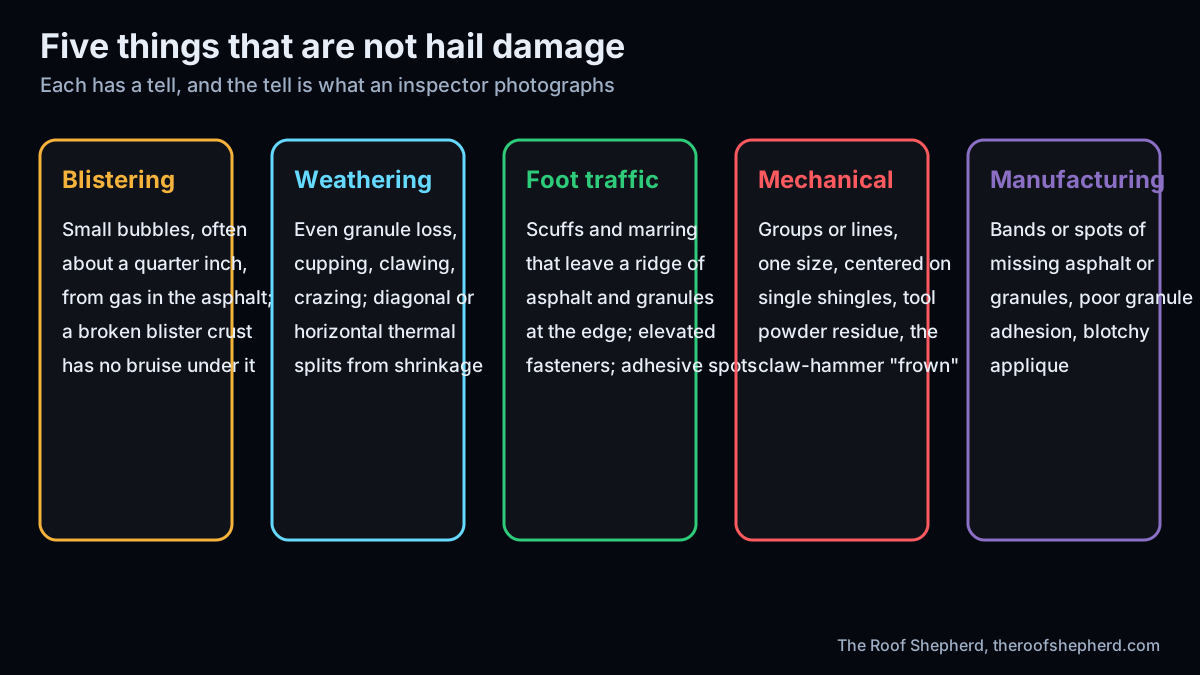
Foot traffic and installation damage leave scuffs with "a ridge of bitumen and granules at the perimeter" of the mark, elevated fasteners and adhesive spots, and they cluster along the paths people walk: at the eaves, around the penetrations, up the valleys. Mechanical damage, including the intentional kind, arrives "in groups or lines," centered on single shingles, struck at near-perpendicular angles, with tool powder residue and, in Haag's memorable phrase, the claw hammer's curving "frowny face" fracture (Haag protocol). IBHS adds the plain test: repeated patterns of "the same size, shape, or depth" are not weather.
Manufacturing defects show as bands or spots of missing asphalt or granules, poor granule adhesion, or blotchy appliqué, and they follow the shingle, not the storm: the same defect shows on the same product on every slope, including the ones the hail could not reach. A roof that shows the same mark on all four sides was not hit by a storm from one direction.
Photograph a suspect mark with a coin for scale, then a second photo after pressing it. The pair is what an engineer wants to see, and it settles most "is this hail" arguments without a second visit.
Everything Else
Metal, tile, wood and flat roofs
Metal, tile, wood and flat roofs fail at different hail sizes, from about 1.25 inches for wood to 2.5 for metal.
Different materials fail at different sizes, and some record every storm
Metal keeps a record of every storm. Metal dents and keeps the dent, so a metal roof "offers an accumulated history of hail events"; in Haag's panel testing there was "no fracturing or spalling of the galvanized coating" at the dents, and functional damage on metal means a rupture, a disengaged fastener or an opening at a seam, which took ice of "at least 2.5 inches" to produce (Haag, August 2018). Dents with scratches in them were not made by hail, because hail cannot scratch metal, and oversized or unusually deep dents point to feet. Haag now recommends writing "dented but did not rupture or puncture" rather than the loaded words cosmetic and functional.
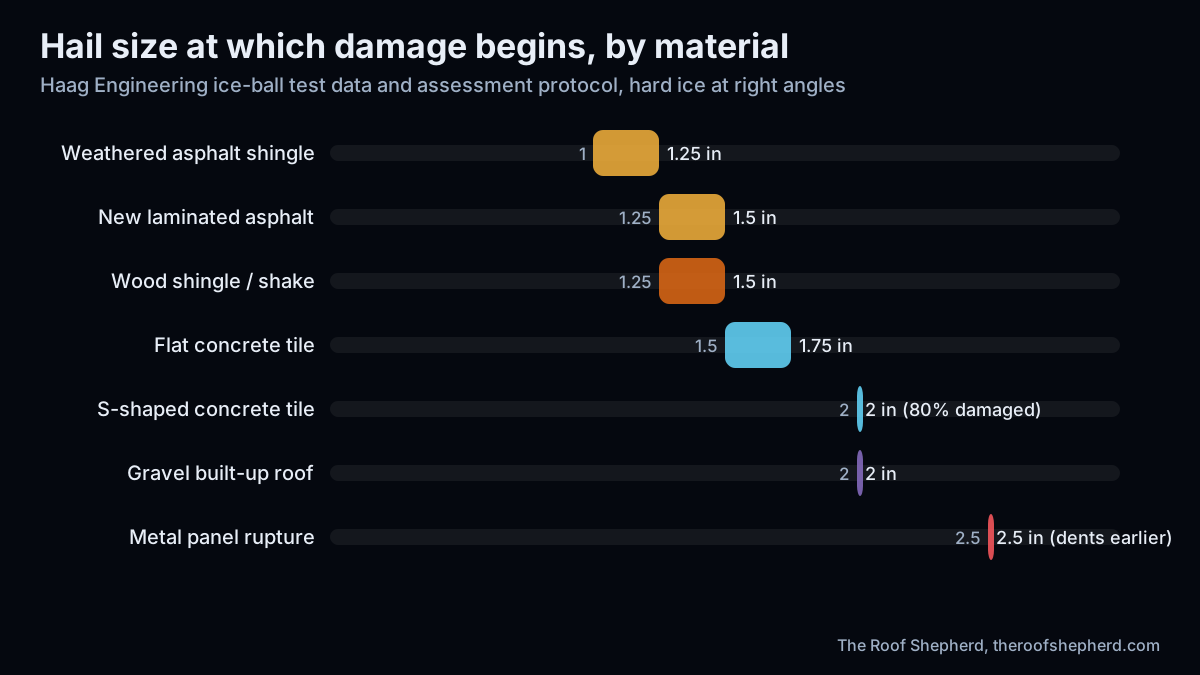
Concrete and clay tile break rather than bruise. Haag's ice-ball testing first damaged flat concrete tile at 1.5 inches, half of the samples at 1.75, while S-shaped concrete tile reached 80 percent damaged only at two inches (Haag ice-ball testing). A description of how a hail crack differs from a foot-traffic break on tile does not appear in the sources we read, so we do not offer one; the test square method applies to tile as it does to shingles. Wood shakes split: a hail split shows "bright, unweathered color" with sharp edges that can be "pieced back together," while a weathering split has rounded, gray edges. About 1.25 inches splits a wood shingle and 1.5 a shake in good condition.
Low-slope membranes fail where they lack support underneath: at blisters, wrinkles and the transitions at curbs and parapets, which is where an inspector looks first. Haag's example language is a PVC roof fractured "at the rate of 10 fractures per roofing square," which required replacement, against a modified bitumen roof where hail ruptured the coating but not the reinforcement. Gravel built-up roofs needed two-inch ice to start damage, and hail dents in polyiso insulation under a TPO membrane "had no measurable effect on the R-value." Numeric thresholds for single-ply and modified bitumen membranes are not given in the sources we read.
On metal, photograph the soft metals first (vents, gutters, condenser fins): they dent at sizes that leave the panels unmarked and they date the storm.
How It Is Counted
Collateral indicators and the test square
A 10 by 10 foot test square on each slope gives a counted, photographed record, and spatter shows storm direction.
Spatter dates the storm; the square counts the damage
Before the roof, the yard. Hail knocks oxidation and dirt off metal, leaving clean "spatter" marks on gutters, downspouts, junction boxes, fences, window trim and the fins of the air conditioning condenser; IBHS is blunt that "spatter isn't damage," but it is evidence of size and direction, and Haag notes it "may last up to two years" (IBHS). Dents in soft metals (vent caps, gutters, flashing), torn window screens and stripped foliage on one side of the property say which way the storm came from, which tells the inspector which slope to count. To see which days radar recorded hail near a given address, use our hail history lookup.
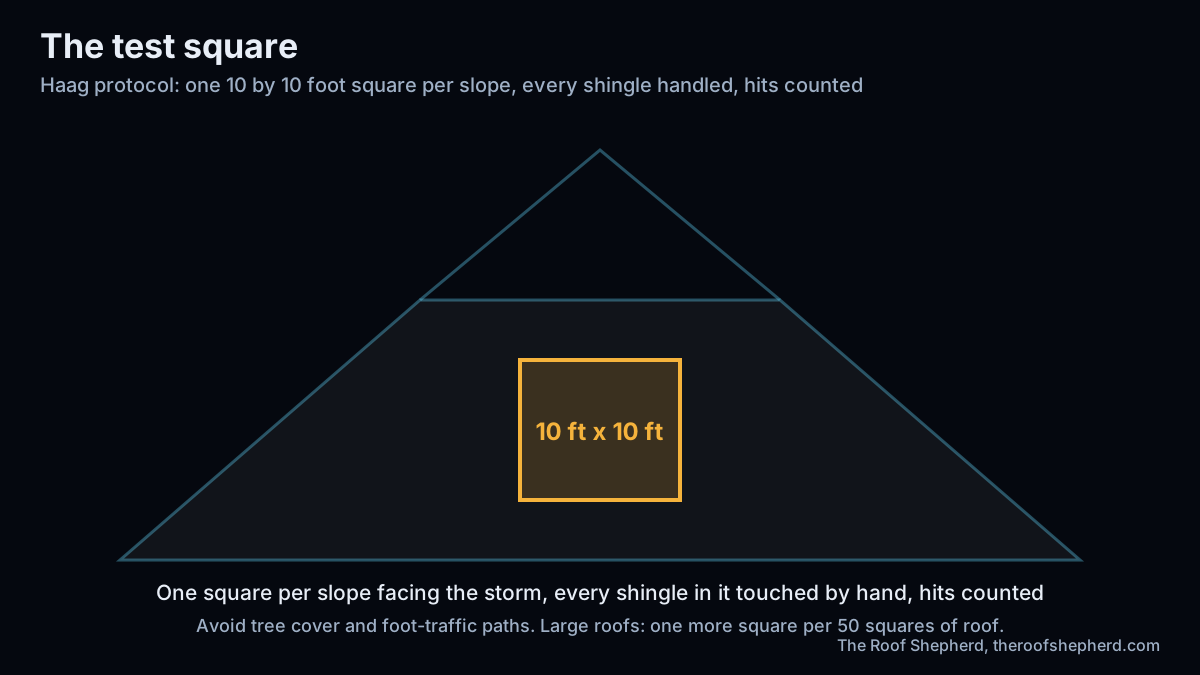
The count is the test square: "10x10 ft. square on each directional roofing slope," every shingle inside it handled and flexed, damaged units tallied, then extrapolated to the slope, avoiding tree cover and foot-traffic areas, with one more square per fifty squares of roof on large buildings (Haag, the test square method). The number of hits that "makes" a claim (eight per square is the figure most often repeated) is an insurer's convention and appears on no Haag or IBHS page we read; it is a working rule adjusters use, not an engineering threshold, and it varies by carrier.
What the square produces is a record: a dated photograph of the square's outline, one of every counted hit with a coin for scale, and the tally by slope. That record is the same whether the answer turns out to be a claim, a repair, or nothing, and it is the reason we document before anyone talks about money.
Chalk the square, photograph it from the ground so the slope and the outline are in one frame, then count. A square with no ground photo cannot be located later.
Class 1 to 4
Impact ratings: what UL 2218 Class 4 does and does not mean
Class 4 means no crack on the back after two hits from a 2 inch steel ball, and the test ignores dents and granule loss.
A steel ball, an ice ball, and a rating that ignores dents
UL 2218 drops steel balls of four sizes on the product from a fixed height: Class 1 is a 1.25 inch ball, Class 2 is 1.5, Class 3 is 1.75, Class 4 is two inches, and the product passes a class "if no crack is visible on the back" after two hits in the same spot (IBHS Roof 101). FM 4473 uses the same sizes but fires "pure frozen water ice balls" instead of steel, at energies from 3.72 foot-pounds for Class 1 to 26.81 for Class 4 (FM Approvals standard 4473). Metal and tile are rated under the same standards.
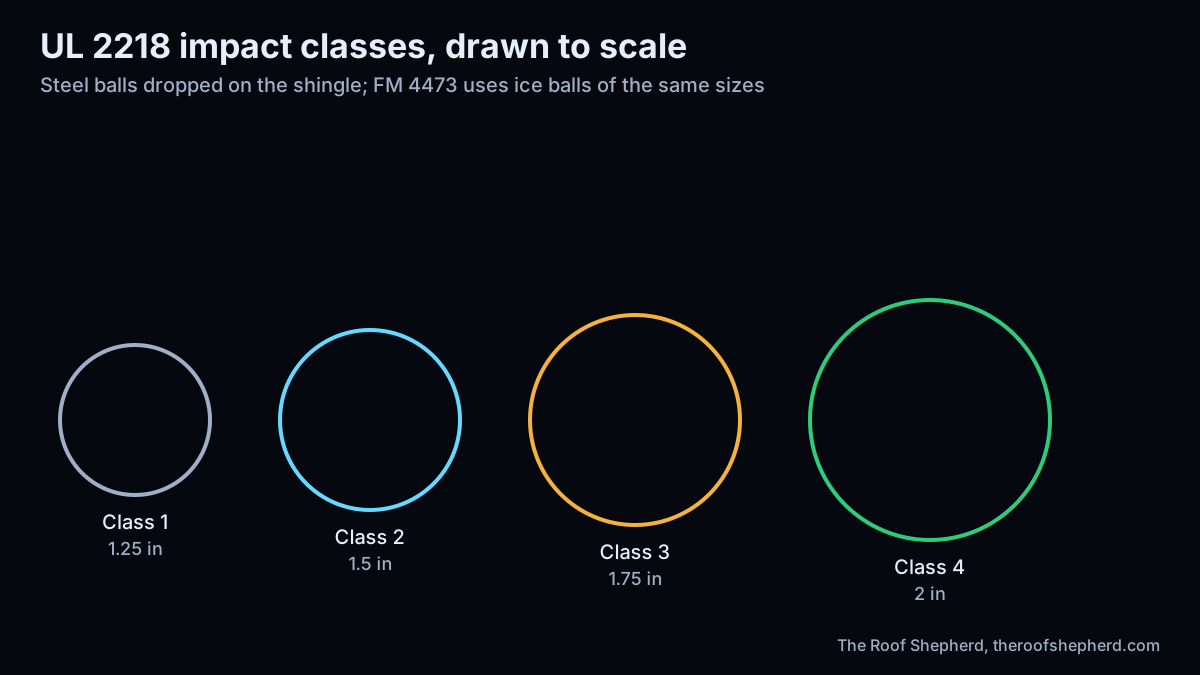
What the rating does not do: UL and IBHS say plainly that UL 2218 "does not account for denting or granule loss," the two things a homeowner or adjuster actually sees. IBHS built its own test to score dents, tears and granule loss with lab-made hail up to two inches, and found that among shingles sold as impact-resistant "product performance ranged from Excellent to Poor" (IBHS hail impact ratings, 2023 update). Two Class 4 shingles can behave very differently in a real storm.
And the money: the Texas Department of Insurance keeps the list of products that qualify for impact-resistant credits, says discounts are not required, and says the amount is set "on a company-by-company basis". Classes 1 through 4 can qualify. A contractor who tells you a Class 4 roof will cut your premium by a percentage is guessing on your behalf; the only number that counts is the one your carrier puts in writing, and it is worth asking whether it comes with a cosmetic damage exclusion attached.
The class is on the bundle wrapper and the maker's data sheet. Photograph the wrapper on delivery; TDI Form PC068 asks for the product, maker and class, and the wrapper is the proof.
Texas
The Texas claim clock, as TDI states it
TDI states 15 days to acknowledge, 15 business days to decide on a complete file, and 5 business days to pay.
Days the carrier owes you, and the two things it tells you not to do
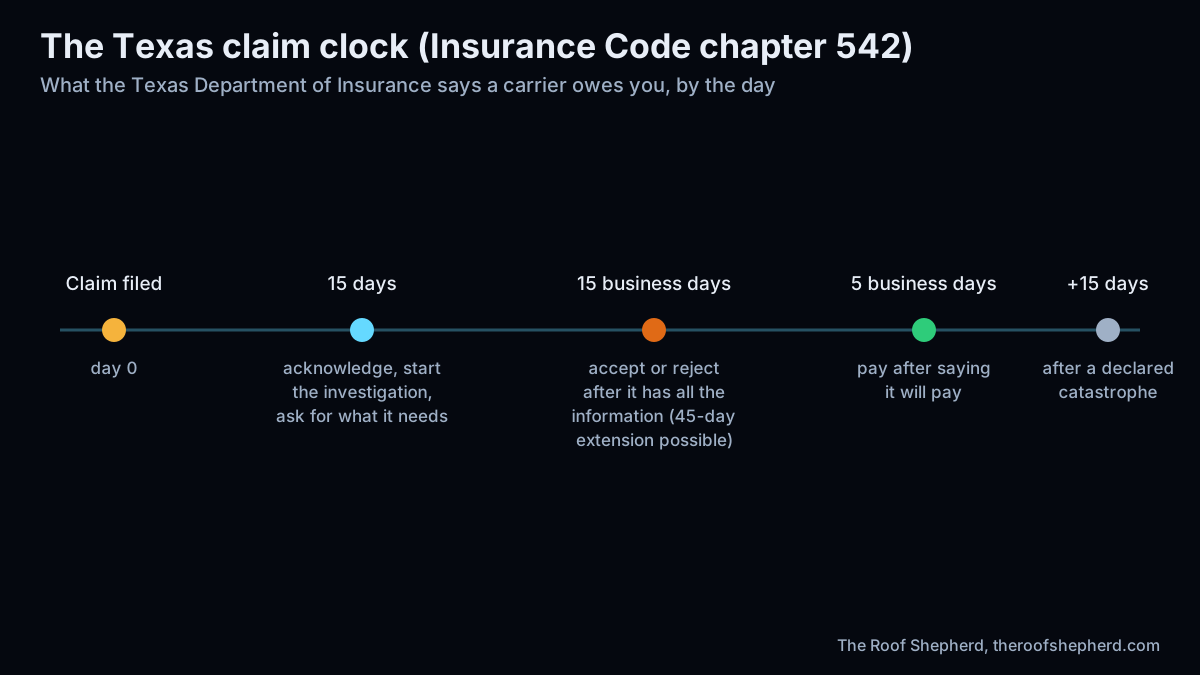
The carrier is on a clock and the days are public. Texas Insurance Code chapter 542 puts a clock on the carrier, and the Texas Department of Insurance states it in days: acknowledge the claim and start investigating within 15 days of receiving it; accept or reject it no later than 15 business days after it has all the information it asked for, with a 45-day extension if it tells you why; and pay within five business days of saying it will pay. After a declared catastrophe the deadlines stretch by 15 days. A carrier that pays late can owe interest and attorney fees (TDI, your rights).
TDI's advice after a hail storm is short and worth repeating: it is illegal for a contractor to waive your deductible, get more than one bid, and do not pay in full up front (TDI, after hail or windstorms). No page we read at TDI states a deadline for the policyholder to file a hail claim; that is set by your policy, and the honest advice is to report promptly and read the policy's own notice clause rather than trust a number from a roofer, including us.
What this atlas cannot do is tell you whether your roof has a claim. It can tell you what the engineering says damage looks like, at what size, and what it is not, so that when someone stands in your driveway and says "you've got hail," you know which questions to ask and which record to insist on.
Keep a dated log of every contact with the carrier: the day the claim was reported, the day each document was sent, the day the adjuster came. The clock only helps the homeowner who can prove when it started.
When You Are Ready
When you are ready
Roof Inspections
Here is how we help. If the atlas looks like your roof, a documented inspection counts the hits slope by slope and photographs each one with scale before anyone talks about a claim.
Or call or text 512-575-5052.
Field Videos
From the field
Real jobs, filmed and explained.
Field videos from real roofs, each with a short note on what the inspection or the work showed.
Real Hailstorm Damage in Dallas, Texas
Documented hail damage across multiple Dallas and Fort Worth homes, including shattered solar panels, after roughly 2.5 inch hail.
Watch on YouTubeHail Damage on a Garage in Round Rock, Texas
Hail hits on garage siding in Round Rock, the property level evidence that tells you the roof deserves a closer look.
Watch on YouTubeHail Damage Atlas Questions
Common questions about hail damage atlas
What size hail damages a roof?
It depends on the material and its age. Haag Engineering's data: weathered asphalt shingles are damaged by hard ice at about 1 to 1.25 inches, new laminated shingles at about 1.5, wood at 1.25 to 1.5, flat concrete tile at 1.5 to 1.75, S-shaped tile at 2, and metal panels rupture at about 2.5 inches while denting much smaller. The National Weather Service calls hail severe at one inch.
What does hail damage look like on shingles?
A roughly circular mark where granules have been driven into or off the asphalt, soft to the thumb because the mat beneath is fractured, scattered randomly across the slope that faced the storm and mixed in size. Marks in lines, groups, or all one size were not made by hail.
How do inspectors tell hail from blistering or wear?
Blisters have no bruise beneath the broken crust and sit where the asphalt is thick, not where the storm came from. Weathering is even and its splits are straight. Foot traffic leaves a ridge of granules around the scuff and follows walking paths. Tools leave groups and lines of one size. Factory defects follow the product to every slope.
What is the test square method?
A 10 by 10 foot square marked on each slope, away from trees and walking paths, in which every shingle is handled and flexed and every hail hit is counted and photographed, then extrapolated to the slope. It is Haag Engineering's protocol and the standard most adjusters use. The number of hits that "makes" a claim is an insurer convention, not an engineering threshold.
Does a Class 4 shingle mean no hail damage?
No. Class 4 means the shingle showed no crack on its back after two strikes of a two-inch steel ball in the UL 2218 test. The test does not score dents or granule loss, and IBHS found that shingles sold as impact-resistant ranged from excellent to poor in its own hail test. Any insurance credit is set by your carrier.
How long does an insurer have to pay a hail claim in Texas?
Per the Texas Department of Insurance: acknowledge within 15 days, decide within 15 business days of having all the information (a 45-day extension is possible with a stated reason), and pay within five business days of agreeing to pay. Deadlines extend 15 days after a declared catastrophe.
Keep Learning
Where to go from here
Each guide below picks up a thread from this page: what the layers cost, what storms do to them, and how to hire the person who touches them.