
Learning Center · Roofing
Metal Roofing in Texas: What to Know Before You Buy
Metal is the longest-lived roof most Texas homeowners will ever consider, and the most misunderstood. This guide covers the two families of metal roof, what hail actually does to a metal panel, the insurance clause that goes with it, heat, noise, gauge and paint, with the numbers taken from manufacturer data sheets and warranty documents.
Updated October 12, 2026
Read This First
The short version
- Standing seam hides its fasteners under locked seams. Exposed fastener panels screw through the face, cost less and need their screw washers checked as they age.
- UL 2218 Class 4 is a laboratory impact classification. Steel panels pass it, but it does not measure denting, and hail dents on metal are usually cosmetic.
- Texas has recognized a cosmetic hail damage exclusion for metal roofs since 1998. Some policies carry one, so read your endorsement page before you buy.
- 24 gauge is the usual standard for engineered standing seam and 26 gauge for exposed fastener panels. PVDF (Kynar 500) paint is warranted to chalk and fade less than SMP.
To talk through metal on your house, start with Get Help or call or text 512-575-5052.
Short version: 3 min. Full page: 11 min. Want the detail? Each section below opens with a tap, or switch to Full at the top to open them all.
Direct Answer
Is a metal roof worth it in Texas?
Often yes for a long-stay owner who accepts hail dents; it costs well above shingle, and the ranges are below.
Who metal fits
Metal makes sense when you plan to stay. The InterNACHI life expectancy chart lists metal at 40 to 80 years against 30 for architectural asphalt. A painted steel roof reflects more sun than dark shingles. The trade is price, and the fact that Texas hail can dent a panel without breaking it.
Who it does not fit
Metal is a poor fit when the budget is tight or the stay is short. Shingle costs far less up front, and an owner who will sell in a few years rarely recovers the difference. It is also a poor fit for someone who cannot live with a dent, because a dented metal roof is usually a working roof that the insurer may not pay to replace.
Panel Types
Standing seam vs exposed fastener metal roofing
Standing seam locks panels over hidden clips; exposed fastener panels screw through the face with washers.
Standing seam
Standing seam is the premium system. Panels run from ridge to eave and lock together at raised vertical seams, held to the deck by clips or hidden fasteners, so nothing that holds the roof down is exposed to sun and rain. Sheffield Metals, a panel manufacturer, calls 24 gauge the usual standard for standing seam roof systems and notes that 24 gauge is often the minimum for engineered systems with tested wind uplift. Our metal roofing service page covers the standing seam work we do.
Exposed fastener
Exposed fastener panels, often called R-panel or ag panel, screw straight through the face with a sealing washer under each head. They cost less and go on faster, which is why they cover barns, shops and budget roofs across Texas. Sheffield lists 26 gauge as the usual standard for exposed fastener roofing. The washers are the maintenance item: sun hardens them over the years, and a roof with thousands of screws has thousands of places to check. Our roofing materials guide compares both families with shingle, tile and flat roofing.
Storm Performance
Will insurance pay for hail damage to a metal roof?
Only if the policy covers it: dents are usually cosmetic, and some policies exclude cosmetic hail damage on metal.
What UL 2218 Class 4 means on metal
Class 4 is a laboratory classification, not a promise. GAF describes the UL 2218 test as dropping steel balls of increasing size from increasing heights; a 2-inch ball from 20 feet earns Class 4, the highest rating. Steel panels pass it easily. What the test measures is whether the material cracks or splits. Sheffield Metals, whose 26 gauge panels carry Class 4, says plainly that the test does not measure the likelihood of denting. GAF makes the same point for shingles: it makes no express or implied warranty about impact performance against hail.
Dents are usually cosmetic
A dented panel is usually still a roof. Two professional engineers published a study of hail dents in Galvalume-coated steel panels in IIBEC Interface in August 2025 and found no evidence of significant deterioration from the hailstone impacts. Their conclusion: unless a dent creates a path for water, such as a split panel or a seam that has come apart, dents from hail up to 2 and a half inches generally do not meet the definition of functional damage and are deemed cosmetic. That is the engineering view. How you feel about dents on your own roof is a separate question worth settling before you buy.
The cosmetic damage exclusion
Texas has recognized this trade since 1998. Texas Department of Insurance Bulletin B-0030-98 adopted mandatory premium credits for residential roof coverings meeting UL 2218, metal roofs among them, and, with it, optional endorsements that exclude cosmetic hail damage to roof coverings on policies taking the credit. The endorsement language read: “We do not cover cosmetic loss or damage to roof coverings caused by the peril of hail.” Policies today use their own forms, and whether yours carries a cosmetic exclusion, a metal roof credit, or both, is printed on your declarations and endorsement pages. Read them before the roof goes on, and ask your agent what the credit and the exclusion do to your premium and your coverage.
What we do on a hail claim
Our role on a metal roof claim is the same as on any claim. We advise and educate you on your options and rights, document the roof, and submit documented supplements. We are not a public adjuster and never negotiate or settle a claim for you. We photograph the roof dent by dent and seam by seam, and we never waive, absorb or discount a deductible, which Texas law forbids. Our hail damage insurance guide explains the claim process and what functional damage means on each roof type.
Living Under It
Metal roofs in Texas heat, and the noise question
Coated metal reflects sun and runs cooler than a dark roof; over a solid deck, rain noise is like any roof.
Heat
Color and coating do the work. The U.S. Department of Energy says a conventional roof can reach 150°F or more on a sunny summer afternoon while a reflective roof can stay more than 50°F cooler, and that cool roofs save the most in hot climates. It also warns that bare, unpainted metal reflects sun well but gives heat up poorly, so it heats more than painted metal with the same reflectance. The practical rule for a Texas roof is a factory-painted panel in a light or cool-rated color, over a vented attic. NOAA’s 1991 to 2020 normals put the average August high at 97.8°F at Austin Camp Mabry, 95.8°F at DFW and 94.9°F at Houston Bush, so the roof surface spends the summer well above air temperature.
Noise
The barn-roof sound comes from the barn, not the metal. A barn has open framing and no deck. A house has plywood decking, underlayment, insulation and a ceiling between the panel and your ear. The Metal Roofing Alliance, the industry’s trade group, says there is little difference between metal and other materials when it comes to noise from rain or hail. On the homes we have been inside during rain, that matches what we hear: a metal roof over a solid deck sounds like a roof.
Specification
Panel gauge and paint: PVDF vs SMP
Lower gauge is thicker: 24 gauge standing seam, 26 gauge exposed fastener; PVDF holds color longer than SMP.
Gauge
Gauge runs backward: the smaller the number, the thicker the steel. Sheffield Metals lists 24 gauge at a minimum of 0.023 inch and 26 gauge at a minimum of 0.018 inch. It calls 24 gauge the usual standard for standing seam and 26 gauge the standard for exposed fastener panels, and notes that 29 gauge is the most popular thickness for corrugated agricultural panels. Thicker panels resist denting and oil canning, the visible waviness in flat panel areas, better than thin ones. Ask for the gauge in writing on any metal quote.
Two paint chemistries
The paint decides how the roof looks in year 15. PVDF, sold under the Kynar 500 and Hylar 5000 names, is a fluoropolymer resin; Sherwin-Williams’ Fluropon data sheet names it a 70 percent PVDF system and tests it to the AAMA 2605 specification, the top tier for architectural coatings. SMP, silicone modified polyester, is the mid-grade; Sherwin-Williams’ WeatherXL data sheet tests it to AAMA 2604. Both sheets report South Florida exposure results at 20 years, and the PVDF sheet holds the tighter color and chalk limits on a sloped surface.
What the warranties say
The panel maker’s warranty is where the gap shows. McElroy Metal warrants its Kynar 500 PVDF panels for 30 years against chalking worse than an ASTM D4214 rating of 8 and against color change over 5 Hunter units, with 40 years on film adhesion. Its SMP warranty allows chalk down to a rating of 6 and color change up to 7 Hunter units on roof panels over the same 30 years, and 30 years on adhesion. Both carry a 50-year warranty on the Galvalume steel itself. In plain words, the SMP warranty permits more fading and chalking before a claim exists. Note that McElroy’s coating warranties are for the original purchaser only and are not transferable.
| Item | PVDF (Kynar 500, Fluropon) | SMP (silicone modified polyester, WeatherXL) |
|---|---|---|
| Resin, per the maker | 70% PVDF | Silicone modified polyester |
| Specification met, per the data sheet | AAMA 2605 and AAMA 621 | AAMA 2604 |
| McElroy chalk warranty, roof panels | 30 years, rating no worse than 8 | 30 years, rating no worse than 6 |
| McElroy fade warranty, roof panels | 30 years, 5 Hunter units | 30 years, 7 Hunter units |
| McElroy film adhesion warranty | 40 years | 30 years |
| McElroy Galvalume substrate warranty | 50 years | 50 years |
Planning Range
What a metal roof costs in Texas
Standing seam is priced per measured square from our register, and exposed fastener metal is quoted per job.
Standing seam, per square
Our planning range for standing seam is $1,500 to $2,200 per measured square, where a square is 100 square feet of roof surface, installed. It is a wider band than shingle because fewer local jobs are on record, and a simple gable roof lands near the low end while a cut-up roof with many hips, valleys and penetrations lands near the high end. To rough out your own number, multiply your roof’s measured squares by $1,500 and again by $2,200; a 30 square roof is 30 times each figure. It is a planning range, not a quote, and the measured roof decides it.
Exposed fastener, quoted per job
Exposed fastener metal is not the standing seam tier. Its price depends on the panel, the gauge, the paint system and the substrate it goes over, so we quote it per job rather than from a per-square figure. Our roof cost factors guide explains what moves any roofing price, metal included.
When You Are Ready
When you are ready
Metal Roofing
Here is how we help. We install standing seam and exposed-fastener metal on your measured roof, walk you through gauge, coating and underlayment before any material is ordered, and photograph the work from the first panel.
Or call or text 512-575-5052.
Field Photos
On the job
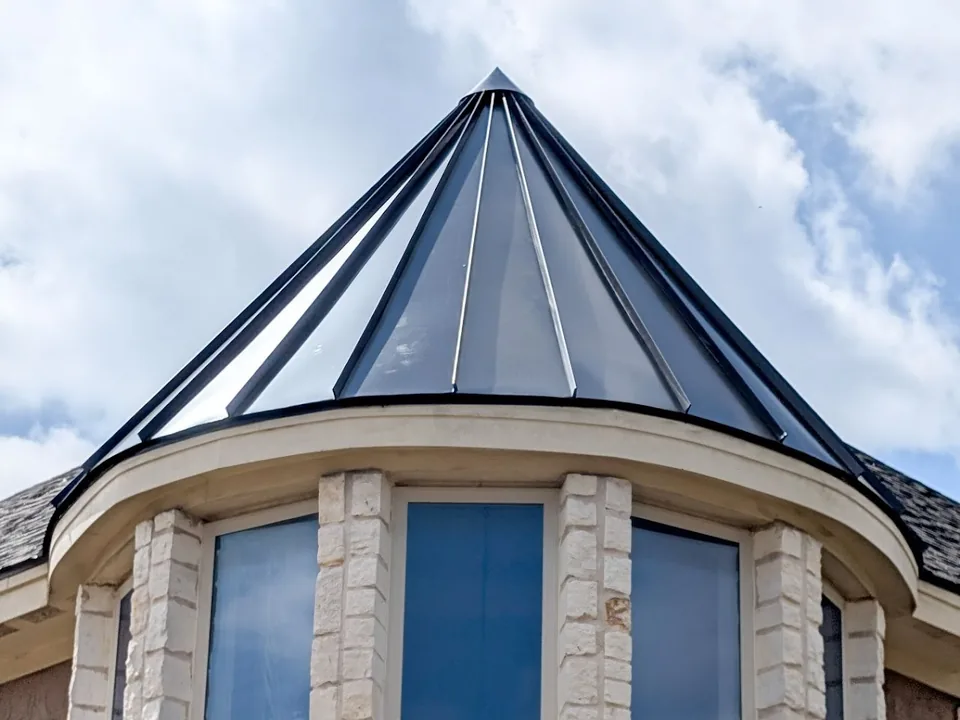
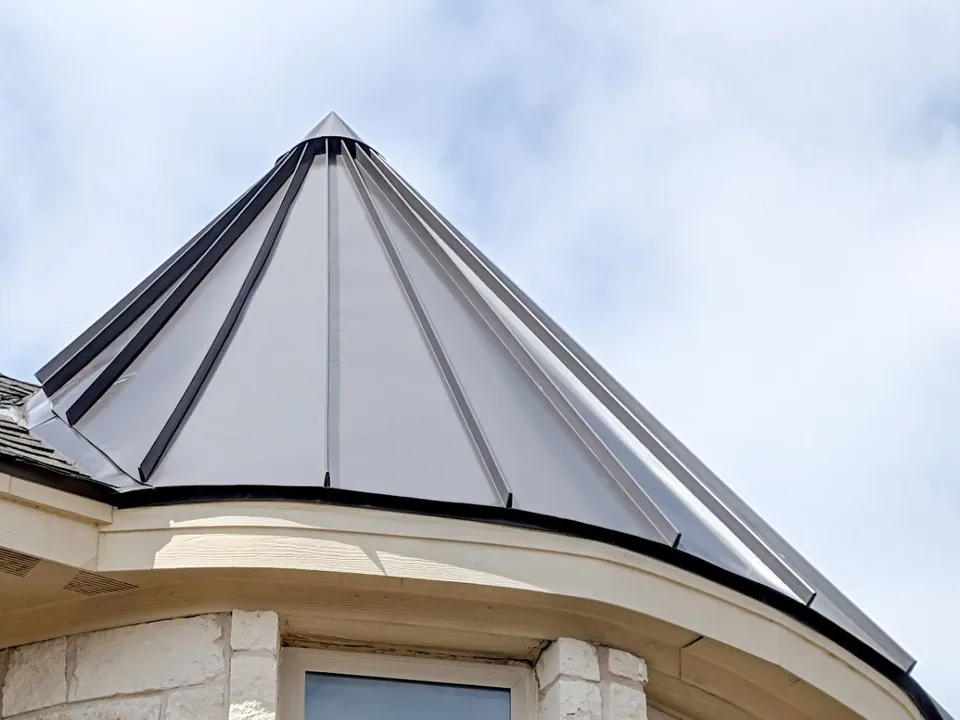
Photos from roofs we have worked on. Select one to enlarge it.
Common Questions
Questions homeowners ask
How long does a metal roof last in Texas?
The InterNACHI life expectancy chart lists metal at 40 to 80 years and the Metal Roofing Alliance says 30 to 50 or more. The paint finish is what ages first in Texas sun, which is why PVDF paint with a 30-year chalk and fade warranty matters more here than in a mild climate.
Do metal roofs dent in hail?
They can. A 2025 engineering study in IIBEC Interface found that hail dents in Galvalume steel panels caused no significant deterioration and that dents from hail up to 2 and a half inches are generally cosmetic unless they split a panel or open a seam. Thicker 24 gauge panels dent less than 26 or 29 gauge.
Will insurance pay for hail damage to a metal roof?
It depends on your policy. Since 1998 Texas has allowed insurers to pair an impact resistant roof credit, which a UL 2218 metal roof earns, with an endorsement that excludes cosmetic hail damage to the roof. If your policy carries that exclusion, dents that do not let water in are not covered. Functional damage, such as a split panel or a failed seam, is a different claim. Read your endorsement page and ask your agent.
Are metal roofs loud when it rains?
Not over a house. The Metal Roofing Alliance says there is little difference between metal and other roofing materials for rain or hail noise. The loud metal roof people remember is a barn with no deck, no insulation and no ceiling.
Does a metal roof make a house hotter?
A painted or coated metal roof usually runs cooler than a dark shingle roof because it reflects more sun. The U.S. Department of Energy notes that bare unpainted metal holds heat more than painted metal, so choose a factory-painted panel in a light or cool-rated color.
What gauge should a residential metal roof be?
Sheffield Metals calls 24 gauge the usual standard for standing seam and 26 gauge the standard for exposed fastener panels. A smaller gauge number is thicker steel. Get the gauge in writing on the quote.
Keep Learning