
Learning Center · Roofing
How Long Does a Roof Last in Texas?
Every roof has a published life expectancy, and most Texas roofs do not reach it. This guide gives the research figures for shingle, metal, tile and flat roofs, explains what the warranty actually promises, and names the three things that end a Texas roof early: heat, hail and a hot attic.
Updated October 12, 2026
Read This First
The short version
- InterNACHI’s chart lists architectural asphalt shingles at 30 years and 3-tab at 20. The NAHB study puts asphalt at about 20. In Texas heat, plan on the lower figure.
- Metal is listed at 40 to 80 years, clay and concrete tile at 100 or more, and single-ply flat membranes at 7 to 25 years depending on the product.
- A lifetime shingle warranty pays full labor and material for 10 years, then shrinks by the calendar. It is not a prediction of roof life.
- Heat, hail and a poorly vented attic are what end roofs around Round Rock before their time. Hail often decides the date, not age.
To find out how much life your roof has left, start with Get Help or call or text 512-575-5052.
Short version: 3 min. Full page: 9 min. Want the detail? Each section below opens with a tap, or switch to Full at the top to open them all.
Direct Answer
How long does a roof last in Texas?
Shingle about 20 to 30 years, metal 40 plus, tile 50 plus, flat 10 to 25; Texas heat and hail push toward the low end.
The short answer
In Texas, an asphalt shingle roof lasts about 20 to 30 years, metal 40 or more, clay or concrete tile 50 or more, and a flat membrane 10 to 25 depending on the product. Those are the InterNACHI and NAHB research figures. Heat, hail and a hot attic push every Texas roof toward the low end of its range.
The published figures
Two studies set the baseline. The InterNACHI Standard Estimated Life Expectancy Chart for Homes lists architectural asphalt shingles at 30 years, 3-tab at 20, metal at 40 to 80, clay or concrete tile at 100 or more, built-up roofing at 30, modified bitumen at 20, EPDM rubber at 15 to 25 and TPO at 7 to 20. The NAHB and Bank of America study of home component life (February 2007) puts asphalt shingles at about 20 years, wood shakes at 30, fiber cement at 25, and slate, copper and clay or concrete tile at over 50. Both are national figures, and both say the same thing about where you live.
What Texas does to them
The chart carries one line that matters most here: “Hot climates drastically reduce asphalt shingle life.” Both sources add that the life of a roof depends on local weather, design, material quality and maintenance. On the roofs we inspect around Round Rock, Georgetown and Pflugerville, architectural shingles from the big three makers commonly show the end-of-life signs in the 18 to 25 year range, and hail usually ends a roof before age gets the chance. That is our field observation, not a study, and your roof is the only one that counts.
Material by Material
Life expectancy by roofing material
Shingle, metal, tile and flat each fail in a different way, and the part that fails first sets the date.
What usually fails first
The published number is for the material. The roof fails at its weakest part. Shingles lose granules and seal strips. Metal keeps its steel for decades while the paint chalks and the screw washers on exposed fastener panels harden. Tile outlasts the house, but the underlayment and flashings beneath it do not. Flat membranes fail at seams, drains and penetrations. The table pairs the research figure with what we see end each type.
| Roof type | InterNACHI chart | NAHB / Bank of America 2007 | What usually ends it in Texas (our observation) |
|---|---|---|---|
| Architectural asphalt shingle | 30 years | About 20 years (asphalt) | Hail, granule loss and brittle shingles on the south and west slopes |
| 3-tab asphalt shingle | 20 years | About 20 years (asphalt) | Wind lifting unsealed tabs, then hail |
| Metal, standing seam or exposed fastener | 40 to 80 years | Not listed (copper: lifetime) | Paint chalk and fade, aged screw washers on exposed fastener panels, hail dents the owner cannot live with |
| Clay or concrete tile | 100 or more years | Lifetime | Failed underlayment and flashings under sound tile, cracked tiles from foot traffic |
| TPO single-ply (flat) | 7 to 20 years | Not listed | Seams and penetrations, ponding water |
| EPDM rubber (flat) | 15 to 25 years | Not listed | Seams, shrinkage at edges |
| Modified bitumen (flat) | 20 years | 20 years | Open laps, blisters, ponding |
Reading the Fine Print
A lifetime warranty is not a lifetime roof
The makers cover a defect in full for 10 years and then a shrinking share, and never cover weather.
What the term promises
Lifetime is a defined word. In the GAF, Owens Corning and CertainTeed warranty documents it means as long as the original owner owns the home, and it covers manufacturing defects only. Each pays full material and labor for a defect during the first 10 years on a homeowner-occupied house, then material only, reduced by age. Hail and wind above the rated speed are excluded by all three. Our guide to roof warranties works through the proration math and the transfer rules.
Why the roof can end before the warranty does
Weather is not a defect. A 20-year-old roof worn smooth by sun and finished by a hailstorm has no warranty claim, because nothing in the shingle was defective. That is why the research life figure and the warranty term should be read as two different things: one estimates how long the material tends to last, the other says what the maker will pay for if the material was made wrong.
Texas Climate
Heat, sun and hail: what shortens a Texas roof
Long, hot summers cook shingles from above, and hail ends many roofs on a single afternoon.
Heat and sun
Shingles age fastest on the slopes that face the sun. NOAA’s 1991 to 2020 normals put the average August high at 97.8°F at Austin Camp Mabry, 97.0°F at Austin Bergstrom, 95.8°F at DFW Airport and 94.9°F at Houston Bush Intercontinental, and a dark roof surface runs far hotter than the air. Heat drives the oils out of asphalt, the mat turns brittle, and granules let go. On the roofs we walk, south and west slopes are usually a few years older than the north slope of the same house.
Hail
Hail sets the date more often than age does. A hailstone that bruises the mat under the granules does not always cause a leak that year, but it shortens what is left. That is a matter for your insurance policy rather than the warranty, and it should be documented when it happens. Our hail damage insurance guide explains what to do after a storm and how a claim is valued.
From Below
Attic ventilation and shingle life
A hot, unvented attic ages shingles from underneath, and all three shingle makers exclude the damage it causes.
The attic is the other sun
A sealed attic turns into an oven. Heat that cannot leave through the ridge bakes the shingles from below while the sun bakes them from above. The shingle makers treat this as your problem: GAF excludes damage from inadequate ventilation, Owens Corning excludes damage from improper or inadequate roof ventilation and unvented attics, and CertainTeed reduces its warranty to 10 years with no non-prorated SureStart period on an inadequately ventilated deck. Our attic ventilation guide explains the intake and exhaust rule and how to tell whether your attic meets it.
Maintenance buys the years back
The cheap years are the maintenance years. Cleared gutters, resealed pipe boots, a replaced cracked vent cap and trimmed branches keep water and heat from finishing a roof early. Our roof maintenance guide lays out a Texas calendar for it, and our roof replacement service page explains what happens when maintenance is no longer enough.
Inspection
Signs your roof is near the end
Loose granules, bare mat, curled edges, brittle shingles and repeat leaks mean the roof is finishing, whatever its age.
What you can see from the ground
Look at the gutters and the slopes. A layer of sand-like granules in the gutter or at the downspout outlet means the shingles are shedding their protection. Shiny dark patches on a slope are bare mat. Curled or lifted shingle edges, missing tabs after wind and moss or staining in shaded areas all count. From the attic, daylight at penetrations or dark stains on the decking mean water has been getting in.
What an inspection adds
Age is a number, condition is a finding. A roof inspection records the granule loss, the seal strip condition, the flashing and the decking, with photographs, so the decision to repair or replace rests on what the roof shows rather than on the year it was installed. Near Round Rock the inspection is free when you call or text 512-575-5052.
When You Are Ready
When you are ready
Roof Inspections
Here is how we help. A documented inspection tells you where your roof is in its life, in dated photos, so the repair-or-replace decision rests on the roof and not on the calendar.
Or call or text 512-575-5052.
Field Photos
On the job
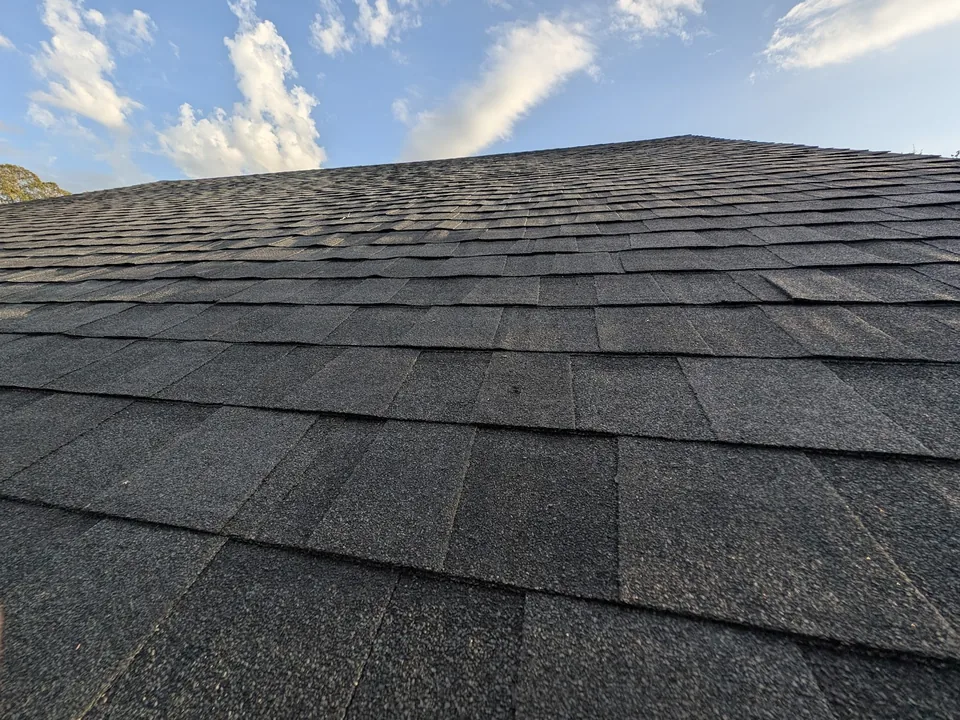
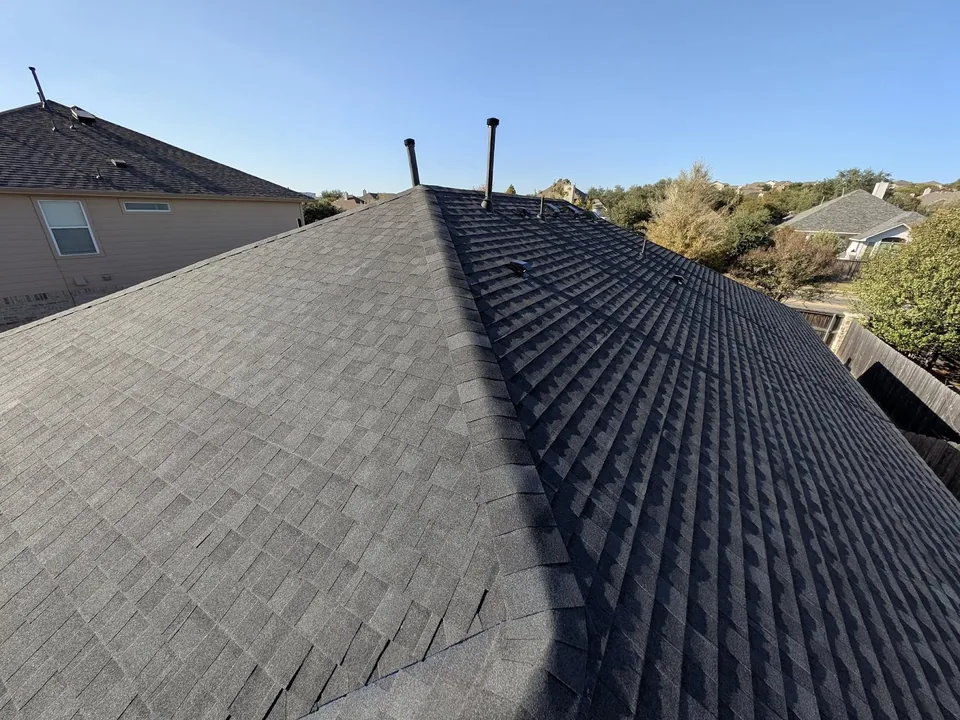
Photos from roofs we have worked on. Select one to enlarge it.
Common Questions
Questions homeowners ask
How long does an asphalt shingle roof last in Texas?
The InterNACHI chart lists architectural shingles at 30 years and 3-tab at 20, and the NAHB study says about 20 for asphalt. The chart adds that hot climates drastically reduce asphalt shingle life. On the roofs we inspect around Round Rock, architectural shingles commonly show end-of-life signs at 18 to 25 years, and hail often ends them sooner.
How long does a metal roof last?
The InterNACHI chart lists metal at 40 to 80 years. In Texas the paint finish and, on exposed fastener panels, the screw washers age before the steel does. Our metal roofing guide covers the paint warranties that matter.
How long does a tile roof last?
Clay and concrete tile are listed at 100 or more years by InterNACHI and as lifetime by the NAHB study. The underlayment and flashings beneath the tile do not last that long, so a tile roof is usually relaid on new underlayment long before the tile itself wears out. That is what we see in the field.
How long does a flat roof last?
It depends on the membrane. InterNACHI lists TPO at 7 to 20 years, EPDM rubber at 15 to 25, modified bitumen at 20 and built-up roofing at 30. Seams, drains and standing water decide which end of the range a flat roof reaches.
Does a 30-year shingle really last 30 years?
The number on the bundle is a warranty term or a marketing label, not a measured life. The warranty itself covers manufacturing defects, pays full labor only for the first 10 years, and excludes hail, wind over the rating and poor ventilation. In Texas sun, plan on the research figure or less and let an inspection tell you the rest.
Does attic ventilation really change how long a roof lasts?
Yes. Heat trapped in the attic ages shingles from below, and GAF, Owens Corning and CertainTeed each exclude or reduce coverage for damage on a poorly ventilated roof. A balanced intake and exhaust system is the cheapest way to protect the years you paid for.
Keep Learning